Dayu Electronics Hydrophone Array: Solving Trenchless Positioning of Deeply Buried Underground Gas Pipelines
In urban underground pipeline maintenance, accurately locating deeply buried gas pipelines has long been a major challenge. This is especially true for PE gas pipelines buried deeper than 10 meters: surface structures make large-scale excavation verification impossible, and traditional ground-based acoustic pickup methods fail entirely due to excessive sound attenuation. To tackle this industry pain point, Dayu Electronics partnered with an enterprise to develop a new trenchless solution for locating deeply buried gas pipelines using a hydrophone array.
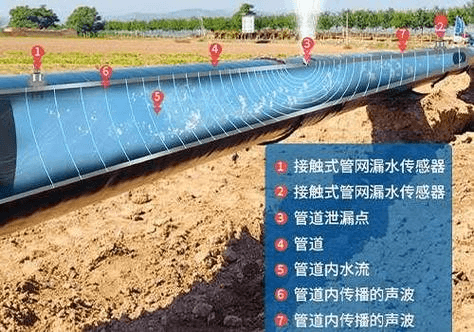
The "Depth Limit" of Conventional Detection
Previously, the company's method involved connecting an acoustic source driver to the vent of a valve well, allowing sound to travel through the gas inside the pipeline and propagate into the surrounding soil, then using pickups on the ground surface to detect sound intensity and determine the pipeline's route.
This traditional approach works adequately in shallow burial conditions, but it failed completely under this project's conditions. On site, the gas pipelines are buried 10 to 15 meters deep, and the PE pipe material itself causes extreme sound attenuation. Beyond 3 meters of depth, surface pickups receive almost no usable signal. Faced with such deeply buried pipelines that cannot be excavated, a new detection method capable of breaking through the depth limit was urgently needed.
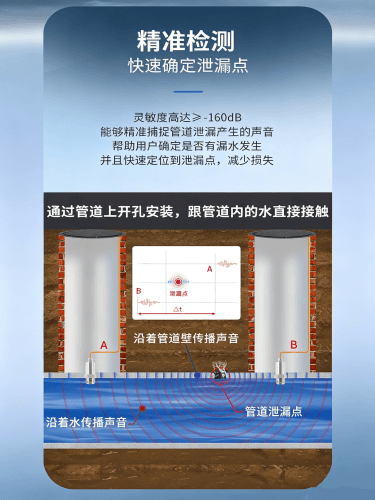
Hydrophone Array: Extending "Ears" Deep Underground
To bypass the attenuation of sound traveling long distances through soil, the project team decided to change the approach—bringing the "ears" directly down near the pipeline.
Dayu Electronics' technical team worked with the customer to design an array detection solution: boreholes are drilled from the surface above the pipeline's approximate route, reaching depths just 1 to 2 meters from the pipeline. Dayu Electronics' M26 hydrophones are then lowered to the bottom of each borehole, pressed against the soil. These hydrophones are specifically designed to receive 300–700 Hz acoustic signals transmitted from the pipeline. With multiple deep boreholes forming a hydrophone array, the differences in signals received at each node, combined with the relative positions within the array, allow the pipeline's exact location and route to be calculated with radar-like precision.
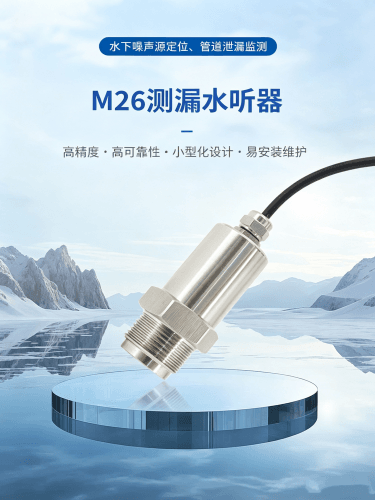
Core Equipment: Dayu Electronics M26 Hydrophone
In this innovative solution, the M26 hydrophone plays the key role of an "acoustic probe." Compared with air as a medium at the surface, the M26 hydrophone captures faint leakage or excitation sound waves with high sensitivity at much closer range at the borehole bottom, even in complex soil-coupling conditions. Its application directly bypasses the blind zone of severe soil attenuation, keeping weak signals clearly distinguishable in deeply buried environments.
Current Status and Outlook
At present, this portable deep-burial gas pipeline positioning device is in the customer's testing and validation phase, with final results pending actual customer feedback. However, there is no doubt that this innovative "deep-borehole deployment + hydrophone array" approach has successfully broken through the traditional 3-meter detection limit, opening a highly promising technical path for trenchless positioning of deeply buried pipelines.
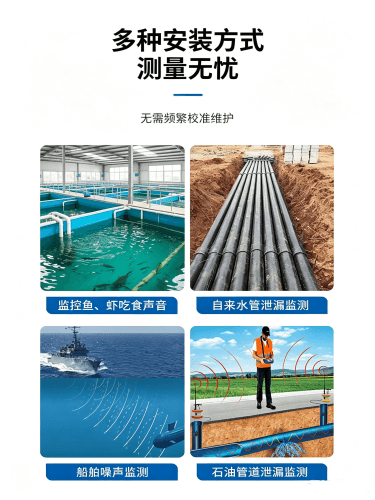
Dayu Electronics not only provides standardized hydrophone products but is also committed to solving complex acoustic engineering challenges for customers. If you face technical bottlenecks in underground pipeline network detection, weak signal acquisition, or similar scenarios, please contact the Dayu Electronics technical team. With a solid foundation in acoustic hardware, we will help you push beyond measurement limits.