Dayu Electronics Ultrasonic Sludge Level Meter: Field Application in Secondary Clarifiers at a Municipal Wastewater Plant
I. Project Overview
A municipal wastewater treatment plant with a design capacity of 30,000 m³/d uses the A²/O biological treatment process, equipped with two Φ24 m radial-flow secondary clarifiers. As the core sludge-water separation unit of the biological system, the clarifier receives biological effluent, where activated sludge settles to the tank bottom. Part of the sludge is returned to the biological tank as return sludge to maintain sludge concentration, while excess sludge is discharged to the thickening and dewatering system; the supernatant overflows through the outlet weir into the advanced treatment unit.
Pain Points Before Retrofit
1. Sludge blanket monitoring relied on manual probe rods and sampling cylinders at scheduled intervals, providing only intermittent data without 24-hour online monitoring. Manual in-tank measurement posed safety risks and results lagged;
2. Sludge discharge relied on operators manually starting and stopping the discharge pump based on experience. An excessively high sludge level easily caused sludge flotation and sludge loss with the effluent, leading to excessive SS in the outlet; an excessively low level caused the pump to run dry, damaging equipment and increasing energy consumption;
3. The lack of online water level monitoring made it impossible to promptly detect influent flow surges or abnormal in-tank levels, leaving process adjustments reactive and making it difficult to quantitatively evaluate sludge settling performance.
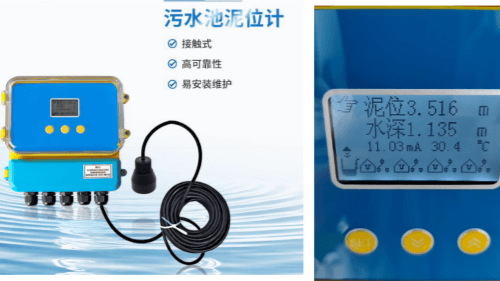
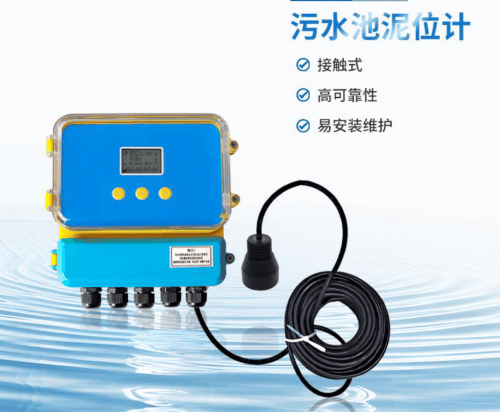
To achieve integrated online monitoring of water level and sludge level in the secondary clarifiers, the project selected the Dayu Electronics split-type ultrasonic sludge level meter with a 0–5 m range. The instrument connects to the plant's PLC + SCADA automation platform, and its built-in relay output can directly output switching signals to interlock with the excess sludge discharge pump, enabling automatic sludge discharge interlock control.
II. Instrument Selection Parameters
· Product Name: Dayu Ultrasonic Sludge Level Meter (Sludge Blanket Interface Meter)
· Measuring Range: 0–5 m
· Probe Material: PTFE anti-corrosion probe, IP68 protection rating, suitable for long-term immersion in wastewater conditions
· Signal Output: 4–20 mA analog + RS485 Modbus digital communication + relay switching output
· Instrument Configuration: Built-in temperature compensation; equipped with Dayu's proprietary sludge-water interface recognition algorithm to filter interference from fine suspended solids and stably identify the sludge-water interface
· Power Supply: 220 V
III. Sensor Installation Plan (Dayu Factory Installation Requirements)
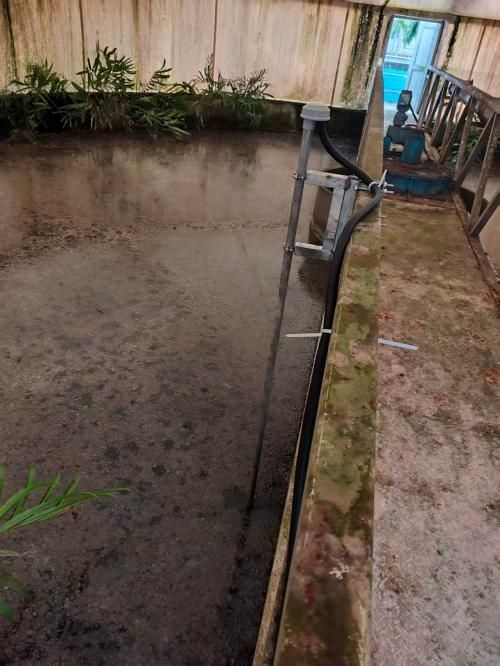
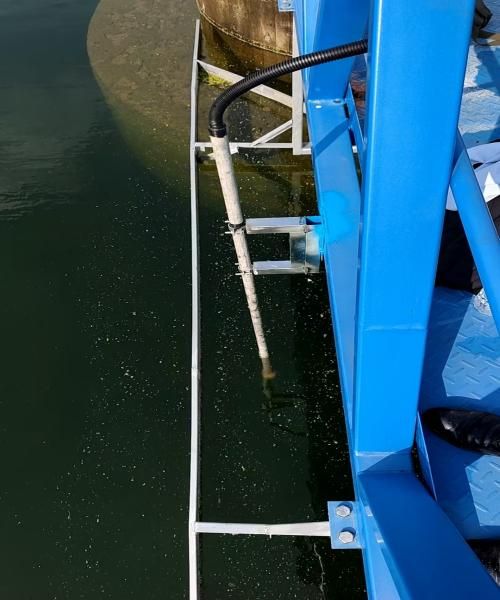
1. Verticality Requirement: Keep the sensor probe perpendicular to the sludge surface and tank bottom to ensure the ultrasonic beam is emitted vertically toward the sludge-water interface, avoiding measurement errors caused by oblique reflections.
2. Obstruction-Free Requirement: No obstacles may exist within the ultrasonic emission area directly below the probe, preventing the ultrasonic signal from being blocked or generating false echoes that interfere with interface recognition.
3. Keep Away from Disturbance Zones: Install the probe away from areas where sudden flow velocity changes generate bubbles and away from floating scum and solids. Also keep it away from inlets and outlets to avoid turbulence, eliminating scattering interference from foam and suspended solids on the acoustic wave and ensuring stable, accurate measurement.
4. Immersion and Wall Distance: The sensor probe must be fully submerged in the water. If the tank wall is smooth and vertical, maintain sufficient distance between the probe and the wall; if the wall is uneven or brackets, pipes, or other structures are present on site, further increase the distance between the probe and the wall to avoid interference from wall or structural reflections.
IV. Automation Interlock Logic
1. Instrument Relay Parameter Settings
The Dayu sludge level meter has a built-in relay that can be configured in the instrument's alarm settings menu with three core parameters:
① Alarm Mode: Selectable high-level alarm, low-level alarm, or alarm function disabled.
② Alarm Value: For high-level alarm, the alarm triggers when the sludge level exceeds the set value; for low-level alarm, it triggers when the sludge level falls below the set value.
③ Hysteresis Value: Used to avoid measurement fluctuations and prevent frequent alarm signal toggling at the alarm threshold.
· High-Level Alarm: The alarm clears when the sludge level falls below (alarm value − hysteresis value);
· Low-Level Alarm: The alarm clears when the sludge level rises above (alarm value + hysteresis value).
2. The instrument outputs switching signals via relays and displays water level and sludge level data in real time
The instrument is equipped with high-level and low-level alarm relays. When the sludge level exceeds the high limit, the relay activates, the system triggers an audible and visual alarm, and the sludge discharge pump starts automatically; when the sludge level falls below the low limit, the relay resets and the pump stops automatically, avoiding dry running. The hysteresis setting eliminates frequent pump starts and stops caused by minor measurement fluctuations.
V. Field Application Results
1. The Dayu 0–5 m range sludge level meter perfectly matches the secondary clarifier water depth. A single instrument simultaneously monitors sludge level and water level, and its built-in relay output enables direct interlock control, saving project investment;
2. It enables 24-hour uninterrupted online monitoring, replacing manual in-tank sludge probing and eliminating on-site safety hazards;
3. Dayu's dedicated sludge-water interface algorithm effectively suppresses interference from fine suspended particles, ensuring stable measurement. The instrument relay combined with the hysteresis setting avoids frequent starts and stops at critical points. Automatic sludge discharge eliminates reliance on manual experience, stably controls sludge blanket thickness, reduces the risk of sludge blanket turnover and loss, and improves the stability of effluent SS; it also prevents the discharge pump from running dry, extending pump service life and reducing power consumption;
VI. Case Summary
This project applied the Dayu 5 m range ultrasonic sludge level meter in a radial-flow secondary clarifier, with on-site deployment completed in strict accordance with Dayu's sensor installation specifications. The instrument's built-in relay output achieves reliable interlocking by configuring the alarm mode, alarm value, and hysteresis value, completing integrated online monitoring of water level and sludge level, and connecting to the automation system for automatic sludge discharge interlock control. It resolves the pain points of traditional manual sludge level measurement—data lag, large errors, and unsafe operations—and relies on Dayu's proprietary sludge-water echo recognition algorithm to ensure long-term stable measurement, reducing plant operation and maintenance costs. It is a mature and reliable solution for sludge-water interface monitoring in secondary clarifiers at municipal wastewater treatment plants.