Dayu Electronics: Counting Fish Underwater? This Sonar Turns Experience into Data
What do fish farmers fear most?
Not falling fish prices, but not knowing exactly how many fish are in their ponds or cages.
How much feed was delivered, how much the fish grew, whether any died of disease, how much was lost after a typhoon, or even if the cage broke and fish escaped—all of this was pure guesswork based on experience. Insurance companies dared not offer coverage because losses couldn't be assessed; banks dared not lend because assets couldn't be calculated.
This murky way of farming is being changed, and the starting point is making the fish underwater visible.
Why is counting fish underwater so hard?
On land, you can count sheep and cattle with a quick glance. Not underwater.
Light attenuates extremely fast in water. In aquaculture waters, everything beyond 0.5 meters is usually a blur, let alone in turbid water. Fish are constantly swimming, making it impossible to count them by taking photos. Cages have netting and feed, and rivers have sediment and water plants—interference is everywhere.
Relying on optics or manual labor is a dead end. The industry has been looking for a solution that can penetrate turbidity, see targets clearly, and calculate quantities underwater. Sonar is the core of this solution.
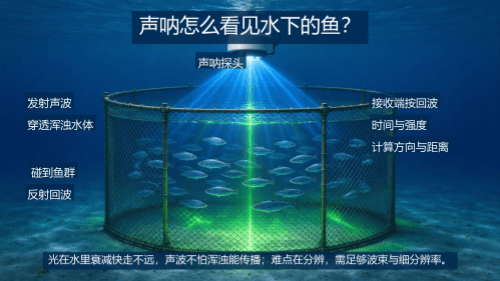
How does sonar see fish underwater?
Sound waves are different from light. Light cannot travel far in water, but sound waves can, and they are not afraid of turbidity.
Sound waves are emitted, hit fish, netting, or the bottom, and reflect back. Based on the time and intensity of the echo, the receiving end can calculate the direction and distance of the target.
The difficulty lies not in whether it can reflect, but in whether it can distinguish. Accurate identification requires enough beams and fine enough resolution.
Dayu Electronics' 3D Fish Counting Sonar uses a seven-transducer rotating imaging solution.
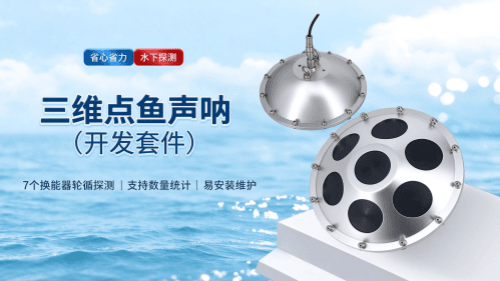
How do seven transducers restore the underwater world?
The core of this sonar is seven ultrasonic transducers. It has three hardcore designs:
1. Rotating detection, cross-correlation imaging
The seven transducers do not work simultaneously but transmit and receive in sequence, each recording a set of signals. After obtaining the seven sets of signals, cross-correlation calculations restore the spatial distribution of underwater targets, forming basic 3D point cloud/image data.
2. Self-transmitting and self-receiving, avoiding crosstalk
Each transducer transmits and receives by itself without interfering with each other. The rotating method makes the signal cleaner and the imaging clearer.
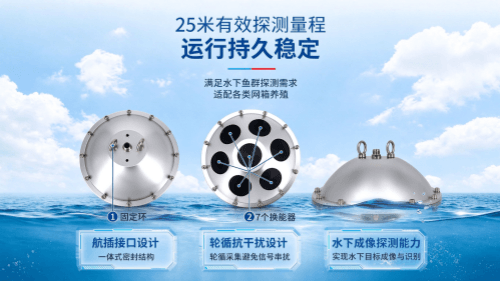
3. Integrated sealing, no exposed interfaces
Underwater equipment fears water ingress the most. This sonar adopts an integrated sealed structure with no exposed interfaces. With overall IP68 protection, it is not afraid of being soaked in water for a long time.
?? Key Point: Dayu only provides front-end hardware and data upload
We need to clarify our service boundaries to our customers:
Dayu Electronics provides front-end high-precision sonar hardware and basic data upload interfaces.
What the sonar collects and transmits are underwater 3D point clouds and signal characteristics. To accurately translate these data points into how many fish are here and how big they are, a set of specialized image recognition and calculation algorithms is needed.
This software algorithm for calculating fish quantity needs to be written by your own software team or developers specializing in fish counting.
We are responsible for making the eyes perfect and providing stable, high-precision basic data. As for how to use this data to do the accounting, we leave it to your development team.
25-meter range, covering rivers, reservoirs, and offshore areas
With an effective detection range of 25 meters, it can meet medium and long-distance underwater detection needs.
Fish school detection in rivers, shallow seas, reservoirs, and fish ponds is all within coverage. Data output goes through RS-485, supports Modbus RTU protocol, and connects directly to the host computer. The operating temperature is -20C to +60C, adapting to the climate of most domestic waters.
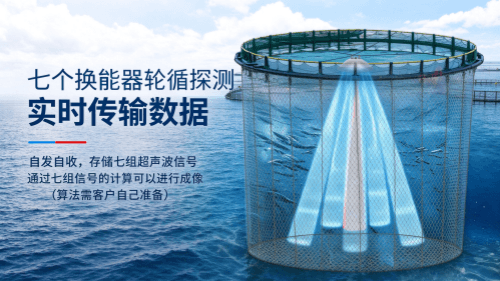
What problems can it solve in actual scenarios?
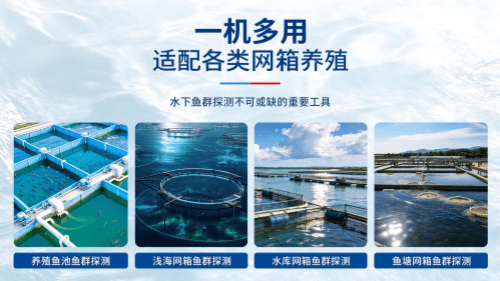
Cage farming: Turning uncountable into countable
Deep-sea cages have large water bodies. The sonar continuously scans, providing basic point cloud data of fish school distribution and activity status. System integrators or software developers can develop application software for precise feeding and abnormal alarms based on this underlying data; insurance companies can also assess losses based on data models.
Aquaculture: From relying on feel to looking at data
In the past, judging the status of fish schools relied on looking at water color and smelling the water. The sonar provides high-density underwater raw data, and developers use this data to write algorithms to analyze density and activity patterns. You can see the degree of aggregation during feeding and discover abnormal activity when diseases occur.
Fishery resource survey: Scientific evaluation, no longer relying on estimation
Scientific research institutions need to accurately grasp the spatial distribution of fish schools when conducting resource surveys. The 3D point cloud data provided by the sonar can be used for resource assessment and ecological monitoring, which is more efficient and less harmful than traditional trawl sampling.
The industry is moving towards data-driven
National policies clearly propose to develop deep-sea aquaculture and modern distant-water fisheries, and promote the transformation of fisheries towards informatization and intelligence.
Marine ranches in various places are already using sonar for fish school monitoring, intelligent feeding, and biomass assessment. Taking the marine ranch in Shandong as an example, through underwater sonar and recognition technology, [it can not only estimate the number and distribution of fish schools but also assist in evaluating fish body length and biomass].
Visible, controllable, and measurable—this is the operating standard of modern marine ranches. And the first step of visibility is to make things underwater visible.
Only when you can see it can you calculate it clearly
Fish farming is changing from experience to data.
What the 3D Fish Counting Sonar aims to do is turn the invisible underwater world into visible 3D data points on the screen.
We are responsible for perfecting front-end collection and transmission; we look forward to creating back-end applications and algorithms with your development team.
About Dayu Electronics
Fuzhou Dayu Electronics Technology has been deeply involved in industrial ultrasonic measurement for 18 years, with over 3,000 project delivery experiences, ISO9001 certification, and full-chain independent R&D. Products cover ultrasonic level meters, flow meters, transducers, industrial sensors, and underwater detection equipment. Cooperative customers include NARI, ABB, Focused Photonics, Fuguang Water, CCCC Second Harbor Engineering, Yellow River Engineering Consulting, Pearl River Water Resources Research Institute, Institute of Acoustics of Chinese Academy of Sciences, Gezhouba Group, etc.