Dayu Electronics Cylindrical Five-Beam Underwater Obstacle Avoidance Sensor for Multi-Dimensional Underwater Perception
Say Goodbye to One-Way Blind Spots | Dayu Electronics Cylindrical Five-Beam Underwater Obstacle Avoidance Sensor for Multi-Dimensional Underwater Perception
Single-Beam or Multi-Beam? How to Choose an Underwater Obstacle Avoidance Sensor
In the operations of underwater robots (ROV) and unmanned surface vessels (USV), obstacle avoidance is a core element in ensuring equipment safety.
Many engineers, when making preliminary design plans, will prioritize single-beam sensors. With strong directivity and simple data processing, they are a highly efficient solution under stable conditions where the equipment attitude is steady and only frontal collision prevention is needed.
However, the underwater environment is often not flat. Once the equipment tilts or obstacles appear on the side, single-point detection will immediately create blind spots. At this point, multi-beam is needed to achieve three-dimensional spatial perception.
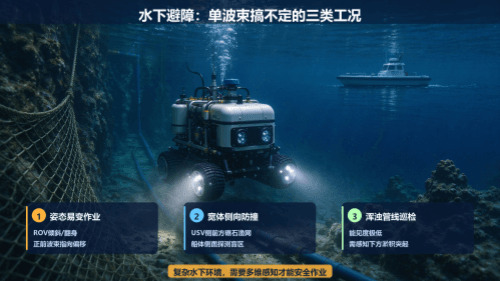
What working conditions can a single beam not handle?
When the equipment enters the following three types of complex working conditions, the limitations of the single beam will be exposed:
Three-dimensional operations with variable equipment attitude: Taking ROV as an example, when performing robotic arm grasping or wall-clinging inspection, the fuselage often tilts or rolls. At this time, the single beam originally facing straight ahead will point to the seabed or water surface as the fuselage tilts, resulting in huge blind spots in the real front and side, or obviously wrong distance measurements.
Lateral collision avoidance for wide-body equipment: Unmanned surface vessels (USV) have wide hulls. If navigating in narrow channels or waters with fishing nets and hidden reefs, a single beam can only measure obstacles in the bow direction. The side of the hull cannot be measured, making scratches very likely.
Pipeline inspection in turbid waters: When operating along pipelines underwater with extremely low visibility, it is necessary not only to know whether there is an obstruction ahead, but also to perceive whether there is siltation or protruding foreign objects on the side and below.
In these scenarios where "seeing in all directions" is a rigid demand, if multiple single-beam sensors are forcibly deployed to cover the field of view, it will lead to complex cables, large volume, and data synchronization between multiple probes is also a big problem.
For such multi-angle detection needs in three-dimensional space, multi-beam sensors have become a more suitable solution.
Five-beam integrated structure for multi-directional obstacle avoidance perception
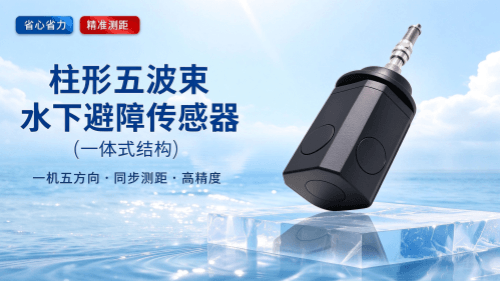
The cylindrical five-beam underwater obstacle avoidance sensor (integrated structure) developed by Dayu Electronics is precisely to fill the blind spots of single-beam in complex space detection.
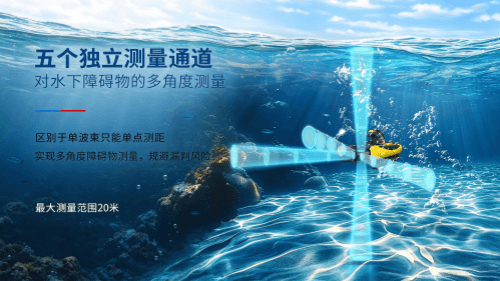
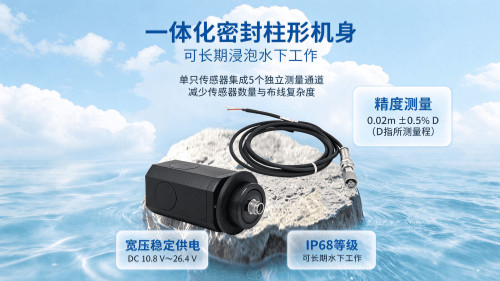
It highly integrates 5 independent ultrasonic measurement channels into a cylindrical housing of Φ60 mm × H100 mm. When the device is working, the 5 channels perform time-division round-robin detection, obtaining distance data in 5 directions within 1-2 seconds, achieving multi-angle scanning of underwater obstacles.
The core advantages of this product are:
Multi-dimensional spatial perception: 5-channel time-division round-robin measurement can not only measure the front, but also cover the side. Even if the ROV fuselage tilts, it can effectively reduce detection blind spots and ensure side and front field of view coverage.
Integrated compact design: Integrating multiple probes into a cylindrical fuselage greatly reduces the installation volume. It is directly fixed to the bottom of the unmanned vessel or the robot fuselage, does not occupy space, and wiring is simpler.
Medium and long range, leaving enough reaction time: 20-meter measurement range (actual range is affected by water turbidity), blind zone is only 0.30 meters, meeting the early warning needs of medium and large waters.
High protection and standardized integration: IP68 protection level combined with aviation plug waterproof connection, can work underwater for a long time; standard RS-485 (ModBus RTU) interface, directly connected to the host computer or control system.
Application Scenarios
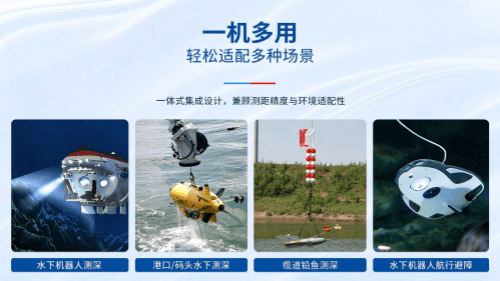
Multi-beam sensors are mainly used in complex working conditions with high requirements for spatial perception:
Multi-directional obstacle avoidance for underwater robots (ROV/AUV): Respond to pitch and roll changes of equipment attitude during underwater operations, and prevent the robotic arm or fuselage from colliding with underwater structures.
Obstacle avoidance and distance measurement for underwater unmanned vessels (USV): Suitable for collision warning of wider hulls, covering fishing nets, hidden reefs and side obstacles in the channel.
Underwater pipeline and cable inspection: In turbid waters with low visibility, perceive foreign objects and siltation in front of and to the side of the pipeline.
Inspection of underwater structures such as ports and dams: Maintain a safe distance when working close to dam bodies or pile foundations.
Aquaculture cage inspection: Prevent underwater cleaning equipment from breaking cages or fences during operation.
Safety warning for underwater operation platforms: Provide surrounding anti-collision monitoring for various underwater construction platforms.
Selection Recommendations
Selection should be based on actual working conditions:
Platforms with simple working conditions and only need forward distance measurement: Single-beam solution is recommended for higher cost performance.
Platforms with complex space and need multi-angle collision avoidance: Five-beam solution is recommended for more comprehensive spatial perception.
Dayu Electronics has been deeply involved in the field of industrial ultrasonic measurement for 18 years, and has mature applications for both single-beam and multi-beam underwater obstacle avoidance products. You can feedback equipment parameters and operating environment to technical engineers to obtain targeted selection recommendations.
About Dayu Electronics
Fuzhou Dayu Electronics Technology has been deeply involved in industrial ultrasonic measurement for 18 years, with 3000+ project delivery experience, ISO9001 certification, and full-chain independent research and development. Products cover ultrasonic level meters, flow meters, transducers, industrial sensors and underwater detection equipment. Cooperative customers include NARI, ABB, Focused Photonics, Fuguang Water, CCCC Second Harbor Engineering, Yellow River Survey and Design Institute, Pearl River Water Resources Research Institute, Institute of Acoustics of Chinese Academy of Sciences, Gezhouba Group, etc.