Dayu Electronics Road Water Sensor: Precise Depth Measurement via Ultrasonic Time-of-Flight
The core working principle of the Dayu Electronics road water sensor is the ultrasonic time-of-flight method. The sensor emits ultrasonic pulses toward the water surface; the sound waves reflect back to the probe upon hitting the surface, and the device records the time difference between emission and echo reception, then calculates the distance from the sensor to the water surface using the speed of sound.
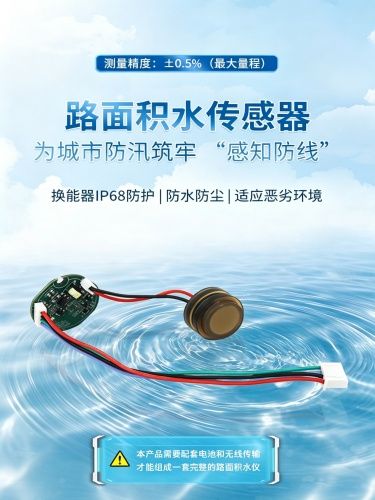
Water Level Determined by Installation Height and Echo Distance Difference
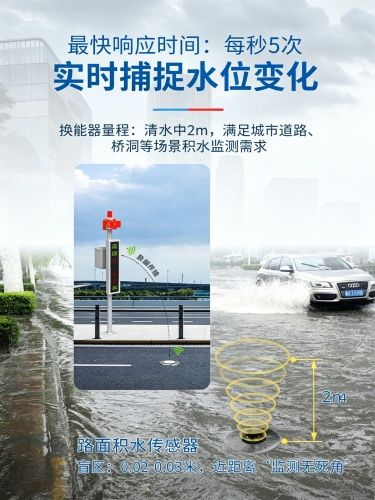
The installation height of the Dayu Electronics road water sensor is known. Subtracting the sensor-to-water distance from the installation height gives the current water depth. The formula can be simplified as:
Water Depth = Installation Height - Speed of Sound × Time Difference ÷ 2
The division by 2 is because the sound wave travels a round trip.
Temperature Compensation: Key to Measurement Accuracy
The speed of sound is not a fixed value; it varies with ambient temperature. At normal temperature, the speed of sound in air is about 340 m/s, but it changes significantly as temperature rises or falls. Without temperature compensation, measurement results will deviate. Therefore, Dayu Electronics road water sensors typically have a built-in temperature sensor to correct the speed of sound in real time, ensuring the accuracy of water depth data.
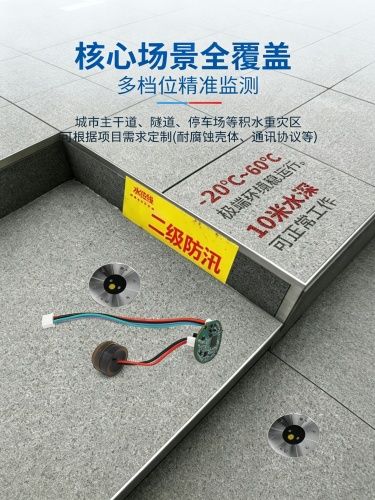
Filtering Algorithm Effectively Reduces Road Environment Interference
Road environments are complex: passing vehicles cause water surface fluctuations, rain wash brings floating debris, and pedestrians or objects may briefly block the probe. To reduce such interference, the Dayu Electronics road water sensor uses a filtering algorithm to smooth multiple measurement results and eliminate obviously abnormal spike data.
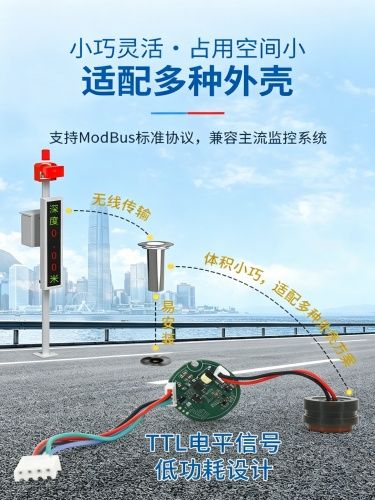
Pole-Mounted and Buried Types for Different Installation Scenarios
Dayu Electronics road water sensors come mainly in two types: pole-mounted and buried. The pole-mounted type is installed above the road, detecting the water surface downward; the buried type is embedded below the road surface, detecting water depth upward, unaffected by vehicle rolling, and is better suited for underpasses, low-lying road sections, and similar scenarios.