
Dayu Electronics: Looks Fine Outside, Hollow Inside? How to Give a Tree a 'Non-Invasive Ultrasound'
Looks fine outside, but hollow inside? How to give a tree a 'non-invasive ultrasound'
Walking down the street or in a park, we see a tree with lush branches and leaves.
But for landscapers and forestry experts, their biggest fear is a tree that is 'sturdy on the outside, hollow on the inside.'
Especially during typhoon season and heavy rain, news often reports incidents of trees being uprooted or thick branches breaking, damaging cars and injuring people. Many fallen trees are only discovered to have internal decay or large cavities after they collapse.
How can we detect internal hazards in advance without damaging the tree?
Why don't tapping and drilling work?
In the past, detecting internal tree hazards mainly relied on two old methods:
1. Hammer tapping: Relying entirely on the experience of veteran workers to listen to the sound. But this method can only detect large cavities, is powerless against early decay and fine cracks, and leaves no data record.
2. Increment borer drilling: Drilling a hole directly to extract a wood core. This is 'destructive testing,' and for precious ancient or famous trees, caretakers simply dare not do it.
To quickly and non-destructively determine whether there are problems inside a tree in the field, we need a more scientific tool—the ultrasonic tree testing sensor.
How does ultrasound 'see through' a tree?
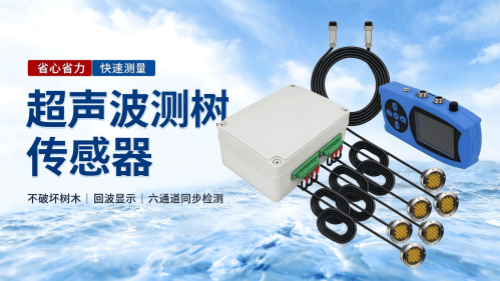
This is a portable multi-channel ultrasonic tree testing sensor designed specifically for detecting internal cavities, cracks, and defects in standing trees.
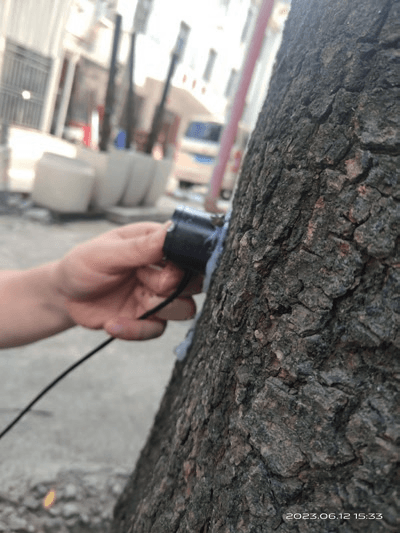
Its principle is similar to medical ultrasound: probes are attached to the trunk surface, using ultrasonic waves to penetrate the trunk. Whether the tree's interior is healthy xylem or has cracks or decay, the transmission time and attenuation of sound waves are completely different.
By collecting data on sound wave penetration time and signal attenuation, the tree's internal health can be quickly assessed, turning invisible hazards into clear echo data on the screen.
Field operation in practice: What makes this device so useful?
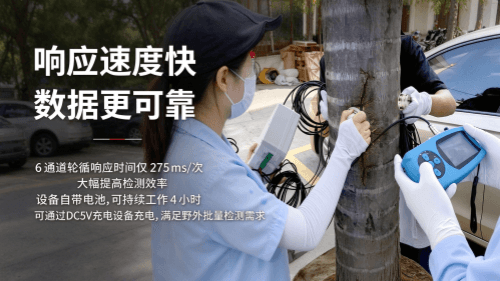
Forestry surveys and landscape inspections often take place in remote forest areas or streets, so the equipment must be fast, durable, and portable. This Dayu device is engineered to directly address the pain points of field work:
? 6-channel rapid response, no waiting for tree measurements:
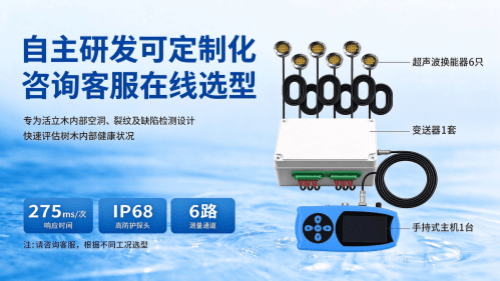
The device has 6 built-in independent measurement channels using a polling detection method. Response time is only 275ms per cycle (active upload). Once the probes are attached, multi-point data is obtained almost instantly, greatly improving the efficiency of batch field testing.
? Built-in battery, no cables, ~4 hours of battery life:
Can't find an outlet in the forest? The main unit has a built-in long-lasting battery that can work continuously for about 4 hours on a full charge (nearly 3 hours and 40 minutes). It also supports DC 5V charging, so a power bank can recharge it anytime, perfectly meeting a full day of field work needs.
? IP68 high-protection probes, fearless of harsh environments:
Bark surfaces are often rough, damp, and even covered in mud. The device probes feature IP68, the highest level of protection—dustproof and waterproof. They attach directly to the trunk surface, are durable, and require long-term maintenance-free operation.
? Accurate data upload, standardized integration:
How to handle the measured data? The device supports RS-485 (Modbus RTU) communication protocol, and the probes use 2-core shielded cables. Collected data can be uploaded to a computer in real time, facilitating subsequent report generation and secondary analysis.
One device, multiple uses—these scenarios can't do without it