Dayu Electronics 200kHz Fish Finder Transducer Sample Customization Guide
Dayu Electronics can customize 200kHz transceiver-integrated underwater transducers. During the sample phase, models with similar structures can be selected for circuit verification. The beam angle must be confirmed separately as either -3dB half-power angle or acute angle. 30-50m depth measurement requires clear water, calm surface, hard bottom, and low flow velocity conditions. Long-term seawater immersion requires IP68 rating and clear maximum working depth. The transducer is a passive three-core wire type that must be connected to the transceiver circuit according to single-ended or differential drive methods.
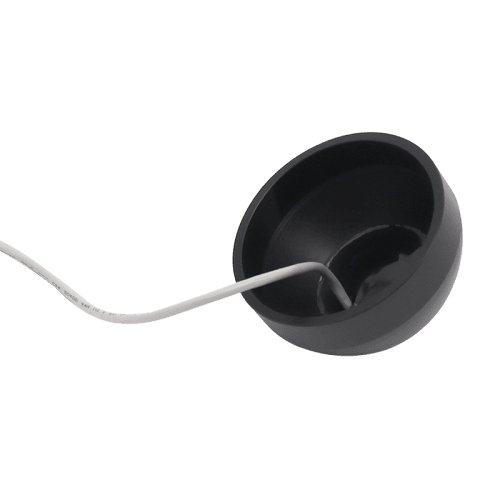
Frequency and transceiver configuration can be customized as needed
200kHz belongs to the conventional underwater ranging and fish detection frequency band. Dayu Electronics has customization capabilities for this frequency band. Fish finder transducers typically adopt a transceiver-integrated structure, where the same piezoelectric chip completes transmission and echo reception, simplifying installation and circuit layout.
Beam angle must be clearly defined as -3dB angle or acute angle
For 15°-25° beam angles, it is necessary to confirm whether it is the -3dB half-power angle. Beam coverage varies significantly under different definitions. After confirmation, structural dimensions with an outer diameter not exceeding 40mm can be matched accordingly. During the sample phase, existing models with similar beam angles can be selected for testing first, and then optimized according to the target angle later.
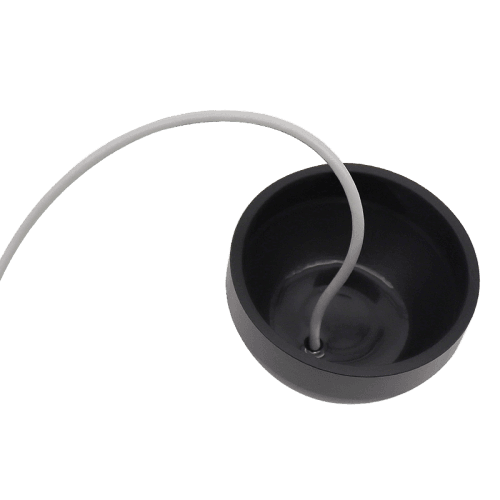
30-50m depth measurement requires evaluation based on water quality and bottom conditions
30-50m depth measurement is typically achieved under conditions of clear water, reservoirs or lakes, no wind or waves, hard bottom, no aquatic plants or silt, and low flow velocity. If 100m depth measurement potential is required, transmission voltage, pulse count, receiving gain, and signal processing algorithms must be confirmed simultaneously. During sample testing, it is recommended to stay as close to the above conditions as possible to determine whether the transducer sensitivity meets subsequent circuit design requirements.
Seawater applications require confirmation of maximum working depth
The transducer's waterproof rating can reach IP68, allowing long-term immersion in seawater. However, seawater conditions also require confirmation of maximum working depth to select appropriate housing materials, sealing structures, and pressure resistance levels. If used for hull installation or towing, housing corrosion resistance and mechanical strength must also be considered.
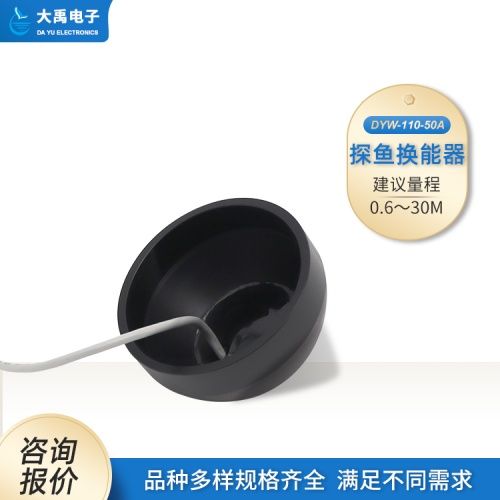
Passive three-core wire must match the transceiver circuit
The sample transducer is a passive piezoelectric transducer without built-in control circuits, directly leading out three-core wires: 2 signal wires and 1 shield wire. If the customer circuit is single-ended drive, the shield wire and signal wire negative pole can be connected in parallel as one wire, with the signal wire positive pole connected separately; if it is differential drive, the shield wire, signal wire negative pole, and signal wire positive pole are each independently connected to the circuit board terminals. The wiring method must be consistent with the subsequent transceiver circuit.
It is recommended that customers provide target beam angle definitions, maximum working depth, housing installation methods, and sample testing circuit solutions, so that Dayu Electronics' technical team can match suitable 200kHz sample models.