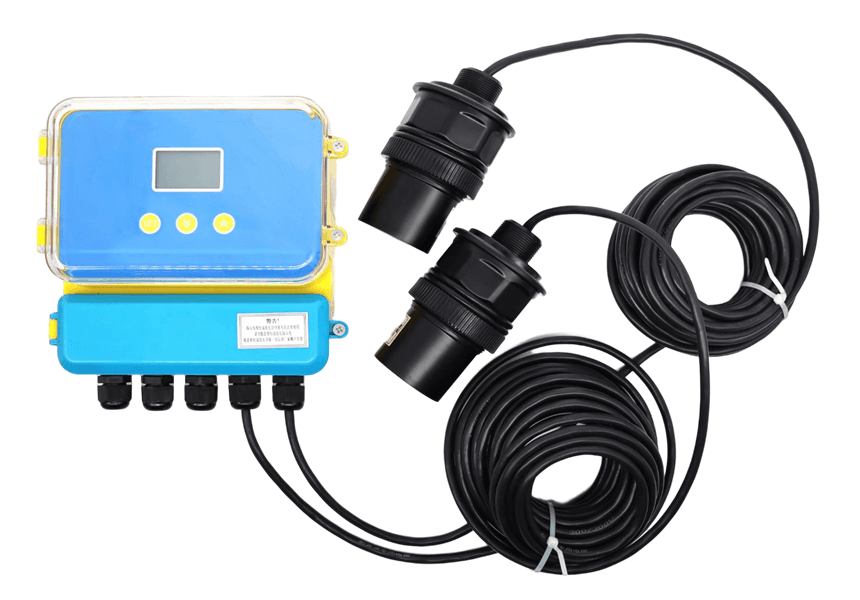
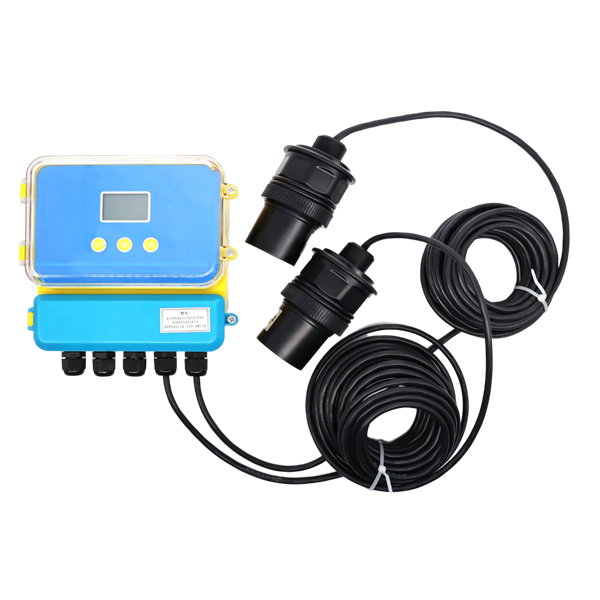
Model: DAYU split-type ultrasonic liquid level difference meter
💬 Online 9:00-18:00 (Mon-Fri) · 📋 Reply within 24h
Product Introduction
The split-type ultrasonic level difference meter / ultrasonic level meter is used to measure liquids such as water, mud, ore pulp, milk, and chemical raw materials, and is applied in industries such as petroleum, chemical, environmental protection, metallurgy, mining, municipal, water conservancy, hydrology, and water treatment.The split-type Ultrasonic Level Meter, ultrasonic material level meter, has the sensor and main unit separated, making it more suitable for installation on storage tanks, silos, and brackets. It is a low-cost measuring device for measuring liquids, slurries, and solids in industrial sites.
Function: split type
Measuring range: 5m, 10m, 15m, 20m, 30m, 40m, 50m, 60m, 70m
Measurement Accuracy: 0.25%-0.5%
Resolution: 3mm or 0.1% (whichever is greater)
Display: Chinese LCD display, or English LCD display
Analog output: 4-wire 4~20mA/750Ω load
Relay output: (optional) 2 groups for single channel, 4 groups for dual channel AC 250V/8A
or DC 30V/5A, status programmable
Power supply: standard 220V AC+15% 50Hz; optional 24VDC 120mA; custom 12VDC or battery powered
Ambient temperature: display instrument -20~+60℃, probe -20~+80℃
Communication: optional 485, 232 communication (manufacturer protocol or MODBUS protocol)
Protection rating: display instrument IP65, probe IP68
Probe cable: up to 100m, standard 10m
Probe installation: according to measuring range and probe selection
Product power consumption:
Split type with 24V power supply: power consumption without relay is 100mA, with one relay is 120mA,
2 relays: 145mA, 3 relays: 170mA, 4 relays: 190mA.
Specific power consumption is as follows:
Without relay: 24×100mA=2.4W;
1 relay: 24×120mA=2.9W; 2 relays: 24×145mA=3.5W;
3 relays: 24×170mA=4.1W; 4 relays: 24×190mA=4.6W;
Remarks:
This series of ultrasonic probes can also be customized according to customer requirements: high-pressure, high-temperature, small-diameter, small-blind-zone, and other special probes.
4. Installation Guide
Level meter installation dimensions: split-type ultrasonic level meter standard type (physical object and structure diagram as described above)
Understanding technical terms
① Range: When selecting the instrument, the meaning of measuring range is very important. Please see the schematic diagram below.
② Beam angle and false echoes
The ultrasonic beam is focused by the transducer. The pulse beam is emitted like the beam of a flashlight; the farther away from the transducer, the larger the spread area.
Any object within the beam angle, such as pipes, brackets, welds, reinforcing ribs, stirring propellers, or wall-attached objects, will cause strong false echoes, especially objects closer to the transducer within the beam angle.
For example: a false echo from a pipe 6m from the probe is 9 times stronger than one from the same pipe at 18m from the probe.
★ Try to keep the sensor axis perpendicular to the medium surface, and avoid any other objects (such as pipes and brackets) within the beam angle.
Measuring range selection
The measuring range depends on the range of the ultrasonic probe. The ultrasonic probe's range in turn depends on the on-site working environment, the target to be measured, temperature, etc.
Using the table below, you can select the measuring range you need in meters.
Liquid surface Attenuation factor Attenuation percentage Range increase factor
Steady 0dB 0% No increase needed
Ripples 5...10dB 50~67% 1x range
Large fluctuation (e.g.
With stirring blades) 10...20dB 90% 3 times range
Solid material surface Attenuation factor Attenuation percentage Range increase factor
Hard, rough 40dB 99% 10 times range
(e.g. granular rubber)
Soft (e.g., coal powder 40...60dB 99~99.9% Not recommended for cement or fly ash)
With dust Attenuation factor Attenuation percentage Range increase factor
None 0dB 0% No increase needed
Slight 5dB 50% 1x range
Heavy 5...20dB 50~90% 3x range
With feeding Attenuation factor Attenuation percentage Range increase factor
None 0dB 0% No increase needed
Slight 5...10dB 50~67% 1x range
Large amount 10...40dB 67~99% 3x range
With mist Attenuation factor Attenuation percentage Range increase factor
None 0dB 0% No increase needed
Small amount 5...10dB 50~67% 1x range
Large amount 10...20dB 67~90% 3x range
With steam Attenuation factor Attenuation percentage Range increase factor
None 0dB 0% No increase needed
Small amount 5...10dB 50~67% 1x range
Large amount 10...20dB 67~90% 3x range
Temperature difference between probe and medium surface Attenuation factor Attenuation percentage Range increase factor
≤20℃ 0dB 0% No increase needed
≤40℃ 5...10dB 50~67% 1x range
≤80℃ 10...20dB 67~90% 3x range
Signal attenuation calculation: if multiple conditions exist on-site, add up all these conditions to calculate the amount of signal attenuation.
·With a small amount of material feed 5...10dB
·With a small amount of steam 5...20dB
·Transducer and medium surface temperature difference ≤40℃ 5...10dB
Total Minimum 15dB, maximum 40dB.
In this case, if the actual maximum measuring range is 5 m, then a 50 m
range Ultrasonic Level Meter to measure.
Bottom threaded mounting
▲ It is recommended to use a plastic flange to connect to the Sensor during installation.
① Install a flange above the measured object
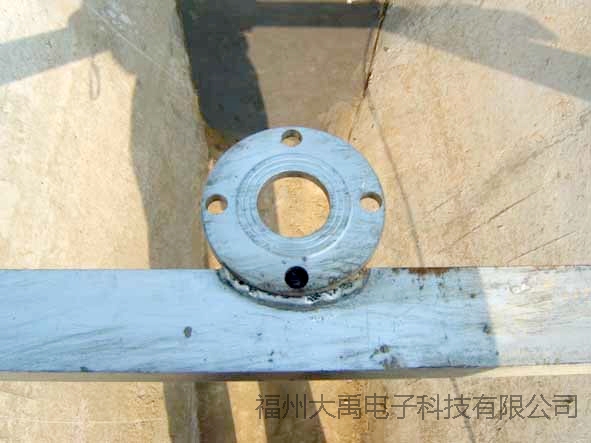
② Place a gasket with the same inner diameter on the flange.
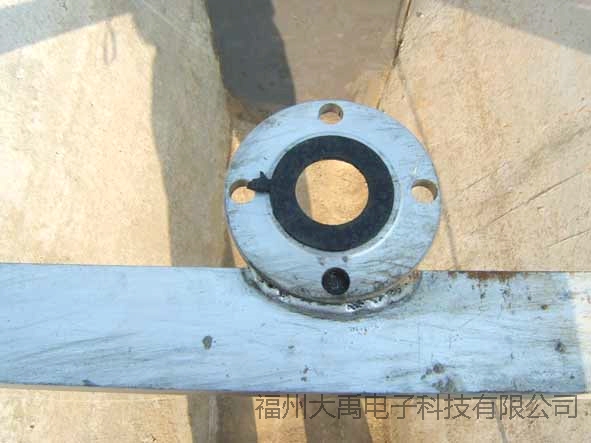
③ Insert the transducer into the flange hole.
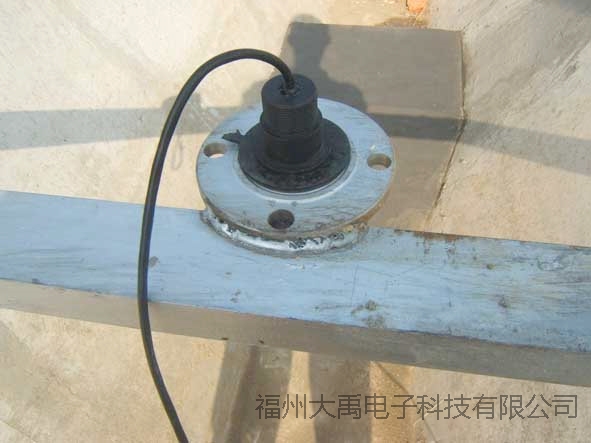
④ Place a gasket with the same inner diameter under the flange.
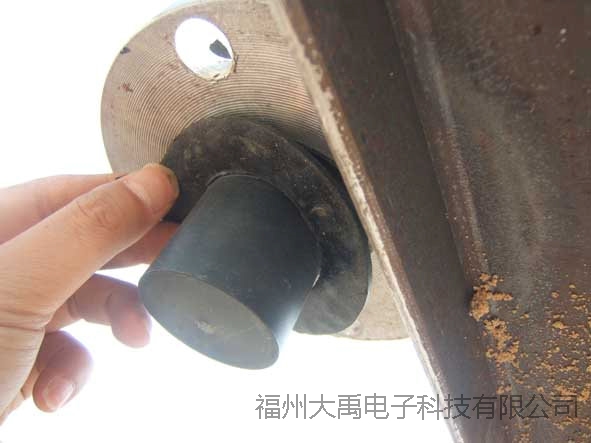
Screw on the nut to secure the Transducer
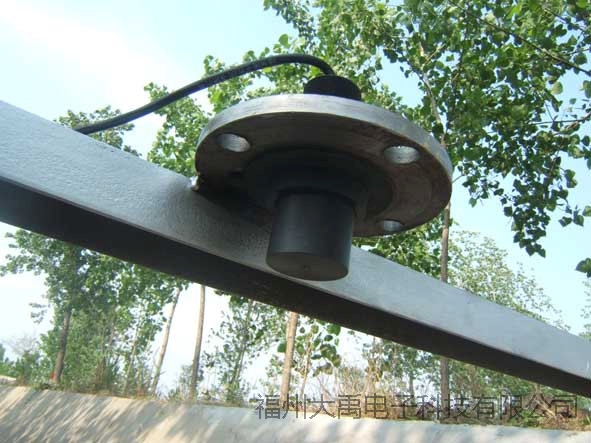
The installed transducer
Top thread mounting - hanging installation method
Secure the transducer at the top thread with a nut.
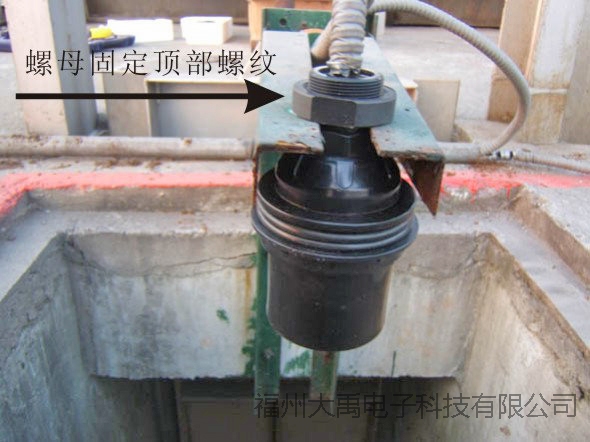
The transducer cable entry must be protected with a conduit.
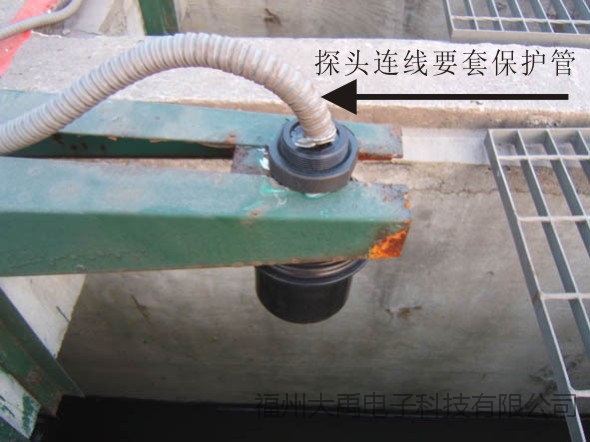
Installation on tanks, pools, cover plates, and brackets is basically the same as the methods above.
★ After installation, the transducer emitting surface must be exposed beyond the cover plate or waveguide tube. It must not be recessed inside the cover plate or waveguide tube.
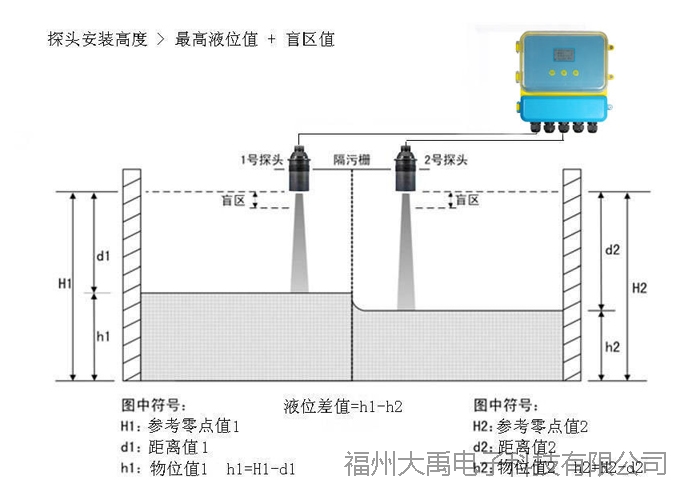
Applications
Split-type ultrasonic level difference meter(Material level, liquid level) is used to measure the difference in liquid level or material level between two different containers.
For more details, see the product manual.
If needed, please call hotline: 0591-28082552
Send us your working conditions — engineers reply with selection advice and pricing within 24 hours.
Online 9:00-18:00 (Mon-Fri)
