
Dayu Electronics: Why Is It Hard for Underwater Sound to Travel into Air? The Mystery of Acoustic Impedance Mismatch
Have you ever tried shouting from underwater toward the shore, only to find that people on the surface can barely hear you? Sound propagates efficiently in water, and its speed is much faster than in air, yet it just cannot get out. The answer is simple: the acoustic impedance difference between water and air is too large, causing almost total reflection at the interface—only a tiny fraction of the signal can pass through the water surface.
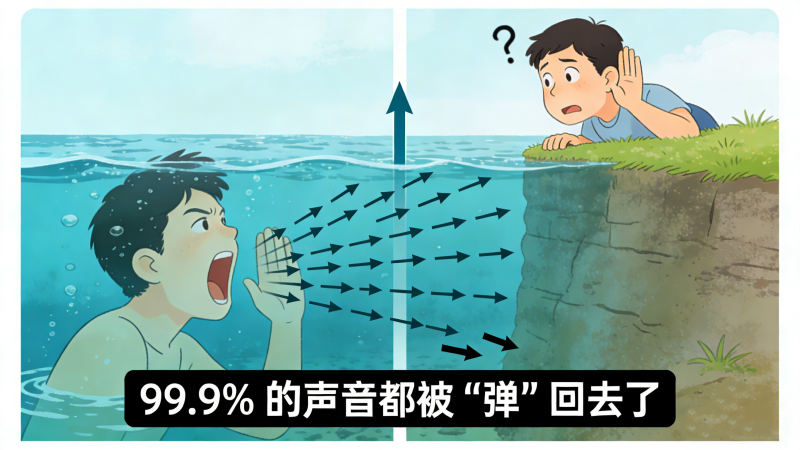
Acoustic impedance can be understood as the "difficulty" a medium presents to sound wave transmission, calculated by multiplying the medium's density by its sound speed.
At room temperature, the acoustic impedance of air is about 415 Rayl, while water is as high as about 1.5 million Rayl—a difference of nearly 3,614 times. This huge gap is like a fast runner suddenly stepping into mud—the energy simply cannot transfer smoothly.
When sound waves travel from water perpendicular to the air interface, most of the energy is directly reflected back. According to acoustic formulas, the energy reflection coefficient is close to 99.9%, meaning only 0.1% of the sound energy can penetrate the water surface into the air. That tiny bit of signal continues to attenuate while propagating in air, becoming so weak by the time it reaches the human ear that it is barely perceptible.
What's more, when underwater sound reaches air, the reflected wave undergoes a phase reversal—peaks become troughs and troughs become peaks—but this does not change the result of massive energy loss. Whether from air to water or water to air, this interface is an "acoustic wall" that is difficult to cross.
This phenomenon is common in daily life: calling from the poolside cannot be heard clearly underwater, and divers cannot hear voices from the shore—both are caused by impedance mismatch. In medical ultrasound and acoustic engineering, impedance matching techniques are used to solve this problem. For example, the matching layer of a B-mode ultrasound probe and the coupling gel used for examinations both use transition materials to allow smooth impedance changes, reducing reflection and enabling efficient sound transmission.
In simple terms, underwater sound is not incapable of traveling far—it just cannot cross the impedance gap between water and air. 99.9% of the energy is reflected at the interface, and only 0.1% of the signal barely makes it through the surface. That is the real reason we cannot hear underwater sounds.
The calculation method for acoustic impedance is: density of the object × sound speed of the object.
The abbreviation for density is the Greek letter ρ.
The abbreviation for sound speed is the English letter c or v.
The abbreviation for acoustic impedance is the English letter Z.
The acoustic impedance formula is unified: Z = ρ × c
1. Calculation of air's acoustic impedance
At normal temperature and pressure (20°C, 1 standard atmosphere)
Air density ρ_air ≈ 1.205 kg/m³
Sound speed in air c_air ≈ 343 m/s
Acoustic impedance of air Z = 1.205 kg/m³ × 343 m/s ≈ 413.3 Pa·s/m
2. Calculation of water's acoustic impedance
Water at normal temperature (20°C)
Water density ρ_water ≈ 998 kg/m³
Sound speed in water c_water ≈ 1480 m/s
Acoustic impedance of water Z = 998 kg/m³ × 1480 m/s ≈ 1,477,040 Pa·s/m
3. Comparison of air's and water's acoustic impedance
Acoustic impedance of water Z ≈ 1,477,040 Pa·s/m
Acoustic impedance of air Z ≈ 413.3 Pa·s/m
1,477,040 Pa·s/m ÷ 413.3 Pa·s/m ≈ 3574 times