
A New Tool for Water Conservation in Irrigation Areas! The Principle of Dayu Ultrasonic Flowmeter Explained in Plain Language
In the comprehensive agricultural water pricing reform project implemented in Dongchuan District, Kunming City, Yunnan Province, the use of a split-type ultrasonic open channel flowmeter combined with a rectangular weir plate for water flow monitoring is an efficient and cost-effective solution. The following is a detailed analysis of this solution and its technical principles:
Project Background and Objectives
In order to promote the comprehensive reform of agricultural water pricing, promote agricultural water conservation in irrigation areas and the sustainable development of rural economy and society, the project aims to achieve regional control and metering of water use in irrigation areas by installing metering equipment. This not only helps to allocate water resources reasonably, but also stimulates farmers' awareness of water conservation and improves the efficiency of water resource utilization.
Solution Overview
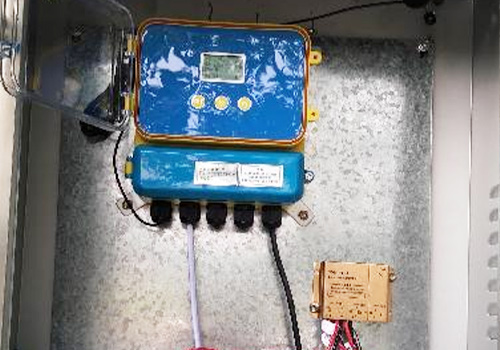
Equipment Selection: A split-type ultrasonic open channel flowmeter is selected, which is suitable for flow monitoring in open channels with regular rectangular cross-sections. Combined with a rectangular weir plate, it can accurately convert the flow rate into a measurable liquid level height.
System Configuration: The system integrates a GPRS wireless transmission RTU and a solar intelligent power supply system, ensuring the stability and reliability of the sensor's non-contact measurement and data transmission. The solar power supply reduces dependence on traditional energy sources and lowers operating costs.
Data Transmission and Storage: The measured flow data is transmitted in real-time to the backend management platform via wireless transmission equipment, enabling remote monitoring, storage, and query functions, providing strong data support for irrigation area management.
Measurement Principle of Ultrasonic Open Channel Flowmeter
The working principle of the ultrasonic open channel flowmeter is based on ultrasonic ranging technology and fluid mechanics principles. The specific process is as follows:
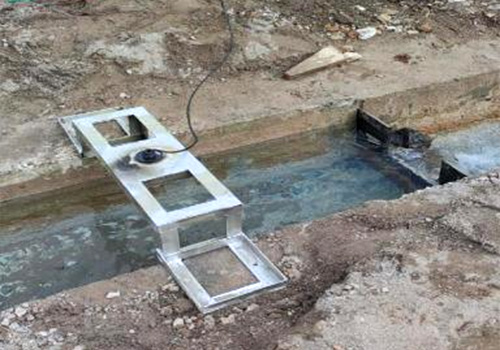
Installation of the measuring weir tank: A measuring weir tank is installed in the open channel, which causes the water flow to form a certain water level difference when passing through, thereby converting the flow rate into an observable water level height. The rectangular weir plate is one of the common forms of measuring weir tanks, with a simple structure and easy maintenance.
Ultrasonic ranging: The ultrasonic open channel flowmeter measures the water level height in the weir tank by emitting ultrasonic waves and receiving their reflected waves. The ultrasonic sensor is installed above the weir tank, emits ultrasonic waves downward, and after hitting the water surface, they are reflected back to the sensor. The water level height is determined by calculating the round-trip time difference of the ultrasonic waves.
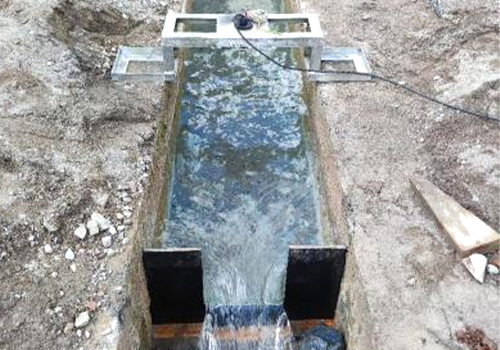
Flow calculation: Based on the water level-flow relationship of the measuring weir tank (usually obtained through experiments or calculations), the measured water level height is converted into the corresponding flow value. This conversion process may involve complex mathematical models or look-up tables, depending on the shape and size of the weir tank.
Summary
Through the use of a split-type ultrasonic open channel flowmeter combined with a rectangular weir plate, Dongchuan District, Kunming City, Yunnan Province has successfully achieved precise metering and remote monitoring of water use in irrigation areas. This solution not only improves the scientific and effective management of water resources, but also lays a solid foundation for the in-depth promotion of comprehensive agricultural water pricing reform. In the future, with continuous technological progress and the widespread promotion of applications, similar intelligent water management solutions are expected to be widely used in more regions.