
Canal Irrigation Agricultural Water Pricing Reform (with/without Weir-Flume) Flow Measurement & Remote Transmission Solution [Dayu Electronics]
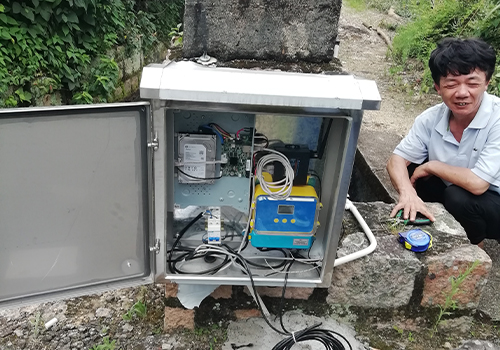
To advance the comprehensive reform of agricultural water pricing and achieve water conservation in canal irrigation areas as well as sustainable rural economic and social development, metering devices are installed in canal irrigation areas to initially achieve water usage control and metering by sub-zone. Due to the remote construction environment of canal irrigation areas, ultrasonic open-channel flowmeters can be used for water flow monitoring. With open-channel flowmeters, GPRS wireless transmission RTUs, and solar smart power supply, non-contact sensor measurement is realized. Flow data is transmitted to the backend management platform via wireless transmission equipment, enabling low-cost measurement, data storage, data inquiry, etc.
Technical Solution:
1. Ultrasonic Open-Channel Flowmeter:
Working Principle:
The ultrasonic open-channel flowmeter can directly measure the liquid level in a channel or flume. When used for flow measurement in open channels, a measuring weir or flume is installed in the channel. The measuring weir or flume converts the flow rate in the open channel into a liquid level height. The instrument measures the water level in the measuring weir or flume, and then calculates the flow rate according to the corresponding water level-flow relationship of the measuring weir or flume.
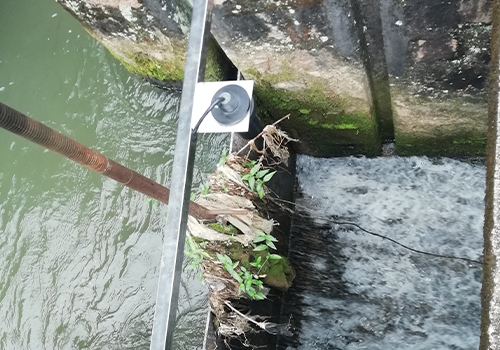
(1) Ultrasonic Liquid Level Measurement Principle:
The transmitting ultrasonic transducer emits ultrasonic pulses, which propagate through the medium to the measured liquid surface, are reflected, and then return through the medium to the receiving transducer. The time taken from transmission to reception is measured. Based on the speed of sound in the medium, the distance from the transducer to the liquid surface can be calculated, thereby determining the liquid level. Therefore, we can calculate the distance D from the probe to the reflecting surface as D = C*t/2 (divided by 2 because the sound wave actually travels back and forth from transmission to reception; D is the distance, C is the speed of sound, and t is the time). The liquid level value is then obtained through subtraction.
(2) Flow Measurement Principle of the Measuring Weir/Flume:
In a smoothly flowing open channel, the higher the flow rate, the higher the liquid level; the lower the flow rate, the lower the liquid level (as shown in Figure 1.1). The flow rate can be inferred by measuring the water level. The corresponding relationship between flow and water level in a regular open channel is affected by the channel's slope ratio and surface roughness. By installing a measuring weir or flume in the channel, a throttling effect is created, establishing a fixed relationship between flow and liquid level in the open channel. This relationship mainly depends on the structural dimensions of the measuring weir or flume, minimizing the influence of the channel.
When using an ultrasonic open-channel flowmeter, it is necessary to know the water level-flow relationship of the matching measuring weir or flume during installation.
The water level-flow relationship of the measuring weir or flume can be found in the national metrological verification regulation "Open Channel Weir and Flume Flowmeters" JJG711-90. This manual excerpts a portion (Section 6, Measuring Weir/Flume). For a Parshall flume, once the throat width b is known, the corresponding formula can be used to calculate the water level-flow relationship.
For a right-triangular weir, the corresponding formula is also used to calculate the water level-flow relationship.
Rectangular weirs also have corresponding formulas. However, they are also related to the installation channel dimensions. When determining the water level-flow relationship, the rectangular weir depends on the channel width B, opening width b, and upstream weir crest height p.
If you are not familiar with calculating the water level-flow relationship of the measuring weir or flume, you can notify the instrument manufacturer of the parameters of the measuring weir or flume used, and the manufacturer will assist with the calculation. Please note that the above-mentioned parameters related to determining the water level-flow relationship should be provided at the same time.
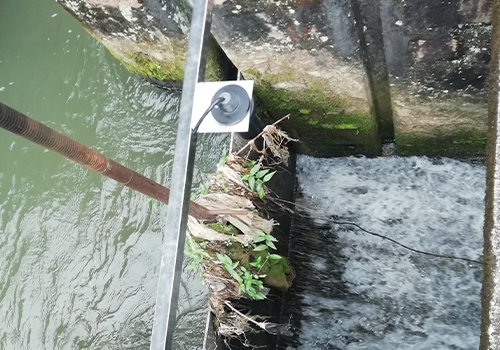
Site Requirements: Upstream of the measuring weir or flume, there must be a straight section at least 10 times the channel width to ensure stable water flow entering the weir or flume; the standard is "no ripples on the water surface," meaning no lateral deflection or thrust caused by channel slope.
If the upstream straight section cannot reach 10 times the channel width, or if there is significant water fluctuation or excessive foam, two layers of perforated baffle plates can be installed to resolve this.