
Ultrasonic Open Channel Flow Monitoring [Dayu Electronics]
Common flow monitoring applications include natural rivers, main irrigation canals, branch canals, hydropower plant discharges, urban inland rivers, and urban stormwater/sewage flows. Different flow instruments are selected based on the measurement environment.
Below is a standard rectangular channel flow monitoring example:
Channel characteristics: channel width 59 cm, height 43 cm;
Channel type: rectangular flow channel
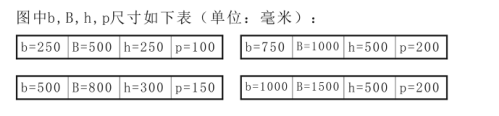
Selection details: An ultrasonic open channel flowmeter can be used for rectangular flow channels. If higher accuracy is required, a Parshall flume can be paired with the flowmeter, achieving a flow measurement accuracy of 1–5%. If accuracy requirements are less strict, a national standard rectangular weir can be used, providing a flow measurement accuracy of 10%. This measurement point uses the rectangular weir method, but according to the national standard dimensions for rectangular weirs:
Structure and precautions for the rectangular weir plate:
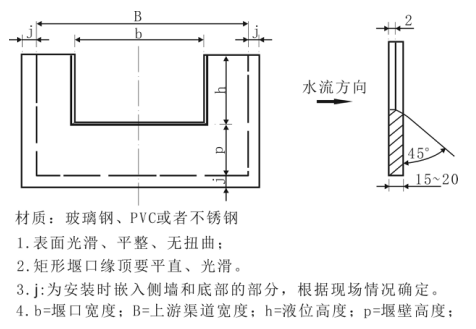
The minimum national standard rectangular weir dimensions selected for this measurement point are: b=250, B=500, h=250, P=100. During weir fabrication, as long as there is no impact on the flow measurement dimensions, B should be adjusted to 590 mm and h to 330 mm as appropriate, so that installation better suits the site conditions.
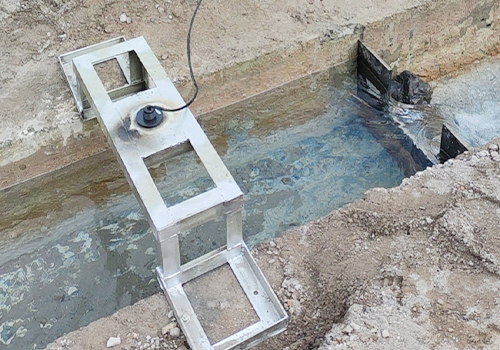
Installation requirements for the flow instrument sensor:
1. The sensor should be installed about 1 meter upstream of the rectangular weir outlet, in a location with steady water flow.
2. The sensor installation height should be at least 20 cm above the maximum water level.
3. The sensor mounting thread is M48*2, and the mounting bracket opening should be 50 mm in diameter.
4. Rubber gaskets and nuts should be used during sensor installation to secure the sensor and provide vibration isolation.
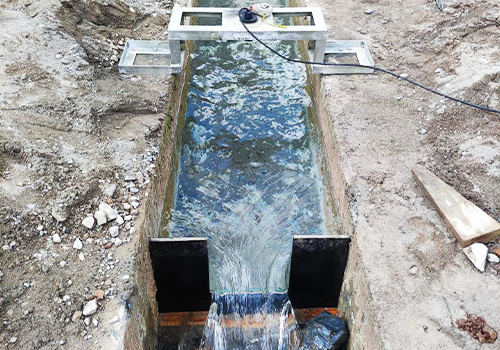
Installation precautions for the flow transmitter:
1. The sensor cable should be routed through a separate conduit for protection to prevent accidental damage.
2. The transmitter (i.e., the flow totalizer) must be housed in a waterproof enclosure to prevent water ingress.
3. The transmitter must be properly grounded to avoid interference.