Compact Doppler Flow Velocity and Flow Meter Application [Dayu Electronics]
Ultrasonic Doppler velocity meter measurement principle: The ultrasonic Doppler velocity meter operates based on the Doppler effect. The probe emits an ultrasonic beam obliquely upward (or forward). As the ultrasonic wave propagates through the fluid, which contains impurities such as bubbles or particles (which can be assumed to move at the same velocity as the water flow), the reflected ultrasonic wave undergoes a Doppler frequency shift Δf when it encounters these impurities. This Doppler shift Δf is directly proportional to the flow velocity. By measuring the Doppler shift Δf, the flow velocity of the fluid can be determined.
Product features: Ultrasonic detection of flow velocity with the measurement point located in front of the probe, without disturbing the flow field. It offers high measurement accuracy, a wide measurement range, the ability to measure both weak and strong currents, high resolution, and fast response. Additionally, integrated pressure and temperature sensors enable measurement of water depth and water temperature, with data transmitted via RS485 for flow velocity, water level, and temperature.
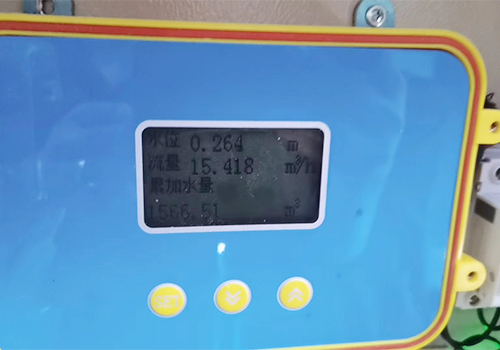
Compact ultrasonic Doppler flow meter: Based on the flow velocity and water level information detected by the velocity meter, it calculates the instantaneous flow rate per second using the cross-sectional area of the channel, and then accumulates these values to obtain the total flow.
Classification of compact Doppler velocity meters:
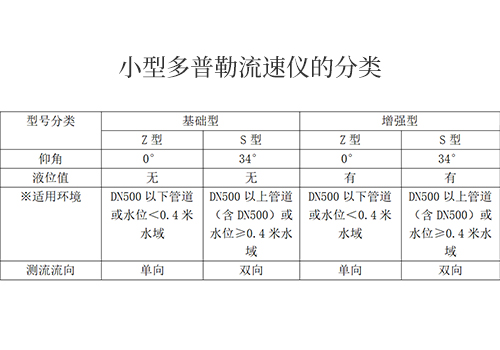
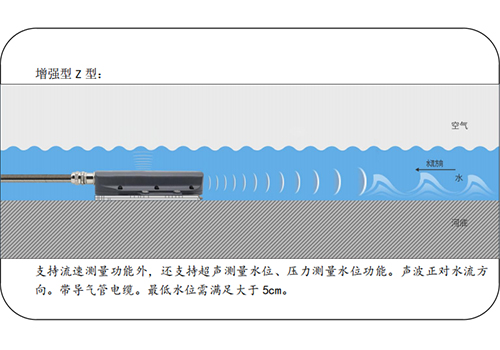
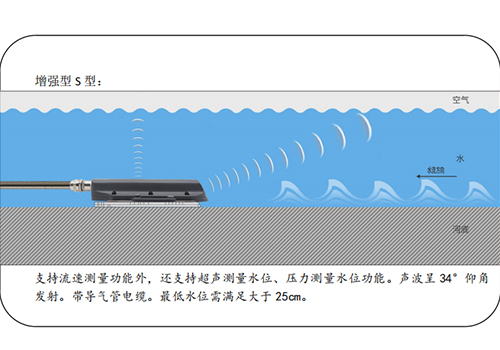
※Z-type minimum water level requirement: Since the ultrasonic Doppler velocity meter has an elevation angle of 0°, a water level of at least 5 cm above the sensor bottom is required for measurement. Ensure there is a straight section of at least 2 m in front of the sensor, with no obstacles within 0.7 m.
Case Study
Measurement point: A regular rectangular channel with a width of 0.6 m (see Figure 1-1).
Measurement objective: Calculate the flow rate by measuring the fluid velocity and water level in the rectangular channel.
Measurement point characteristics: The fluid velocity is extremely slow; other velocity meters and flow meters cannot accurately measure it.
Selected product: Compact ultrasonic Doppler velocity/flow meter for measuring low-velocity environments.
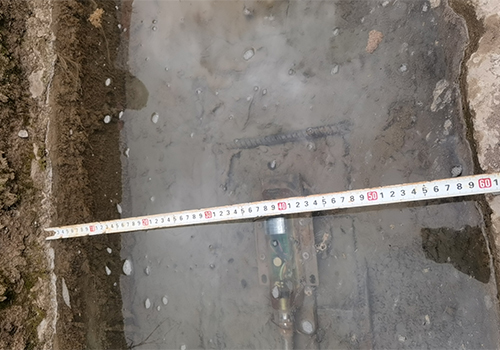
Identified issues are as follows:
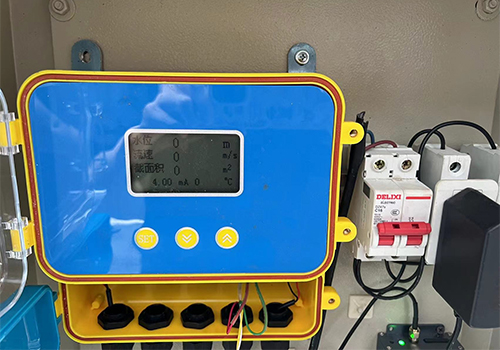
1. The compact Doppler velocity meter is factory-set to exclude low-velocity measurements; when the flow velocity is below 0.03 m/s, the flow transmitter does not register readings (see Figure 1-2).
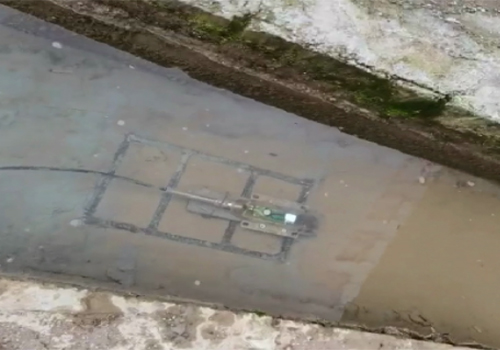
2. The velocity meter installation must avoid the mud layer, and there should be no obstructions within 0.7 m directly in front of the flow velocity sensor (see Figure 1-3).
Problem resolution:
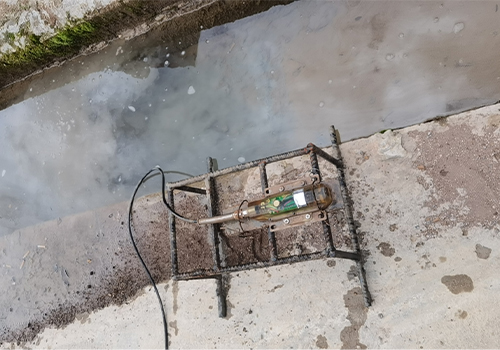
1. Raise the fixed mounting bracket of the velocity meter to completely clear the silt layer; clean the silt and stones within 3 m upstream and 2 m downstream of the measurement point (see Figure 1-4).
2. Connect the Doppler velocity meter to software and disable the low-velocity lock value, allowing measurements from 0.01 to 0.03 m/s (see Figure 1-5).
3. Installation and calibration settings:
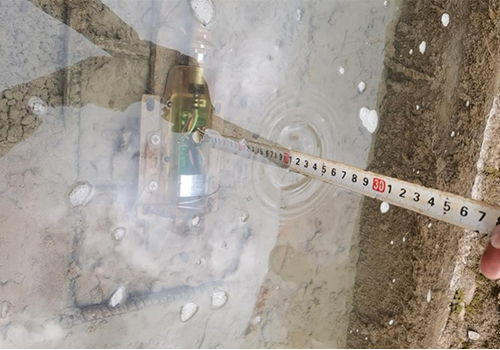
The Doppler velocity meter is mounted on a bracket for measurement. The pressure water level sensor is positioned at a certain distance from the bottom; in this case, measure the height from the pressure water level sensor to the bottom and correct the flow transmitter parameter settings accordingly (see Figure 1-6).
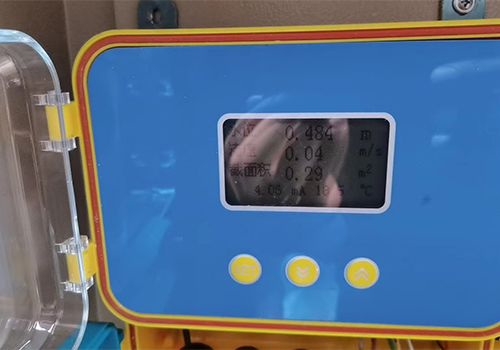
After cleaning the channel, adjusting the mounting bracket, disabling the low-velocity limit, and performing water level calibration, the ultrasonic Doppler flow meter provides accurate and stable readings, meeting the measurement objectives (see Figure 1-7).