
Impact of Non-Standard Parshall Flume Supports on Open Channel Flow Meter Measurements
Impact of Non-Standard Parshall Flume Supports on Open Channel Flow Meter Measurements:
Phenomenon: Open channel flow meter readings are incorrect.
Cause: The on-site stainless steel Parshall flume had its mounting brackets field-welded, resulting in right-angle reflection points on the flume surface.
Solutions: 1. Re-modify the mounting brackets. 2. Adjust menu parameters to reduce the influence of reflection points on measurements. According to standards, the shape of a Parshall flume is fixed and must include three sections: converging section, throat section, and diverging section. Each Parshall flume model has fixed standard dimensions.
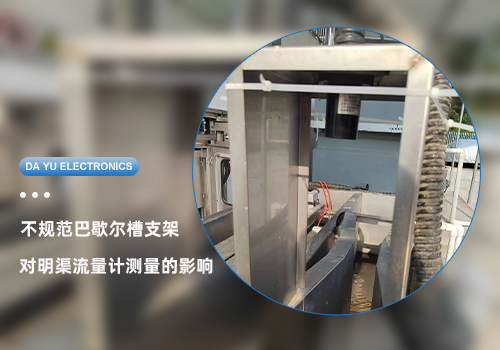
Parshall flume dimensions are related to channel installation and should be determined based on the specific site conditions. Some flumes can be installed directly in the flow path, while others can be installed at the end of a discharge outlet. However, according to national standards, they are typically placed in the middle of the flow path, with an open channel flow meter installed above.
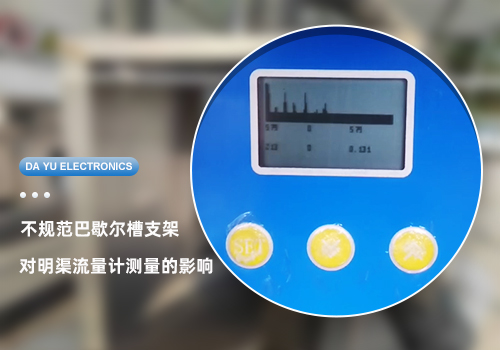
In an open channel, the higher the flow rate, the higher the liquid level; the lower the flow rate, the lower the liquid level. For general channels, there is no fixed relationship between liquid level and flow rate, because at the same water depth, the flow rate also depends on the channel's cross-sectional area, slope, and roughness. By installing a measuring weir or flume in the channel, since the weir notch or flume constriction is smaller than the channel's cross-sectional area, the relationship between upstream water level and flow rate is mainly determined by the geometric dimensions of the weir or flume. The same weir or flume placed in different channels will yield the same flow rate for the same liquid level. The measuring weir or flume converts flow rate into liquid level. By using a radar level meter (SCJ-LD07) to measure the liquid level in the weir or flume, and then based on the water level-flow rate relationship of the corresponding weir or flume, the flow rate is calculated by the remote terminal unit (SCJ-RTU01).