
Why Does the Ultrasonic Anemometer Fail to Measure Wind Speed at High Wind Speeds? [Dayu Electronics]
Ultrasonic anemometer works on the principle of the ultrasonic time-difference method to measure wind speed and direction. Since the speed of sound in air is combined with the airflow velocity in the wind direction, if the ultrasonic wave propagates in the same direction as the wind, its speed increases; conversely, if it propagates in the opposite direction, its speed decreases. Therefore, under fixed measurement conditions, the propagation speed of ultrasonic waves in air can be correlated with a function of wind speed. Accurate wind speed and direction can then be obtained through calculation. Since sound waves in air are significantly affected by temperature, the wind speed sensor detects two opposite directions on two channels, so the effect of temperature on sound wave speed can be ignored.
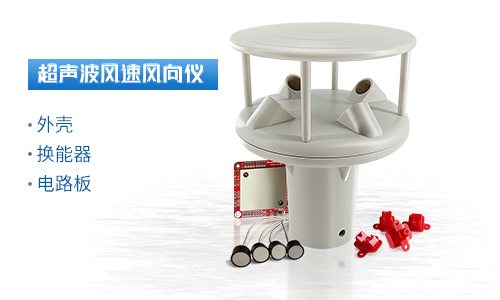
But why does the ultrasonic anemometer lose signal when wind speed reaches 50 m/s or higher?
After analysis, the following situations may occur:
1. Frequency deviation caused by the Doppler effect: The transducer of the ultrasonic anemometer has a center frequency of 200 kHz. Under no-wind conditions, one transducer transmits and the other receives a 200 kHz signal. When wind speed reaches 50 m/s, due to the Doppler effect, the frequency of the signal received by the receiving transducer deviates significantly from 200 kHz, causing the received signal to fall outside the transducer's center bandwidth range.
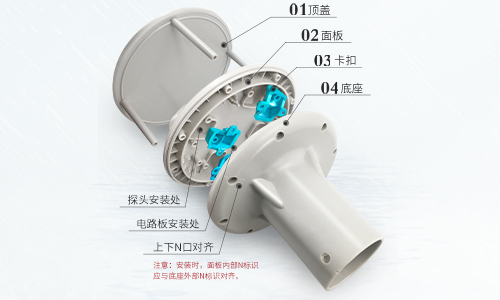
2. Sensitivity change: Under no-wind conditions, the 200 kHz anemometer transducer DYA-200-01D is driven with 12V, 16V, and 24V voltages. With the two transducers placed 5 cm or 10 cm apart, one transmitting and one receiving, the higher the wind speed, the lower the wind pressure, the greater the attenuation of the ultrasonic wave during transmission, and the weaker the signal received by the receiving end. At a wind speed of 50 m/s, the signal received by the receiving transducer is only at the microvolt level, so wind speed can no longer be measured.
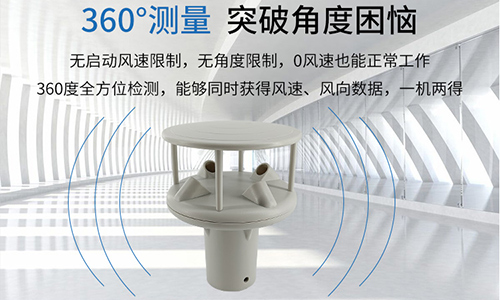
3. Transmitting angle deviation: Taking the DYA-200-01D anemometer transducer as an example, (beam width) half-power angle @-3dB: 10°±2, sharpness angle: 23°±4. The higher the wind speed, the greater the angular deviation of the transmitting transducer. At a sufficiently high wind speed, the receiving transducer falls outside the sharpness angle range, resulting in no wind speed measurement. This factor has the smallest impact on high wind speed measurement.