
The Importance of Corrosion Protection for Ultrasonic Level Gauge Probes [Dayu Electronics]
Application: The procurement requirement was for level measurement in a sewage tank.
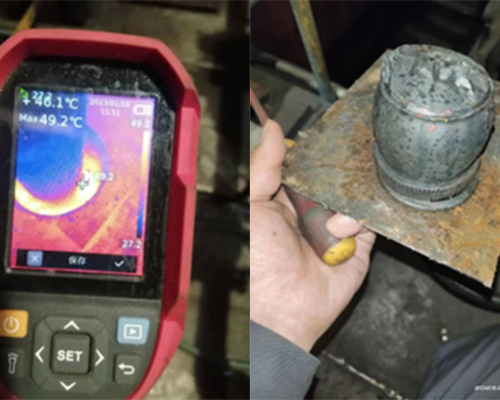
Problem: After just over one month of installation and use, the ultrasonic level gauge probes experienced swelling and cracking.
Actual conditions: This batch of products was actually used on volatile alkaline solvent tanks with an ambient temperature of around 52°C.
Cause: The end user lacked understanding of the chemical properties of the measured medium and the on-site working environment, including temperature and humidity.
As shown in the figure below, the ABS probe was severely corroded and needs to be replaced with a corrosion-resistant PVDF or PTFE probe.
Corrosion-resistant Ultrasonic Level Gauge (for measuring level, solid level) is a non-contact, highly reliable, cost-effective, and easy-to-install-and-maintain level measurement instrument. It can meet most level measurement requirements without contacting the medium, and is mainly used to measure corrosive liquids such as sulfuric acid, hydrochloric acid, nitric acid, hydrofluoric acid, chlorosulfonic acid, sodium hydroxide, lime slurry, and liquid alkali, and is used for level measurement in petroleum storage tanks, chemical storage tanks, chemical product tanks, sewage treatment plants, dosing tanks, seasides, docks, and other applications.
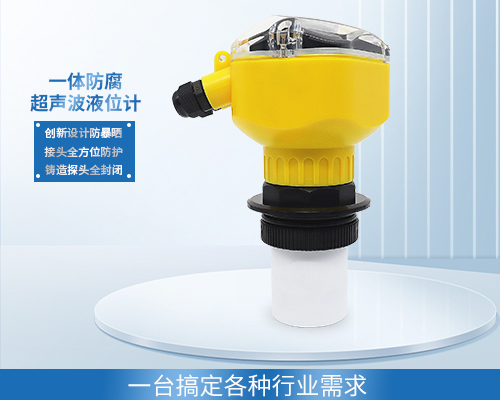
Since on-site installation environments vary, the corrosion-resistant ultrasonic level gauge must be set up with knowledge of the basic measurement parameters before operation, such as measurement range, zero point, full scale, and on-site conditions. Therefore, the instrument must be configured before measurement.
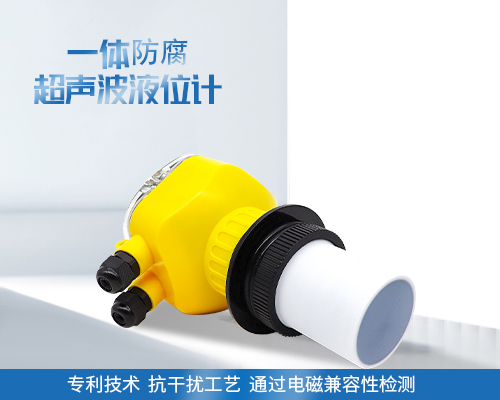
Main technical specifications:
1. Measuring range: 5m, 10m, 15m, 20m, 30m, 40m, 50m, 60m
2. Measurement accuracy: 0.25%-0.5%
3. Resolution: 3mm or 0.1% (whichever is greater)
4. Display: Chinese LCD display
5. Analog output: 4-wire 4~20mA/750Ω load; 2-wire 4~20mA/250Ω load
6. Relay output: optional 2 groups AC 250V/8A or DC 30V/5A, programmable status
7. Power supply: standard 24VDC; optional 220V AC +15% 50Hz
8. Ambient temperature: display instrument -20~+60°C, probe -20~+80°C
9. Communication: optional 485, 232 communication (manufacturer protocol)
10. Protection rating: display instrument IP65, probe IP68
11. Probe installation: depends on range and probe selection