
Ultrasonic Tree Testing Sensor for Detecting Holes, Cracks, and Defects in Trees [Dayu Electronics]
Ultrasonic tree testing sensor measures holes, cracks, and defects inside trees. It uses six transmitter circuits and six receiver circuits, allowing one transducer to transmit sound waves while the other five transducers receive.
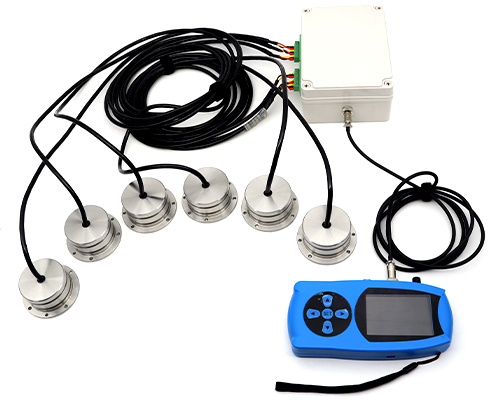
The six ultrasonic transducers are numbered 1, 2, 3, 4, 5, and 6.
Testing method: Apply coupling gel to the radiating surfaces of the five receiving transducers, then attach them around the tree trunk to be inspected and secure them in place. Apply coupling gel to the transmitting ultrasonic transducer as well and attach it to the trunk. Then connect the host computer to the circuit board and observe the signals received on the channels of the other receiving ultrasonic transducers as the transmitting transducer is moved to different positions, making it possible to determine whether there are holes, cracks, defects, or looseness inside the tree.
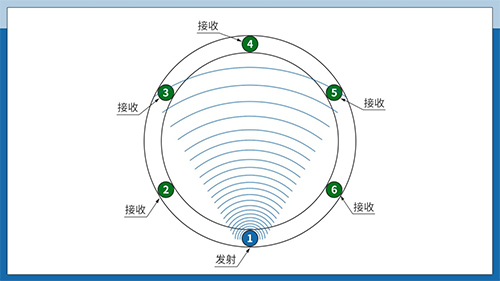
To illustrate how to measure holes, cracks, and defects inside trees, let's take transducer No. 1 as the transmitter and the other five transducers as receivers.
Assume there is a horizontal crack directly facing transducer No. 1, spanning about 70-80% of the tree's diameter, and the crack extends over a considerable vertical height.
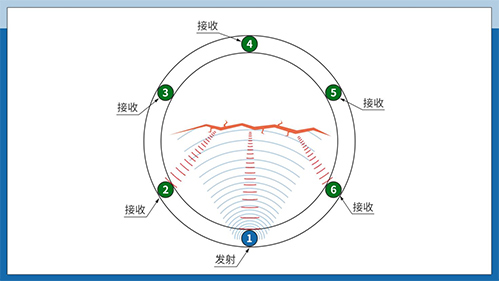
When transducer No. 1 transmits, the ultrasonic waves travel inside the tree. When they encounter a crack, because the acoustic impedance of the wood and the acoustic impedance of the air gap at the crack are very different, about 99% of the ultrasonic waves are reflected back, and only about 1% can penetrate through.
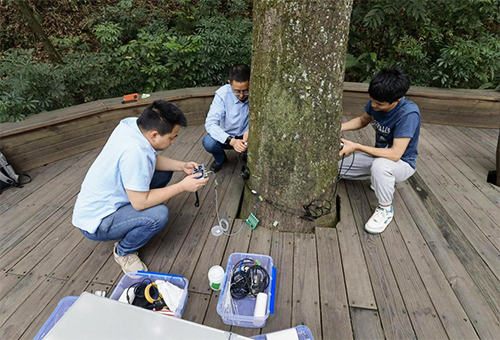
At this point, transducers No. 1, No. 2, and No. 6 all receive ultrasonic signals. Since No. 1 is the transmitter and does not receive in this mode, in practice, it is No. 2 and No. 6 that receive the reflected ultrasonic waves.
Transducers No. 3, No. 4, and No. 5 receive no signal at all, or only a very weak signal.