
How to Position a Subsea Lifting Pin for Accurate Entry into a Tapered Horn Mouth [Dayu Electronics]
1. The lifting equipment suspends the pin with a cable and moves it above the water surface. A transmitting sensor, also called an underwater communication module, is installed on the pin, designated as D.
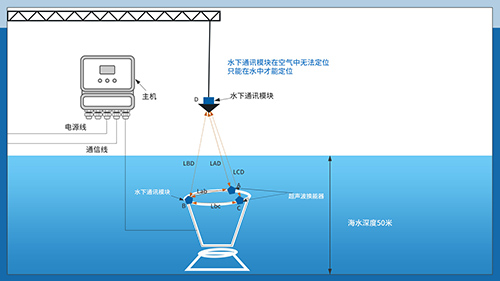
2. Three ultrasonic transducers are arranged around the underwater horn mouth, designated as A, B, and C. Among them, B is the underwater communication module. The underwater communication module cannot operate in air; it only works in water. The circuits corresponding to designations A, B, and C are located in the host unit, which can be placed in the user's underwater equipment on site and connected via cables.
The communication module D is fixed to the pin, powered by a battery, and its circuit is also contained within the module.
After the host calculates the distance and angle of the pin relative to the horn mouth, it transmits the data externally via the RS485 interface.
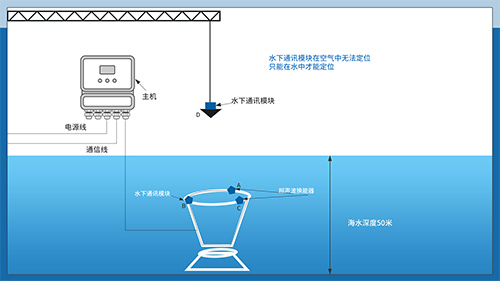
3. Only when the pin enters the water can the underwater communication module operate properly.
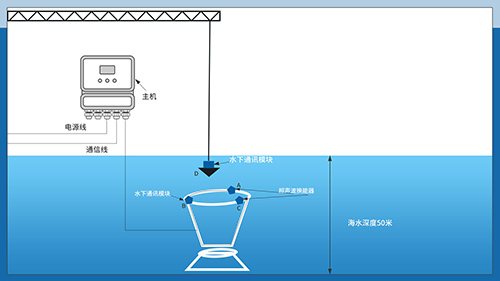
4. Assuming the pin is now in the water, communication module B, located around the horn mouth, transmits an ultrasonic signal that propagates through the water to reach communication module D. Upon receiving the signal from B, module D returns an ultrasonic signal, which is then received by the three ultrasonic transducers A, B, and C. Based on the time differences at which transducers A, B, and C receive the signal from module D, the distances LBD, LAD, and LCD can be calculated. Using the distances LAB and LBC, angles ∠ABD and ∠DBC can be derived, thereby determining the distance and position of D.
The positioning here refers to determining a position in the three-dimensional underwater space.
Communication Module D
Power Supply: Battery powered
Battery Type: Primary lithium battery
Battery Capacity: 12V 34AH
Continuous Operating Voltage and Current: DC 12V 150mA
Pressure Rating: Maximum water depth 100 meters
Housing Material: ABS+PC
Protection Class: IP68 for 100-meter water depth
Output Signal: No RS485 output
Ultrasonic Frequency: Tentatively 30–45 kHz
Ultrasonic Propagation Direction: Horizontal opening angle 360°; vertical opening angle 40°
Mating Cable Length: None
Anti-Corrosion Requirement: Resistant to seawater corrosion for 1000 days
Explosion-Proof Requirement: Non-explosion-proof
Total Weight: To be determined