
Hydrophone Applied to Leak Monitoring of Sewer Pipe Network at Qingdao Haier Industrial Park [Dayu Electronics]
1. Is it better for a hydrophone measuring leaks to be in contact with water or mounted on the outside of the pipe?
Answer:
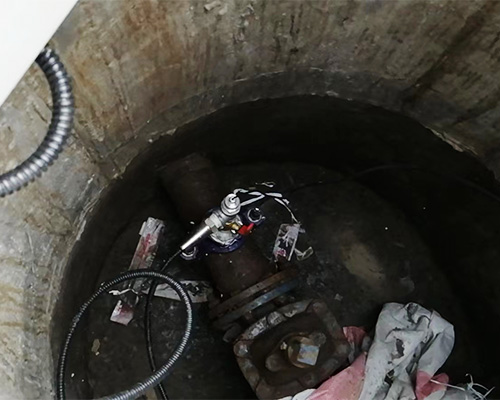
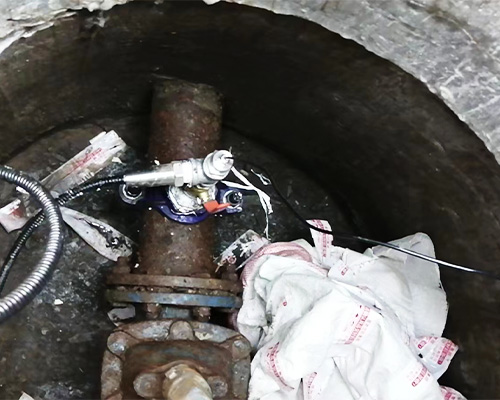
From a measurement perspective, as long as the pipe is full, installing the hydrophone inside the pipe in direct contact with water will result in stronger leak sounds, making it easier to detect.
2. How is a hydrophone installed in contact with water on the pipe?
Answer:
1.Fix the hydrophone onto a mounting base.
2. Make a hot tap (pressure drilling) on the pipe.
3. Use the mounting base to secure the hydrophone to the pipe.
3. How is a hydrophone mounted on the outside wall of the pipe?
Answer:
1. Polish a 50×50mm area on the outer wall of the pipe at the installation position using a polishing machine.
2. Apply a coupling agent between the hydrophone and the pipe, such as 704 silicone, or place a silicone pad.
3. Place a 5-10mm thick soft rubber pad on the outer side of the hydrophone.
4. Use a clamp to secure the hydrophone to the pipe.
4. What is the supply voltage for the hydrophone?
Answer:
DC 5.0 to 15.0V.
5. What kind of signal does the hydrophone output?
Answer:
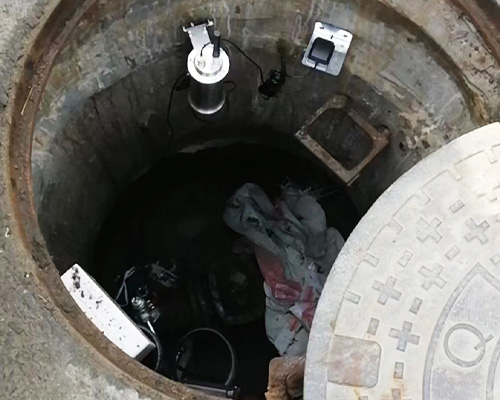
The hydrophone receives leak sounds; for example, a 1050Hz sound is converted to a 1050Hz frequency signal output.
6. Is there a hydrophone with 485 output?
Answer:
Yes, 485 output is available as a custom product.
7. Can a hydrophone be made with 4-20mA output?
Answer:
The leak signals received by a hydrophone have both frequency and amplitude data, which cannot be represented by a 4-20mA analog output.
8. What pressure can a hydrophone withstand when in contact with the water in the pipe?
Answer:
The standard hydrophones that come into contact with the water in the pipe are all rated for a pressure of 10 kg. If higher pressure resistance is required, a custom order is needed.
9. Can the leak sound travel through the pipe wall?
Answer:
The leak sound can travel through the pipe wall. Because pipes are connected section by section, there is a loss in signal strength at each pipe joint, approximately 10% to 40%.