
Twelve Major Issues in the Use of Rail Detection Transducers (Part 2) [Dayu Electronics]
7. Can a rail transducer transmit continuously?
As a transmitting transducer, continuous transmission for 24 hours is not feasible. Even continuous transmission for 1 hour is not acceptable. Under continuous transmission conditions, heat easily accumulates inside the transducer. Once the heat builds up to a certain level, the transducer's performance will degrade, and in severe cases, the transducer may be permanently damaged.
8. Since the rail transducer cannot transmit continuously, how should it be operated to avoid damage?
Calculate based on a duty cycle of ≥1:20. Assuming each transmission lasts 1000 ms, the minimum interval between the end of one transmission and the start of the next is 1000 ms × 20 = 20000 ms, i.e., 20 seconds. Assuming each transmission lasts 2 ms, the minimum interval between the end of one transmission and the start of the next is 2 ms × 20 = 40 ms. As long as the interval is ≥20 times the transmission duration, it is acceptable.
9. What is the maximum continuous transmission time in seconds for a rail transducer?
In other words, what is the maximum single transmission duration in seconds that will not cause transducer performance degradation? We have not conducted such extreme tests to determine the maximum single transmission duration that will not degrade transducer performance. You could purchase 4 rail transducers and run this experiment yourself to see what the maximum single transmission duration is that does not cause performance degradation.
10. The existing 30KHz rail transducer is somewhat large in size. Can it be made smaller for easier installation?
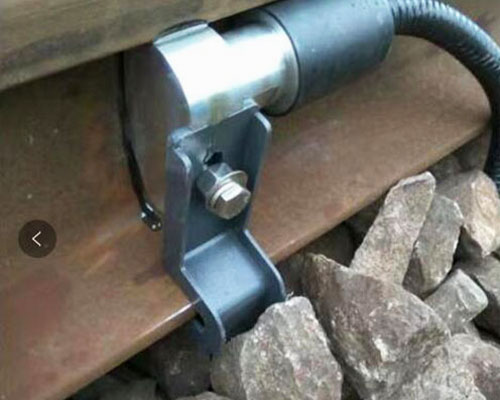
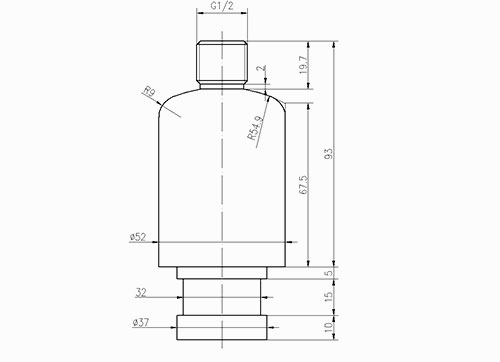
The existing 30KHz rail transducer can be made smaller, but the following factors limit how small it can be. ① If the frequency must remain at 30KHz, and the transmission sensitivity is to be maintained, the diameter can only be reduced to approximately 60mm. ② Sensitivity: because the transducer's sensitivity is proportional to the transmitting area, if a decrease in sensitivity after miniaturization is acceptable, the diameter can be reduced to approximately 50mm.
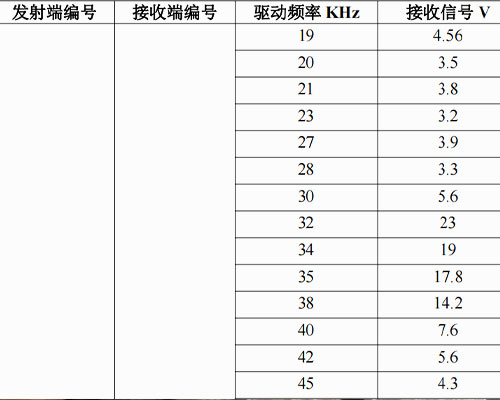
11. The existing rail transducers operate at a frequency of roughly 30-33KHz. Can higher frequencies be achieved, such as 40KHz or 50KHz? Given a distance of 800-1200 meters between the two transducers, it is possible to manufacture 40KHz or 50KHz transducers. They would be smaller in size, but the transmission sensitivity would decrease. If the transmitting and receiving circuits are well designed, higher frequencies can be used.
12. What factors can affect measurement during on-site rail break detection?
① When a train passes over the rail, it generates noise across a very wide frequency band, from a few KHz up to several hundred KHz. This noise is transmitted through the rail and arrives at the measurement point when the train is still 1000-2000 meters away. After the train passes the measurement point, the noise does not completely disappear until the train is at least 1000-2000 meters away. ② Electromagnetic interference: if the site is powered purely by batteries, the situation is manageable. However, if the railway on-site AC power is converted to DC to power the circuit, there will be strong electromagnetic interference. Extra effort must be invested in the AC-to-DC conversion stage, for example, by using a linear power supply for AC-to-DC conversion, or using an isolated power supply.