
Manhole Level Gauge Applied to Sewer Level Measurement in Henan Province [Dayu Electronics]
Manhole Level Gauge applied to measure liquid levels in multiple sewers in Nanyang City, Henan Province. On-site feedback indicated that the data fluctuated randomly and some data was not uploaded. After Dayu technicians arrived on site and opened the manhole covers, they found that the bracket was too thin, causing the sensor to be non-perpendicular to the measured surface. After reinforcing the bracket, the data returned to normal, and the system was upgraded on site to ensure proper data uploading.
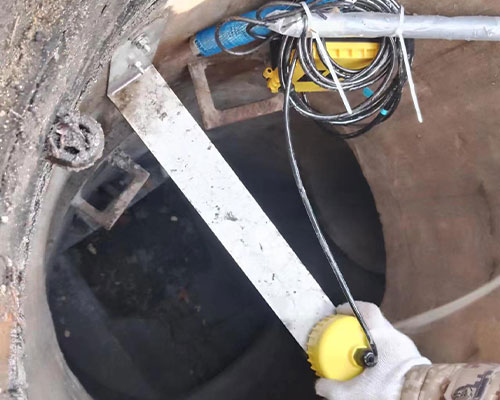
Based on customer requirements, we continuously improved the product and launched a 3.6V low-power manhole level gauge. This level gauge consists of a main unit box, a probe, a submersible level transmitter, and an antenna. The main unit box is equipped with two lithium batteries, providing a 3.6V supply voltage. With one upload every 5 minutes and one measurement every 5 minutes, the unit can operate for 2-3 years, with a working time of up to 26,000+ hours, making it extremely energy-efficient and eliminating concerns about power supply in remote or confined environments such as manholes. This product is compact and can be installed in many narrow spaces. The probe has an IP68 protection rating, so immersion in water does not affect its performance. With Bluetooth connectivity, users can view relevant data directly via a mobile phone, making operation more convenient.
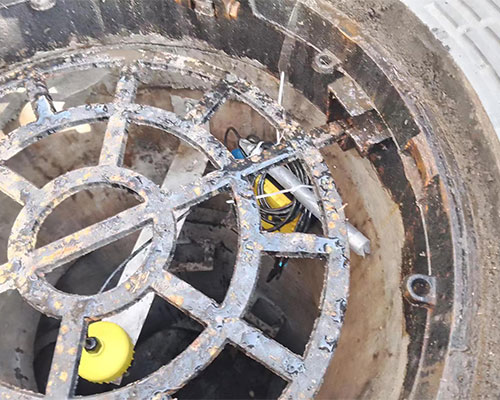
Installation method: Bracket-type installation. When installing on the wall inside a manhole, both circular and flat wall surfaces must be considered. The sensor must be perpendicular to the measured surface.
Specific requirements for the level gauge:
1. Measurement range: Most are within 6 meters, and a few are within 8 meters.
2. Working environment: Inside manholes, there are rainwater wells and sewage wells. Sewage contains sediment, foam, and debris that can cause material buildup (coating).
3. Installation method: The meter head must be mounted flush against the manhole wall, and the measuring rod may also come into contact with the manhole wall.
4. Display method: LCD or digital tube display; it does not need to be always on but should wake from sleep mode when needed to show the liquid level and fault conditions.
5. Power supply method: Voltage is 12VDC or 9VDC, with a 12AH rechargeable lithium battery. In practical operation, the battery is expected to last up to 1 year; if that cannot be achieved, it should last at least 6 months.
6. The probe rod must withstand wear, impact, and other factors that could damage the insulation layer, as workers regularly perform desilting and cable laying on site.
7. The output signal is TTL to reduce power consumption, which is then transmitted to a GPRS module for direct sending to the designated background server.
Battery and GPRS requirements:
1. Voltage is 12VDC or 9VDC, with a 12AH rechargeable lithium battery. In practical operation, the battery is expected to last up to 1 year; if that cannot be achieved, it should last at least 6 months.
2. The GPRS module must operate stably, with an antenna interface on the outside of the sealed enclosure, and the antenna should be connected for communication with the background system.
3. The fastest data transmission interval is every 5 minutes, and the slowest is every 30 minutes.
4. The data acquisition interval ranges from 5 seconds to 5 minutes.