
Ultrasonic Doppler Flowmeter Case Study [Dayu Electronics]
Ultrasonic Doppler flowmeters are commonly used for water level, flow velocity, and flow rate monitoring in urban rivers, main canals of agricultural irrigation districts, urban sewage pipe networks, and urban stormwater pipe networks. Below, we review a failure case: (an open-channel flowmeter installed with a Parshall flume at a sewage manhole).
From the photos provided by the customer, we can clearly see that the manhole diameter is 600 mm. In Figure 2, the Parshall flume support bracket and the open-channel flowmeter probe are visible. As the water level rose, the body of the Parshall flume became completely submerged, and the open-channel flowmeter could no longer accurately measure instantaneous flow and cumulative flow!
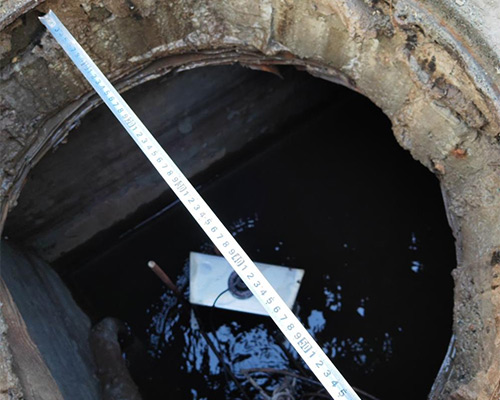
Through communication with the customer, we learned that the discharge pipe is a DN600 circular pipe, with a water level of approximately 500 mm. When retrofitting this measurement point, our company's first-generation Doppler flowmeter can be selected. The product appearance is as follows:
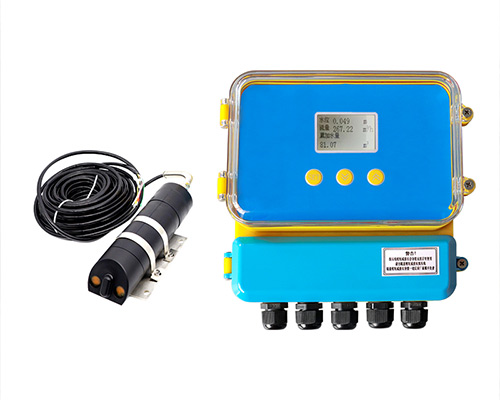
This product can monitor flow online for both full-pipe and partially full-pipe conditions. It measures the instantaneous flow velocity of the fluid using ultrasonic principles, measures the actual water level passing through the pipe via pressure-type water level sensing, and then calculates the instantaneous flow rate through the pipe based on the instantaneous flow velocity and water level, ultimately providing cumulative flow data. The product offers high measurement accuracy, low flow velocity and water level errors, and ensures the timeliness, accuracy, and effectiveness of online monitoring.
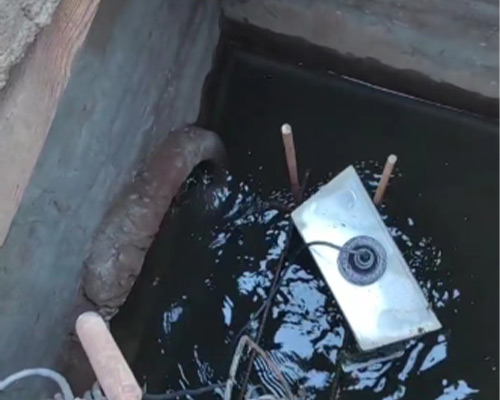
Installation considerations for the measurement point retrofit:
1. In circular pipes with sediment, install the sensor above the sediment to prevent sediment from covering it and affecting measurements. See the schematic below:
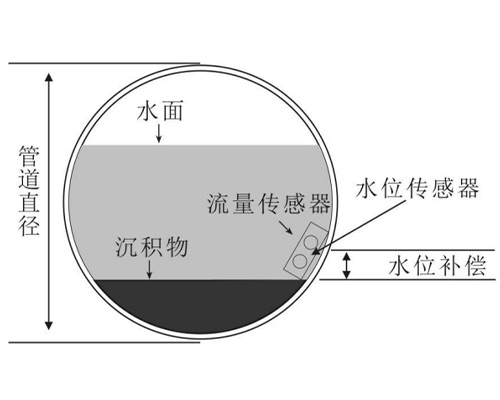
In pipes without sediment, the sensor can be installed directly at the bottom of the channel. To prevent water flow from shifting the sensor's installation position, the sensor has a base at the bottom specifically designed to secure it to the pipe. Additionally, the sensor can be installed near the pipe outlet, which facilitates both installation and future maintenance or replacement.