
Open Channel Flowmeter with V-Notch Weir at Chemical Plant Discharge Outlet [Dayu Electronics]
Dayuopen channel flowmeter, used with a V-notch weir, is installed at the discharge outlet of a chemical plant in Sanming to monitor wastewater discharge and upload data to the environmental protection department.
Ultrasonic open channel flowmeter generally requires a weir or flume. The selection of the weir/flume type must consider the flow rate in the channel, the flow regime (whether free flow can be established), and the maximum flow. We can choose different weirs or flumes based on the maximum flow rate, such as V-notch weirs, Parshall flumes, and rectangular weirs.
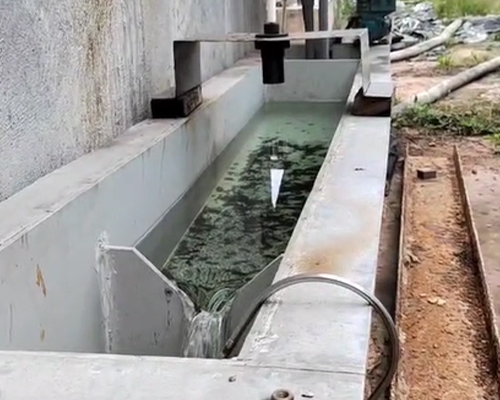
How to correctly construct the weir/flume for an ultrasonic open channel flowmeter?
The weir plate must be vertical and installed along the centerline of the channel. For V-notch weirs, the apex can be squared, typically at a 90-degree angle. When determining the zero-level position, note that the zero point for a V-notch weir is at the intersection of the extended lines from the side edges of the notch. The probe should be installed upstream, 0.5 to 1 meter from the weir plate.
If the approximate flow range is known and it is less than 40 liters per second, selecting a V-notch weir for the open channel flowmeter is more reasonable. Because the flow is small, and the V-notch opening is the smallest among all weirs/flumes, it is suitable for low flow rates, improving measurement accuracy. If the flow exceeds 40 L/s and the water velocity is high, do not use a V-notch weir, as it may cause water to overflow the weir structure itself.
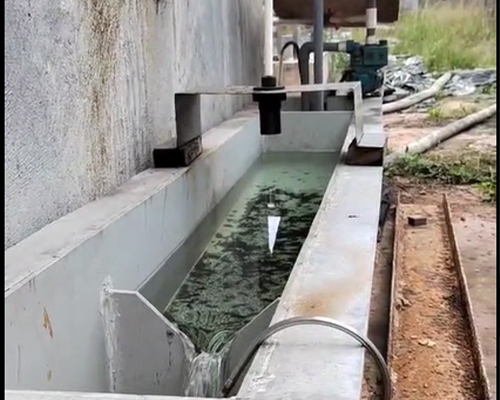
The V-notch weir open channel flowmeter is a device for measuring free-surface flow in open channels under non-full-pipe conditions. The waterway with non-full-pipe flow is called an open channel, and the instrument for measuring flow in open channels is an open channel flowmeter. The ultrasonic open channel flowmeter works with a Parshall flume (or similar) to measure liquid level height using the propagation principle of ultrasound in air, transmitting level data to the host, which automatically calculates instantaneous and cumulative flow and stores the data.