
Dayu Electronics Wastewater Discharge Monitoring
Routine sewage discharge typically occurs through discharge wells or pipelines, mostly intermittent. When the sewage stored in the discharge well reaches a certain high level, the sewage will overflow from the pipe or channel. The fluid characteristics are slow flow velocity and small flow rate. It is necessary to monitor such sewage discharge volume. Conventional radar flowmeters, Doppler flowmeters, ultrasonic pipe-section flowmeters, and electromagnetic flowmeters are no longer able to perform normal measurement. At this point, we can appropriately modify the on-site channel, pair it with a suitable measuring flume, and use an ultrasonic open-channel flowmeter to measure the discharge volume.
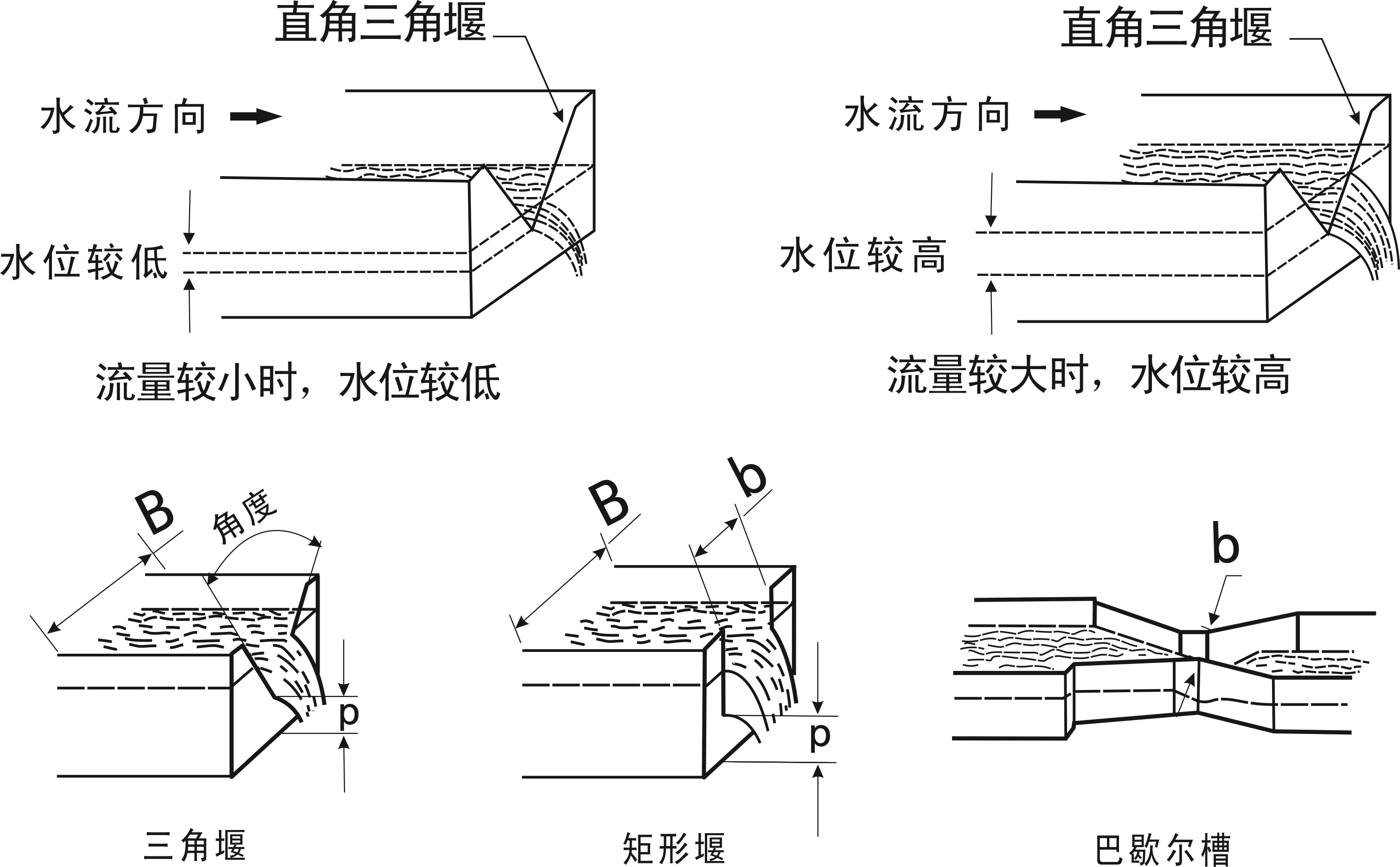
The flow measurement principle of the measuring flume: In a smoothly flowing open channel, the higher the flow rate, the higher the liquid level; the lower the flow rate, the lower the liquid level (as shown in Figure 1.1). The flow rate can be deduced by measuring the water level. The corresponding relationship between flow rate and water level in an ordinary open channel is affected by the channel's slope ratio and surface roughness. By installing a measuring flume in the channel, a throttling effect is created, giving the flow rate and liquid level a fixed corresponding relationship in the open channel. This relationship mainly depends on the structural dimensions of the measuring flume, minimizing the influence of the channel as much as possible.
Commonly used measuring flumes include the V-notch triangular weir, rectangular weir, and Parshall flume (as shown in Figure 1.1).
The figure below shows the discharge flow monitoring of overflowing sewage at the discharge well outlet using an ultrasonic open-channel flowmeter paired with a No. 2 Parshall flume:
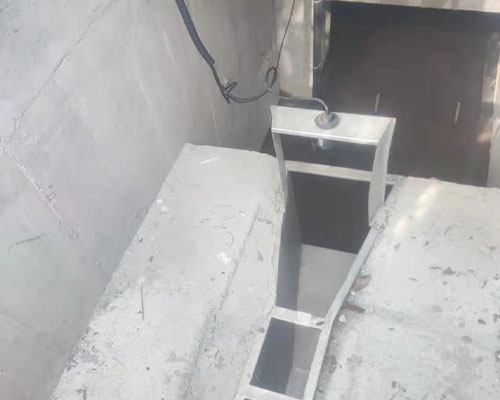
The measurement characteristics of the above Parshall flume are: when the water level in the sewage well rises, water slowly and steadily overflows from the Parshall flume channel. The sensing part of the open-channel flowmeter is installed on a bracket 20 cm above the Parshall flume, and the sensor length is 8-9 cm. During flow measurement, the flow rate increases as the water level rises and decreases as the water level falls. When there is no sewage discharge, no water overflows inside the channel, so the water level value measured by the flowmeter is nearly zero. When performing this type of flow monitoring, the following points should be noted, and the flow measurement error is within 5%.
Figure 1.1 Commonly used measuring flumes and the relationship between water level and flow rate variations
When using an ultrasonic open-channel flowmeter, the water level-flow rate corresponding relationship of the matching measuring flume must be known during installation.
The water level-flow rate relationship of the measuring flume can be found in the national metrological verification regulation "Open Channel Weir and Flume Flowmeters" JJG711-90. This manual has excerpted a portion (Section 6, Measuring Flumes). Once the throat width b of the Parshall flume is known, the corresponding formula can be used to calculate the water level-flow rate relationship:
Type Category | No. Number | Throat width b (m) | Flow formula Q=Chan(L/S) | Water level range h (m) | Flow range Q (L/S) | Critical submergence % | ||
Min | Max | Min | Max | |||||
Small
Standard | 1 | 0.025 | 60.4ha1.55 | 0.015 | 0.21 | 0.09 | 5.4 | 0.5 |
2 | 0.051 | 120.7ha1.55 | 0.015 | 0.24 | 0.18 | 13.2 | 0.5 | |
3 | 0.076 | 177.1ha1.55 | 0.03 | 0.33 | 0.77 | 32.1 | 0.5 | |
4 | 0.152 | 381.2ha1.54 | 0.03 | 0.45 | 1.50 | 111.0 | 0.6 | |
5 | 0.228 | 535.4ha1.53 | 0.03 | 0.60 | 2.5 | 251 | 0.6 | |
Large
Note:
Standard | 6 | 0.25 | 561ha1.513 | 0.03 | 0.60 | 3.0 | 250 | 0.6 |
7 | 0.30 | 679ha1.521 | 0.03 | 0.75 | 3.5 | 400 | 0.6 | |
8 | 0.45 | 1038ha1.537 | 0.03 | 0.75 | 4.5 | 630 | 0.6 | |
9 | 0.60 | 1403ha1.548 | 0.05 | 0.75 | 12.5 | 850 | 0.6 | |
10 | 0.75 | 1772ha1.557 | 0.06 | 0.75 | 25.0 | 1100 | 0.6 | |
11 | 0.90 | 2147ha1.565 | 0.06 | 0.75 | 30.0 | 1250 | 0.6 | |
12 | 1.00 | 2397ha1.569 | 0.06 | 0.80 | 30.0 | 1500 | 0.7 | |
13 | 1.20 | 2904ha1.577 | 0.06 | 0.80 | 35.0 | 2000 | 0.7 | |
14 | 1.50 | 3668ha1.586 | 0.06 | 0.80 | 45.0 | 2500 | 0.7 | |
15 | 1.80 | 4440ha1.593 | 0.08 | 0.80 | 80.0 | 3000 | 0.7 | |
16 | 2.10 | 5222ha1.599 | 0.08 | 0.80 | 95.0 | 3600 | 0.7 | |
17 | 2.40 | 6004ha1.605 | 0.08 | 0.80 | 100.0 | 4000 | 0.7 | |
Big
Standard | 18 | 3.05 | 7463ha1.6 | 0.09 | 1.07 | 160.0 | 8280 | 0.8 |
19 | 3.66 | 8859ha1.6 | 0.09 | 1.37 | 190.0 | 14680 | 0.8 | |
20 | 4.57 | 10960ha1.6 | 0.09 | 1.67 | 230.0 | 25040 | 0.8 | |
21 | 6.10 | 14450ha1.6 | 0.09 | 1.83 | 310.0 | 37970 | 0.8 | |
22 | 7.62 | 17940ha1.6 | 0.09 | 1.83 | 380.0 | 47160 | 0.8 | |
23 | 9.14 | 21440ha1.6 | 0.09 | 1.83 | 460.0 | 56330 | 0.8 | |
24 | 12.19 | 28430ha1.6 | 0.09 | 1.83 | 600.0 | 74700 | 0.8 | |
25 | 15.24 | 35410ha1.6 | 0.09 | 1.83 | 750.0 | 93040 | 0.8 | |
Points to note:
1. The flume needs to be installed horizontally at the overflow outlet so that sewage can flow out slowly and steadily;
2. Keep the Parshall flume channel clean and free of blockages. If there is debris, it will cause misjudgment of the water level value and incorrect flow calculation;
3. Ensure rapid discharge of sewage downstream of the Parshall flume outlet to avoid backflow of sewage, which may create stagnant water in the channel, preventing normal discharge and causing excessive flow measurement;
4. The sensor cable needs to be protected by running it through conduit, which is both aesthetically pleasing and prevents the cable from being pulled and broken under special circumstances.