
Dayu Electronics Ultrasonic Level Meter in Conduit Application
Ultrasonic level meter in conduit application:
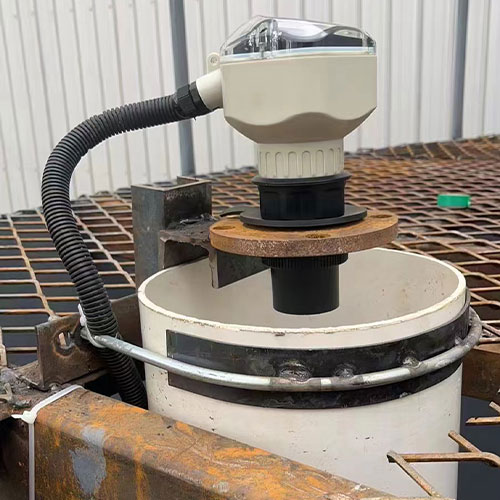
For complex installation environments (many obstacles within the transducer's radiation range, narrow spaces), a conduit is added to avoid measurement errors or signal loss.
Ultrasonic level meter is a microprocessor-controlled digital level instrument specifically designed for continuous level measurement. It features safety, cleanliness, high accuracy, long service life, stable and reliable operation, easy installation and maintenance, and simple reading. It is widely used for level measurement in industries such as chemical, water treatment, water conservancy, food, and pharmaceutical. The transducer of the ultrasonic level meter emits high-frequency ultrasonic pulses. When these pulses encounter the measured liquid surface, the sound waves are reflected back, and a portion of the reflected echoes is received by the transducer and converted into electrical signals. The ultrasonic level meter calculates the liquid height using the time difference between sound wave transmission and reception, as well as the speed of sound propagation. The ultrasonic level meter adopts non-contact measurement technology, enabling stable and reliable continuous level measurement in various storage tanks and basins. However, due to the complexity and diversity of actual working conditions, how should the ultrasonic level meter be installed on site?
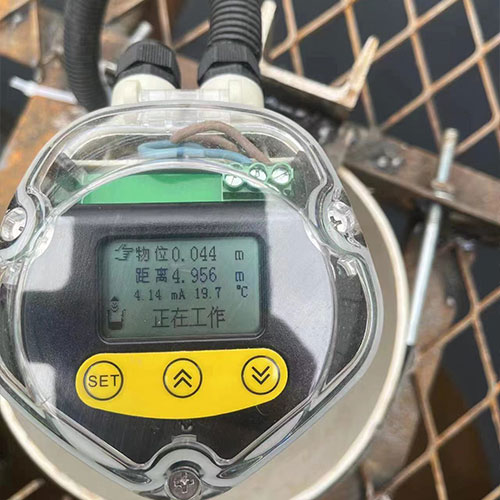
1. The instrument should be installed vertically. When installing the ultrasonic level meter, ensure that the transducer's emitting surface is parallel to the measured plane, so that the sound waves emitted vertically to the surface of the measured object return with maximum energy.
2. During installation, if the site conditions involve steam and water droplets are likely to adhere to the transducer surface, and the transducer's range is much larger than the actual measurement distance, the transducer can be tilted by about 3° to avoid the influence of water droplets.
3. During installation, attention should be paid to the blind zone of the ultrasonic level meter. Ensure that the distance from the highest liquid level to the transducer surface is greater than the blind zone of the transducer.
4. During installation, proper operation should be based on the smoothness of the tank wall and the presence of obstacles. Specifically, if the tank wall is relatively smooth and there is no material buildup when the liquid level drops, the transducer can be installed at a distance of 30 cm from the tank wall. If the tank wall is rough, the transducer should be installed farther away from the wall. Additionally, if the tank bottom is not flat, false measurements may occur during zero-level measurement. If the bottom is conical, the transducer should be installed directly above the apex of the cone. For circular crossbars, as long as the distance is more than 1 m and the diameter does not exceed 5 cm, the impact is minimal; otherwise, they should be avoided as much as possible. If the crossbar is flat and the tank wall has right angles, it should also be avoided.
5. In applications with stirring or wave motion, an extended conduit can be used for installation, allowing the conduit to extend directly to the bottom of the liquid level. As long as the inner wall of the conduit is smooth and the liquid level inside the conduit is consistent with the outside, the diameter of the ultrasonic level meter conduit only needs to be larger than the radiation surface of the transducer. If a large range is not suitable for conduit installation, the range can be reduced; the amount of reduction depends on the wave size.