
In Dayu Electronics Ultrasonic Level Meters, What Is Resolution? What Is Accuracy?
01. In ultrasonic level meters, what is resolution? What is accuracy?
Simply put:
Resolution: Taking distance measurement as an example, the LCD displays 0.983m, meaning it shows to 0.001m, i.e., 1mm.
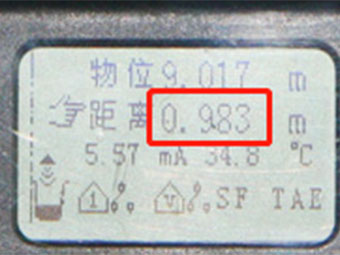
Technically, it is the scale used to describe the measurement value after signal processing by the circuit and software.
For example: a tape measure with the smallest scale of 1 millimeter has a resolution of 1 millimeter.
Accuracy refers to the correctness of measurement.
For ultrasonic level meters:
It is the actual distance from the probe to the measured surface in meters. For example: 9.000 meters;
The measurement reads 9.017 meters.
(9.017-9.000)÷9.000=0.00188, meaning an accuracy of 0.188%.
In actual measurement, you do not use a single point reading for comparison; you should select multiple points across the entire measurement range for comparison.
Taking the test report from the National Institute of Metrology as an example, the "indication error" listed is the measurement accuracy.
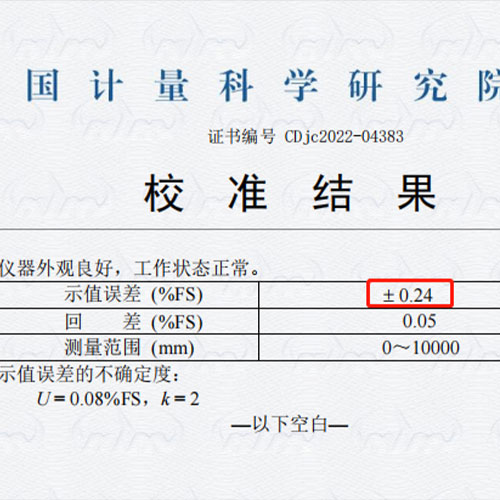
Let's use a tape measure as an example again.
The smallest scale on the tape measure is 1mm, so its resolution is 1mm.
However, the accuracy of the tape measure is not necessarily 1mm; it could be 0.5mm or 0.9mm.
If you stretch the tape measure forcibly, as long as it doesn't break.
The smallest scale shown is still 1mm, so its resolution remains 1mm.
But its accuracy is no longer the original 0.5mm or 0.9mm.
It could be 1.0mm or 1.2mm.
It depends on how much it was stretched.
Dayu Electronics products fall into four main categories: industrial instrumentation, industrial sensors, marine equipment, and ultrasonic transducers. Application scenarios for these products: ultrasonic distance measurement, water level/flow velocity/flow rate/mud level/water depth monitoring, underwater communication/positioning/obstacle avoidance.