
Dayu Electronics Doppler Flow Meter Applied to Municipal Sewage and Stormwater Wells for Water Level and Flow Velocity Measurement
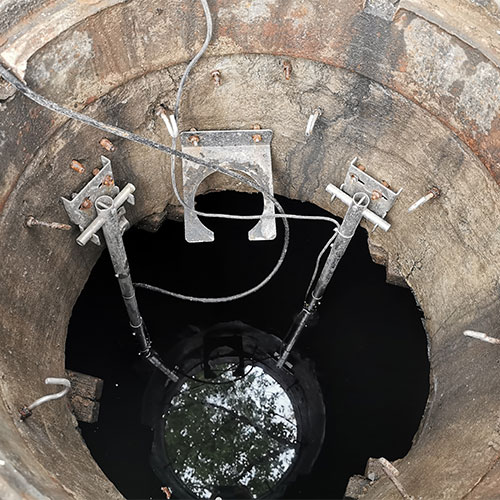
Site conditions: municipal sewage wells and stormwater wells.
On-site measurement content:
1. Water flow velocity and flow rate.
2. Water level height inside the well.
3. Water quality: ammonia nitrogen.
4. Data transmission: 4G
Measurement frequency:
Measured once every 30 minutes, with data uploaded each time.
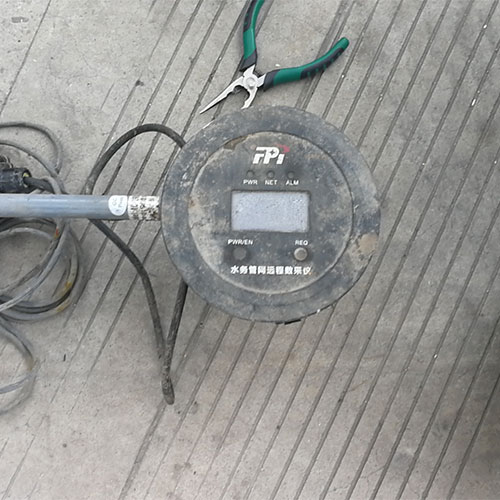
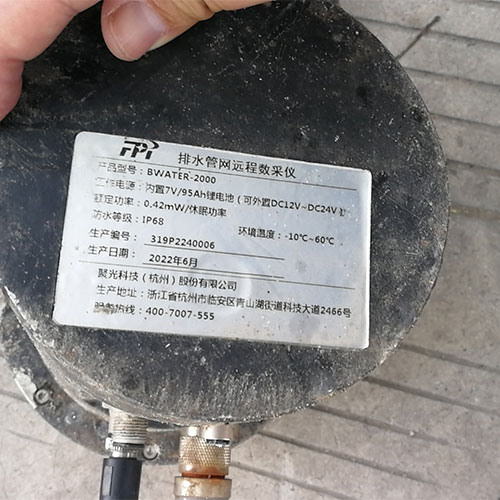
Battery used: 12V 95AH
Battery type: disposable lithium battery
Battery capacity: 12V 95AH
Battery service life: with measurement every 30 minutes and one data upload per measurement, the battery can last for 6 months.
Uses the "Remote Data Acquisition Instrument for Drainage Pipe Networks"
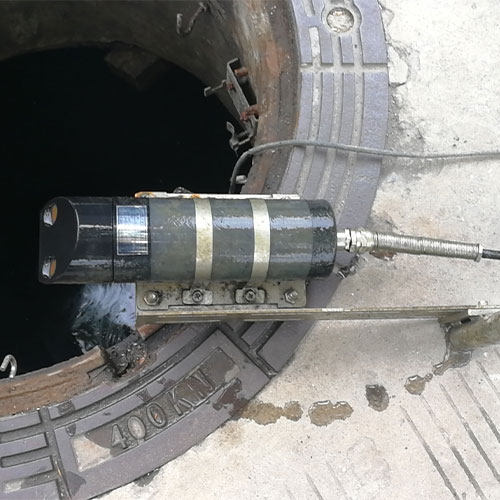
On site, our ultrasonic Doppler flow meter is used to measure,
without a separate host unit.
The Doppler flow meter measures water level and flow velocity,
transmitting the data to the backend to calculate flow rate.
Question: In wells with dirty water and low flow velocity, the pressure port for level measurement is prone to clogging. Can a flow meter plus a non-contact level measurement method, such as ultrasonic or radar, be recommended?
Answer: From a technical standpoint, it is feasible. Maintenance requirements would be reduced.
However, customers often consider price when making a purchase.
Therefore, the pressure transmitter on the ultrasonic Doppler flow meter is used to measure water level.
Question: His water quality analyzer must use the spectroscopic method, which is unlikely to perform well in this environment and demands high maintenance. I wonder if FPI (Focused Photonics Inc.) also has this issue?
Answer: They are aware of it.
Such measurements are qualitative rather than quantitative.
The existing problem is that the ammonia nitrogen sensor requires frequent cleaning.
In such environments, only the national standard method can be used.
Question:
After a period of use, the existing problem is that the ammonia nitrogen sensor requires frequent cleaning.
How often should cleaning be performed? How to know when cleaning is necessary?
Answer:
How to know when it needs cleaning?
You can determine this by observing the data trend over a period of time in the backend.
Discussion:
Let's consider a question:
How can customers know when it is time to clean the "Ultrasonic Doppler Flow Meter"?
Fan: The spectroscopic method is certainly not suitable for this scenario. FPI probably made some modifications to their platform software.
Han: If there is no more flow velocity, cleaning might be needed.
Fan: Combine water quality analysis with the flow meter's own parameters.
When data changes abnormally or no data is received,
Chen: When a customer inquires about a sewer flow meter, what information do we need to confirm with the customer?
What is the minimum water level at the site?
What parameters need to be measured?
How often should measurements be taken?
How often should data be uploaded?
How often does the battery need replacement?
What is the data transmission method?
Are there any other aspects to confirm?
Ding:
1. What is the pipe diameter?
2. What is the minimum water level?
3. Is it a stormwater well or a sewage well? (Does stormwater contain debris? Does sewage contain sludge?)
How often is data uploaded? Is the power supplied by solar or solely by battery? If solar-powered, pay attention to cable lengths; if battery-powered, a technical calculation is required to determine the battery replacement interval—that is, how long the battery lasts after a full charge.
4. For water quality, we currently offer conductivity, turbidity, pH, or other sensors, but all are based on national standard methods and require regular cleaning, especially the glass diaphragms on conductivity and turbidity sensors using the spectroscopic method.
It should be noted that the spectroscopic method used in water quality sensors is a local standard method, not a national standard. National standard methods use colorimetric water quality analyzers!
Liu:
Installation in urban sewers:
1. Is it a sewage pipe or a stormwater pipe?
2. What is the pipe inner diameter?
For instance: minimum DN400, maximum DN800.
3. How often are measurements taken?
4. How often is data uploaded?
5. Is it battery-powered, solar-powered, or externally powered?
If battery-powered, the battery should support a specified number of days before replacement.
6. What is the minimum water level?
7. What accuracy is required?
Ding:
Important note: For water quality sensors—conductivity, turbidity, and COD using the spectroscopic method—if data remains consistently high over a long period, it is necessary to go on site to check whether the glass diaphragm needs cleaning or replacement!
The main product categories of Dayu Electronics are: industrial control instruments, industrial sensors, marine equipment, and ultrasonic transducers. Application scenarios include: ultrasonic distance measurement, water level/flow velocity/flow rate/sludge level/water depth monitoring, underwater communication/positioning/obstacle avoidance.