
Application of Integrated Ultrasonic Level Meter on a Liquid Caustic Soda Tank in a Chemical Plant
Integrated ultrasonic level meters are widely used for level and volume measurement in tanks, pools, and reservoirs, as well as for flow measurement in open channels. In practice, many interfaces cannot be contacted, such as in situations where the measuring equipment may be corroded by acids or alkalis, contaminated in sewers, or affected by substances that cause adhesion (e.g., adhesives). Since the measurement technology of integrated ultrasonic level meters is based on the non-contact ultrasonic principle, they are suitable for measuring liquid and bulk solid levels where physical contact is not possible. Due to the wide variety of field conditions, the performance and models of integrated ultrasonic level meters produced by different manufacturers vary, which makes it difficult for users to select the appropriate product. So, what should be considered when selecting an integrated ultrasonic level meter?
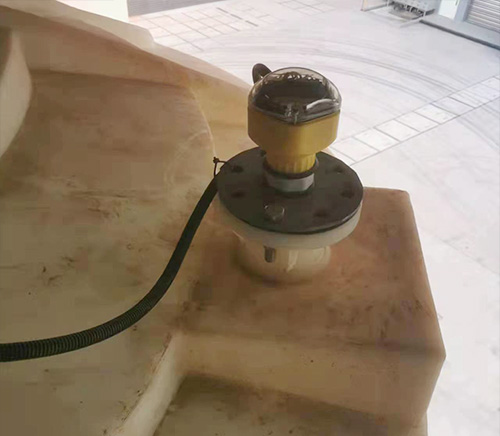
Considerations for Selecting an Integrated Ultrasonic Level Meter
1. Use of ultrasonic level meters on highly volatile liquids.
In chemical storage tanks, many liquids are organic solvents, such as toluene, xylene, alcohol, and acetone. Most organic solvents are highly volatile. Chemical companies often only consider explosion-proof requirements without accounting for the impact of volatility on measurement.
2. Only considering explosion-proof requirements without considering corrosion resistance.
When selecting ultrasonic level meters, chemical companies generally consider explosion-proof requirements, as most liquids are flammable and explosive. Corrosion-resistant materials are typically only considered for liquids like hydrochloric acid, sulfuric acid, and hydrofluoric acid. However, corrosion resistance should also be considered when measuring organic solvents such as toluene, xylene, alcohol, and acetone, as most organic solvents can dissolve common plastic materials. We have seen dissolved probes that look like glue at multiple chemical plant sites.
3. Selecting the measurement range based solely on the actual height.
Basically, all companies select ultrasonic level meters based on the tank height without leaving a margin.
On tanks containing highly volatile liquids such as hydrochloric acid, the liquid evaporates, causing a large number of fine liquid particles to suspend in the air inside the tank. The ultrasonic waves emitted by the level meter are scattered when they encounter these suspended particles. As a result, when the liquid level drops to a lower position, the ultrasonic level meter may fail to receive the echo. In such cases, it is generally necessary to increase the maximum measurement distance by 30-50%.
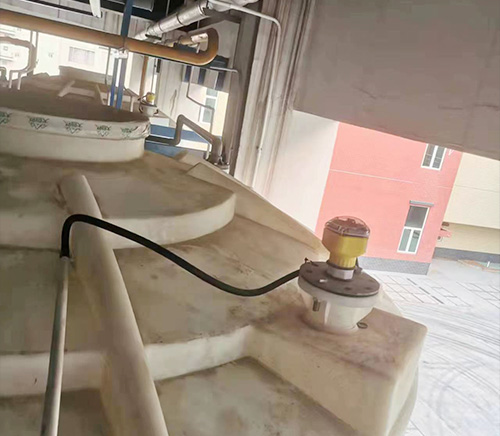
In addition, because the ultrasonic level meter probe is a mechanical vibrating component, its performance degrades over time. After about one and a half years, the originally selected maximum measurement distance may no longer be achievable. Therefore, when selecting an ultrasonic level meter, it is advisable to add a few meters to the actual tank height to allow for performance degradation.