
Dayu Ultrasonic Level Gauge Applied to Urban Manhole Liquid Level Monitoring in Taijiang District, Fuzhou
The liquid level monitoring uses an ultrasonic level gauge, whose working principle is that the transducer (probe) emits high-frequency ultrasonic pulses that are reflected back upon encountering the surface of the measured medium. Part of the reflected echo is received by the same transducer and converted into an electrical signal. The ultrasonic pulse propagates at the speed of sound, and the time interval from transmission to reception of the ultrasonic pulse is proportional to the distance between the transducer and the surface of the measured medium.
The relationship between this distance value S, the sound speed C, and the transmission time T can be expressed by the formula: S = C × T / 2.
In underground pipe networks for rainwater and sewage, due to the thick accumulation of urban sewage sludge, if a submersible level gauge were used, the water level pressure sensor would quickly be buried by the sludge. Since the submersible level gauge is a contact-type measurement, considering later maintenance and equipment lifespan, an ultrasonic level gauge is adopted instead.
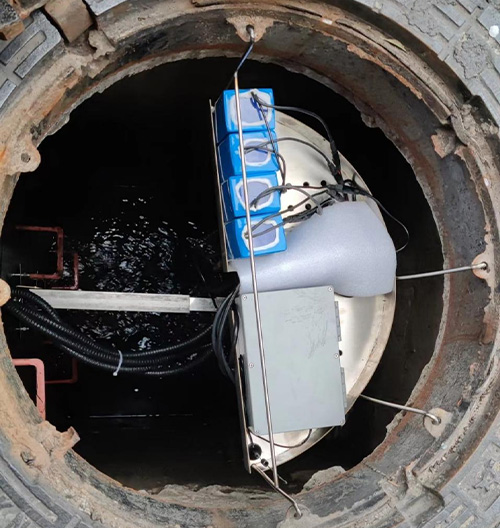
For manhole liquid level monitoring, a wall-mounted ultrasonic level gauge is used. It can be installed on the manhole covers of sewage pipes and combined rainwater-sewage pipes. For reservoir water level monitoring, it is fixed to the pool wall.
According to the working principle of the monitoring equipment, the transducer has a certain emission opening angle when emitting ultrasonic pulses. In the area radiated by the emitted ultrasonic beam between the lower edge of the transducer and the surface of the measured medium, there must be no obstacles. Therefore, during installation, other obstacles such as ladders, limit switches, heating equipment, and brackets should be avoided as much as possible.
When installing the instrument, it is also important to note: the highest liquid level must not enter the measurement blind zone; the instrument must maintain a certain distance from the tank wall; and the installation should make the transducer's emission direction as perpendicular to the liquid surface as possible.