
Dayu Doppler Flow Meter Applied to Underground Pipe Network Flow Monitoring on Fulunan Road, Fuqing City
This system uses an ultrasonic Doppler flow meter, a sensor that measures water flow velocity and flow rate in natural water bodies, channels, or pipes.
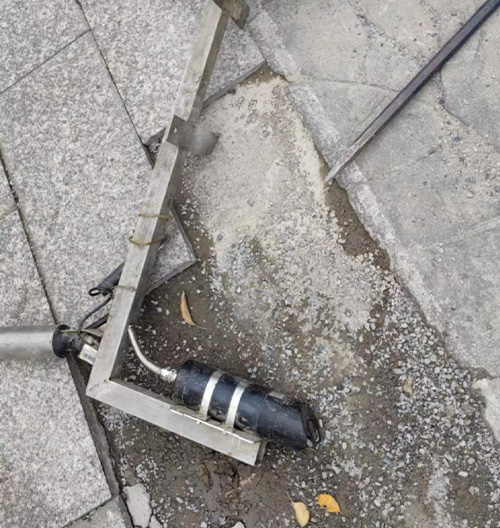
The sensor has two transducers: one for transmitting and one for receiving. When the sensor is oriented directly against the water flow direction, i.e., measuring upstream:
1. When the water is still, the received frequency is the same as the transmitted frequency.
2. The faster the flow velocity, the higher the frequency received by the receiving sensor, which will be higher than the transmitted frequency.
3. The slower the flow velocity, the lower the frequency received by the receiving sensor, but it will still be higher than the transmitted frequency.
When the sensor is oriented in the direction of water flow, i.e., measuring downstream:
1. When the water is still, the received frequency is the same as the transmitted frequency.
2. The faster the flow velocity, the higher the frequency received by the receiving sensor, but it will be lower than the transmitted frequency.
3. The slower the flow velocity, the lower the frequency received by the receiving sensor, but it will still be lower than the transmitted frequency.
From the above, the water flow velocity and flow direction can be calculated through hardware and software.
① For installation inside a pipe, measurement is possible as long as the minimum water level is 20 cm above the sensor and the pipe inner diameter is greater than 500 mm. It does not require a full pipe; partial flow conditions are also measurable. Choose a location with stable flow for installation. The upstream should have a straight channel with a length equal to 20 times the pipe inner diameter, and the downstream should have a straight channel with a length equal to 5 times the pipe inner diameter.
② Choose a location with stable water flow for installation. In areas with unstable flow, measurements will be unstable and errors will be large. Two situations can occur: first, data fluctuates significantly; second, measured data is lower than actual values.
③ Consider sediment and sludge buildup in the pipe. If sludge is present, the sensor should be positioned to avoid it.
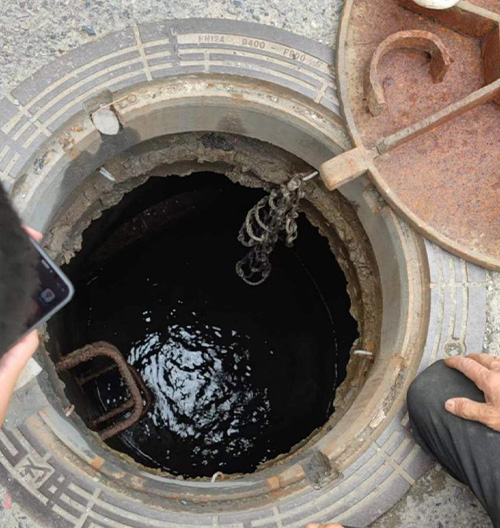
For debris or floating objects coming from upstream, install a grille on the upstream channel to filter them. The grille should be placed at a distance of at least 5 times the pipe inner diameter from the sensor.
For installation inside a pipe, it is not necessary to dewater the pipe; a bracket can be lowered from the top of the pipe for fixing. For pipes generally within 2000 mm, the sensor can be installed centrally, fixed to the bottom of the pipe with a bracket. The bracket should be made in an "L" shape, with the sensor fixed to the bottom of the "L" bracket, extending into the pipe, with the sensor facing the direction of water flow.