
Common Types of Radar Level Meters: Pulse Radar Level Meters and Guided Wave Radar Level Meters
Radar level meters can be categorized into contact and non-contact types. Non-contact types include pulse radar and frequency-modulated continuous wave (FMCW) radar. The probe typically uses a horn antenna, also known as a tubular antenna, which varies in aperture size, beam angle, and horn length. The common types of radar level meters are pulse radar level meters and guided wave radar level meters. The following is an introduction to these two types:
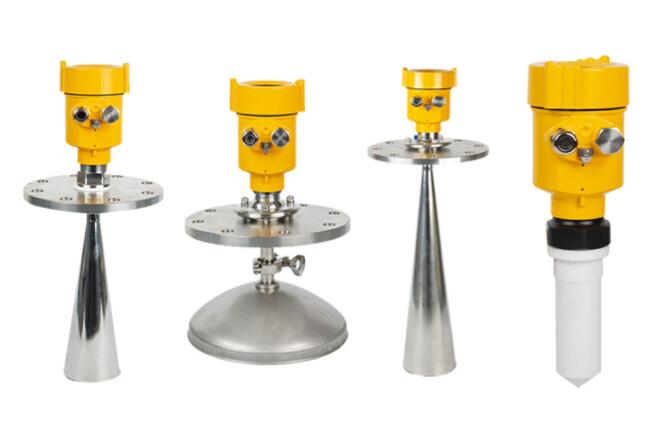
I. Guided Wave Radar Level Meter
The working principle of guided wave radar is very similar to that of conventional radar that transmits electromagnetic waves through space. It is based on the time-domain reflectometry (TDR) principle of electromagnetic waves. This principle is used to locate breaks in buried cables or cables embedded in walls. When testing cable breaks, the TDR generator sends an electromagnetic pulse signal along the cable; when the pulse encounters a break, a reflected pulse is generated.
At the same time, a pre-set impedance change in the receiver, corresponding to the total cable length, also generates a reference pulse. By comparing the reflected pulse with the reference pulse, the exact location of the break can be determined.
Disadvantages: The guided wave radar level meter is a contact-type radar, so it cannot be used in corrosive or flammable/explosive liquid applications.
Advantages:
1. Unaffected by liquid density, the looseness of solid materials, temperature, or dust during loading; 3. Low maintenance, high performance, high accuracy, high reliability, and long service life;
2. Strong suppression of vapor and foam, so measurements are not affected.
II. Pulse Radar Level Meter
Pulse radar uses high-frequency, narrow pulses to modulate a microwave source signal, emitting pulses at a fixed frequency (i.e., carrier frequency) in the form of a beam. After reflection from the medium surface, the pulses are received by the receiver. The time of flight of the pulse determines the distance from the transmitting antenna to the medium surface.
Disadvantages:
1. When there are obstacles such as agitators, pipes, etc. in the tank, these obstacles also reflect electromagnetic wave signals, which can create false level signals;
2. Most economical pulse microwave level meters operate at 5.8 GHz or 6.3 GHz microwave frequencies, which have a relatively large radiation angle (about 30°), easily causing interference echoes from the tank wall or internal structures. Although increasing the horn antenna size can slightly reduce the emission angle, it increases the size and makes it inconvenient to use;
3. When the liquid surface has fluctuations and foam, the situation becomes more complex. The signal scattering deviates from the propagation path or absorbs most of the energy, causing the signal returning to the radar level meter's receiving antenna to be weaker or even absent.
Radar level meters and radar level meters for solids both belong to the category of radar level instruments, which are classified according to the medium being measured. They are both very important continuous level control instruments in the field of process control automation and are widely used.
Advantages:
1. Wide applicability, including oil tank farms, asphalt storage tanks, LPG, petrochemical wastewater tanks, and steel industry blast furnace molten steel, among others;
2. Integrated structure with non-contact horn;
3. Capable of measuring large distances.