
Measurement Methods for Partially Filled Pipe Flowmeters and Installation Requirements
In thepartially filled pipe flowmeter measurement method, the ultrasonic transmitter serves as a fixed sound source, and solid particles moving with the fluid act as an "observer" moving relative to the source. Of course, it merely reflects the incident ultrasonic waves back to the receiver. The frequency difference between the transmitted and received sound waves is the acoustic Doppler shift caused by the motion of solid particles in the fluid. Since this frequency difference is proportional to the fluid velocity, the flow rate can be determined by measuring the frequency difference, and thus the fluid flow rate can be obtained. Therefore, this method is suitable for measuring dirty water and slurries with high impurity content, such as municipal sewage, sludge, etc.
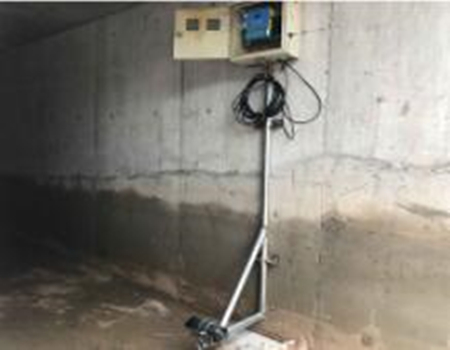
In some field conditions where wired data transmission is not feasible, GPRS can be chosen to transmit data to the backend via a mobile SIM card. In such cases, an optional wireless transmitter (accessory) can be configured to achieve this goal.
Partially filled pipe flowmeters have a wide range of applications, such as the following condition monitoring:
1. Flood disaster monitoring · Sewage discharge · Natural rivers and streams.
2. Estuary and tidal studies · Fisheries/Water conservancy · Coastal erosion research.
3. River flow monitoring.
4. Municipal water supply and drainage · Water loss/infiltration monitoring · Irrigation flow monitoring.
5. Culvert flow monitoring · Road drainage monitoring · Canal flow research.
The installation method for partially filled pipe flowmeters is shown below. During installation, the device must be aligned parallel to the water flow direction and raised to a certain height to prevent silt from affecting the measurement.
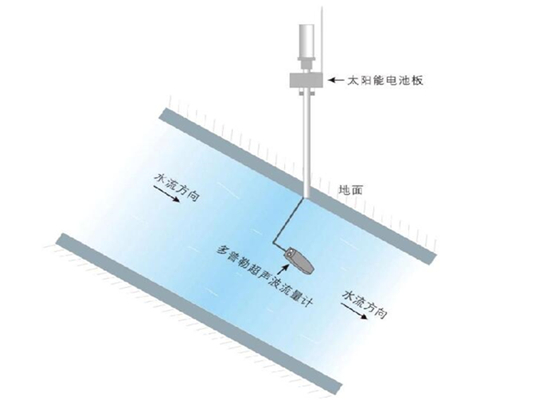
Installation method (pipe)
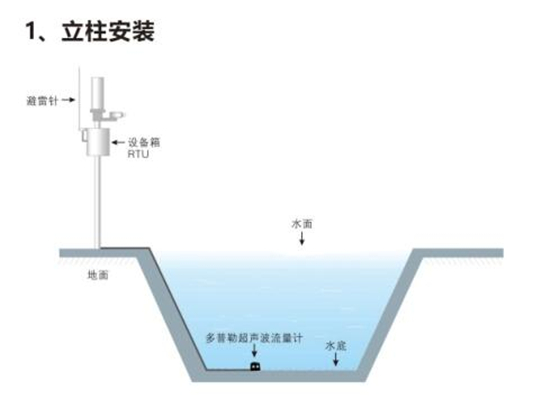
Installation method (open channel)