
Ultrasonic Distance Sensor English Manual
1. Product Introduction
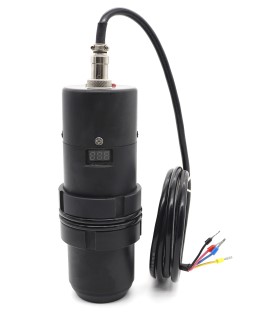
Ultrasonic Distance Sensor uses acoustic media to perform non-contact and wear-free detection of the target object.Ultrasonic Sensors can detect transparent objects or colored objects, metallic or non-metallic objects, as well as solids, liquids, or powders. Environmental conditions such as smoke, dust, or rain hardly affect the detection performance of ultrasonic sensors.
One. Product Introduction
By using acoustic media of the tested non-contact and no wear test, Ultrasonic sensors can detect transparency of the object or colored objects, metallic objects or non-metallic objects, as well as solid, liquid or powder material, can detect. Ambient conditions such as smoke, dust environment or under the condition of rain almost does not affect the detection performance of ultrasonic sensor.
2. Ultrasonic Ranging Principle
The ultrasonic transducer emits ultrasonic pulses, which propagate through the transmission medium to the measured medium, reflect back through the sound transmission medium, and return to the receiving transducer. The time taken for the ultrasonic pulse to travel from transmission to reception in the sound medium is measured. Based on the speed of sound in the medium, the distance from the transducer to the medium surface can be calculated, thereby determining the liquid level. Therefore, we can calculate the distance D from the probe to the reflecting surface: D = C*t/2 (divided by 2 because the sound wave actually travels round trip, where D is distance, C is speed of sound, and t is time).
Two. The Principle of Ultrasonic Ranging
Launch of the ultrasonic transducer emit ultrasonic pulse, spread through transmission medium to be measured medium, after reflection by sound transmission medium again returns to the receiving transducer, ultrasonic pulse is measured from the launch to receive in the transmitted time of sound transmission medium. Then according to the speed of sound, sound transmission medium can calculate the distance from the transducer to the media. To determine the liquid level. So we can calculate the probe to the reflection surface distance D = C * t / 2 (divided by 2 is because the sound waves from transmitting to receiving actual is a back and forth, D is the distance, C is the velocity of sound, t is the time).
Installation Precautions
(1) When installing the ultrasonic sensor, the emitting surface should be perpendicular to the target object;
(2) Do not reverse the power supply and output signal wires.
Ultrasonic Distance Sensor English Manual Download:
Ultrasonic Distance Sensor English Manual V20201111 Neutral.pdf