
Open Channel Flowmeters Have Many Measurement Types; Selecting the Weir/Flume is Key
Dayu Electronicsopen channel flowmeter: how to select the weir/flume? The open channel flowmeter supports flow calculations for three types of open channel weirs/flumes: V-notch triangular weir, rectangular thin-plate weir, and Parshall flume. You can select any data source as the calculation input (menu: calculation data source), and the calculated value can be custom-scaled (when the flow unit = 1000, the flow unit is liters; when = 0.001, it is thousand cubic meters). Conditional accumulation can also be performed based on any data source, e.g., set condition data source = 6, condition low = 50, condition high = 0.5, meaning flow is accumulated when the flow velocity is greater than 0.5 and less than 50.
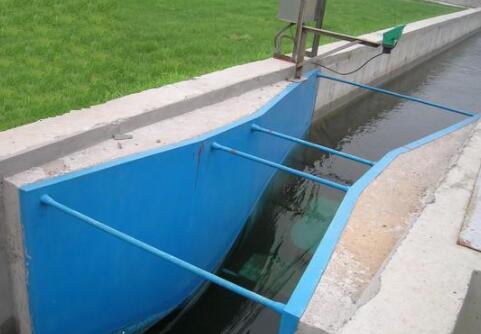
Open channel flowmeters have many measurement types, and there are many weir and flume configurations, such as thin-plate weirs, broad-crested weirs, triangular-profile weirs, flat-profile weirs, long-throat flumes, short-throat flumes, and end-depth methods. Among the short-throat flumes, the Parshall flume is more commonly used, but for accuracy, many factors come into play. Before designing the weir/flume, a detailed understanding and field survey of the natural characteristics and hydrological and hydraulic conditions of the river section should be conducted to assess feasibility and select the appropriate weir/flume type.
Currently, in applications such as sewage treatment plants, wastewater discharge outlets of enterprises and institutions, urban sewer flows, and irrigation channels, intelligent open channel flowmeters are chosen to measure flow; they use non-contact measurement and can be used in sticky, viscous, or corrosive liquid conditions. Compared to contact-type meters, they offer higher reliability and durability. Because of their widespread use, how to select the weir/flume for an intelligent open channel flowmeter has also become a common challenge.
The intelligent open channel flowmeter consists of two parts: a level-measuring instrument and a weir/flume built according to documents published by metrology institutes. Common weirs/flumes include the V-notch triangular weir, rectangular weir, and Parshall flume. Based on the maximum flow rate and specific site conditions, different weirs/flumes can be selected.
① If the maximum flow rate is less than 40 liters/second, a V-notch triangular weir is recommended;
② If greater than 40 liters/second, a Parshall flume is recommended;
③ If the upstream channel is short and the maximum flow rate exceeds 40 liters/second, a rectangular weir is recommended.