Dayu Electronics Dual-Channel Split Insertion Ultrasonic Level Switch: "Listening" to Liquid Levels with Ultrasonics
Anyone who works in the field knows that level monitoring in some storage tanks may seem simple, but it can be quite troublesome in practice.
Take chemical dosing tanks in water treatment: a layer of foam on the surface, and a regular level switch sees "liquid"—but the actual level has already dropped. Alarms don't come when they should, and they go off randomly when they shouldn't.
Take outdoor storage tanks or pipes subject to alternating hot and cold conditions: condensation forms on the sensor, causing an immediate false alarm from the level switch—the system thinks the tank is full, so the pump stops, and production halts.
Foam being mistaken for liquid, and condensation being mistaken for liquid—these are the two main culprits behind false alarms from level switches. Anyone who has dealt with this in the field knows the pain.
1. Why Do Foam and Condensation Fool Regular Level Switches?
False alarms from foam: Regular tuning fork or capacitive level switches rely on contact with the medium to determine the presence of liquid. Once foam covers the fork, they think "liquid is present"—but in reality, the level is far below the switch position.
False alarms from condensation: Condensation on the sensor surface forms a water film. For switches operating on electrode conduction or capacitance change principles, this is equivalent to "the sensor is submerged in liquid"—that's how false alarms occur.
These two situations are not due to poor instrument quality; they occur because the instrument's operating principle itself is not suited to the site conditions.
2. How Does the Dual-Channel Split Insertion Ultrasonic Level Switch Solve These Problems?
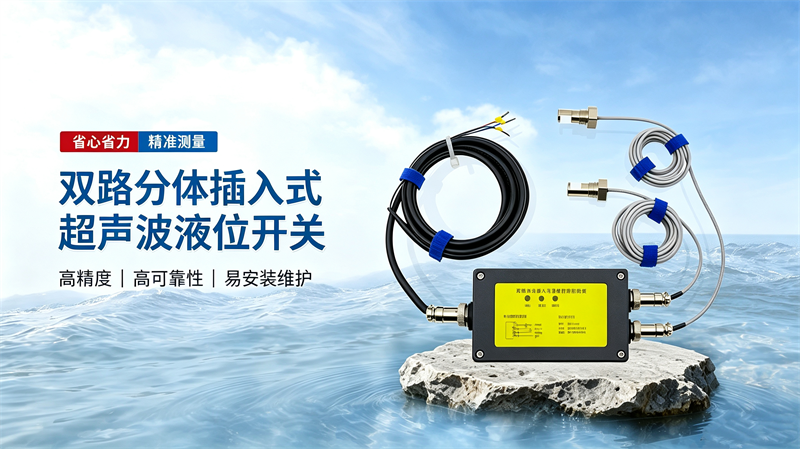
The Dayu Electronics Dual-Channel Split Insertion Ultrasonic Level Switch uses ultrasonic waves to "listen" to liquid levels—relying on ultrasonic sensing. By capturing acoustic echo signals, it determines whether liquid has reached the detection point, which is completely different from the conduction-based detection method of traditional mechanical contact level switches.
? Unaffected by Foam
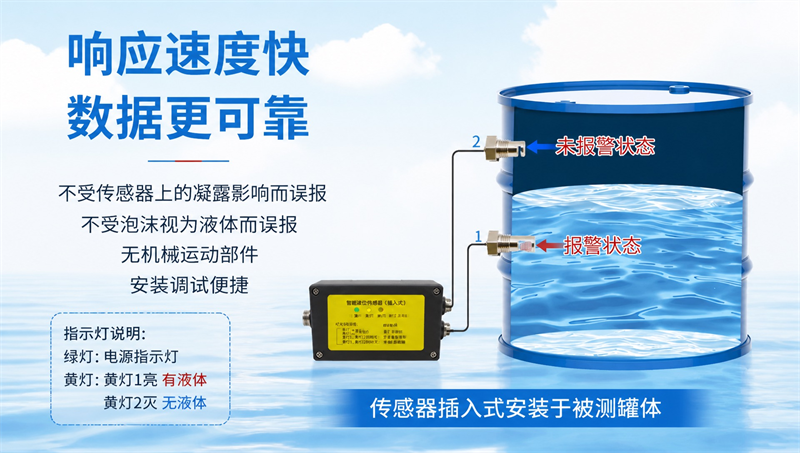
The core advantage of this level switch lies in its resistance to foam interference. It uses the principle of acoustic signal intensity discrimination, producing a strong feedback only for real liquids. Foam severely attenuates ultrasonic propagation, so even if the probe is completely wrapped in foam, the system can clearly distinguish between liquid and air states, fundamentally avoiding false operations caused by foam and ensuring control accuracy and reliability.
? Unaffected by Condensation
A water droplet condenses on the sensor surface? No problem. The ultrasonic waves determine the submersion state of the fork, not whether a water film is present on the surface. Condensation does not change the signal difference between the fork in air and in liquid.
? No Mechanical Moving Parts
No float balls, no tuning fork vibration—no jamming, no wear, no fatigue.
? Dual-Channel Design, One Controller for Two Points
One controller with two independent sensor inputs. One for high level, one for low level—high and low level alarms handled by a single device.
3. Key Parameters and Their Field Value
Parameter | Specification | Field Significance |
Power Supply | DC 24 V ±10% | Standard industrial power, plug-and-play |
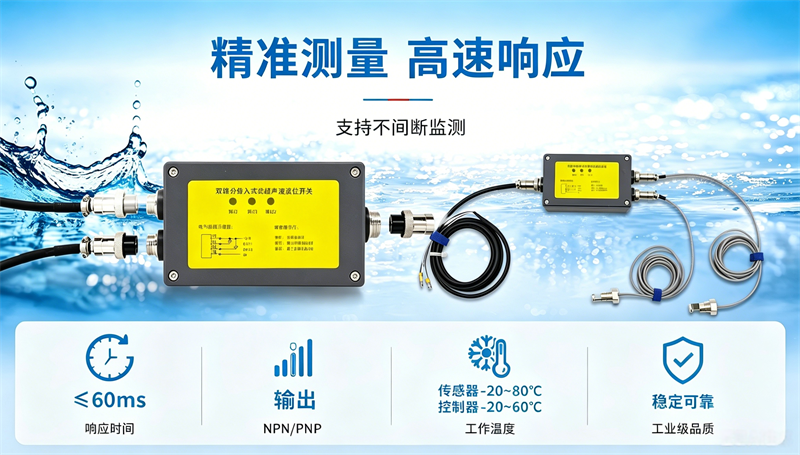
Output | NPN / PNP | Compatible with various PLC input types |
Response Time | ≤60 ms | Millisecond-level response, no lag in control logic |
No-Load Current | 13 mA | Extremely low power consumption, no added system load |
Sensor Operating Temperature | -10℃~+80℃ | Suitable for most industrial media temperatures |
Controller Operating Temperature | -20℃~+60℃ | Normal use in control cabinets |
Working Pressure | ≤2 MPa | Can withstand relatively high pressures |
Sensor Protection Rating | IP68 | Can be permanently submerged in liquid |
Controller Protection Rating | IP65 | Dust-proof and protected against water jets |
Sensor Material | Titanium alloy | Corrosion-resistant, long service life |
Mounting Method | Sensor with threaded fitting (1/4 NPT etc.), controller DIN35 rail mounting | Easy installation, space-saving |
Repeatability | 2 mm | Decisive switching, no repeated toggling |
4. Where Is It Best Suited?
The datasheet lists 7 typical applications:
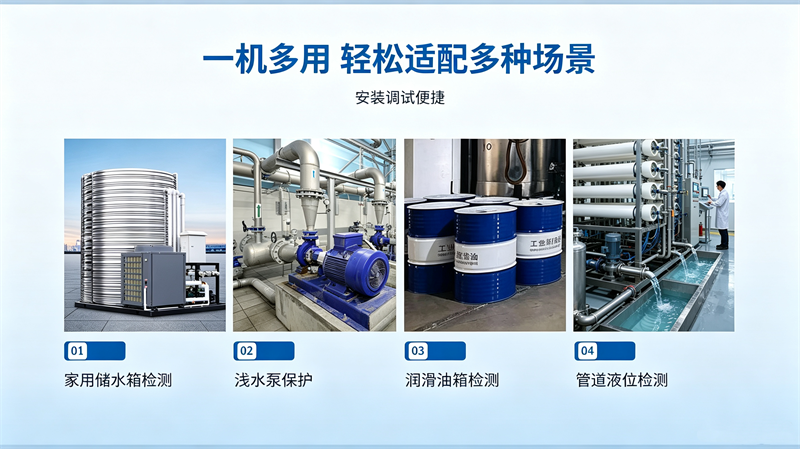
Storage tank level detection: high/low level alarms for various liquid storage tanks
Pump protection: prevents dry running and overheating
Medical and laboratory equipment: level control for precision instruments
Hydraulic oil tanks and lubricating oil tanks: oil level monitoring
NC equipment level detection: coolant level in CNC machines, etc.
Water industry disinfection and dosing equipment: chemical liquid level control
Collection sumps (subways, utility tunnels, tunnels, etc.): groundwater level monitoring and alarm
Especially for sites with "excessive foam" or "condensation-prone" conditions—such as water treatment dosing tanks, outdoor storage tanks, and piping systems with alternating hot and cold temperatures—this product is specifically designed.
5. Selection Recommendations
Confirm media type: | Suitable for water, hydrocarbon-based liquids, and solids that melt when heated (e.g., paraffin wax) |
Confirm media temperature: | Sensor -10℃~+80℃, beyond this range requires customization |
Confirm mounting method: | Standard thread 1/4 NPT, other specifications available upon request |
Confirm controller mounting location: | DIN35 rail mounting, placed inside the control cabinet |
Confirm output type: | NPN/PNP, specify when ordering |
Dual-channel usage suggestion: | Install one at the high level and one at the low level—a single controller handles both alarm points |
6. Summary in One Sentence
Foam can't fool it, condensation can't fool it, and with no moving parts it won't jam—this is the Dayu Electronics Dual-Channel Split Insertion Ultrasonic Level Switch.
If you've been plagued by false alarms from foam or condensation in the field, give it a try.