
Analysis of Causes for Liquid Level Measurement Deviation of Dayu Electronic Ultrasonic Level Gauge in Winter
With the arrival of winter, many users will notice deviations between the liquid level readings of ultrasonic level gauges and the actual levels. This is not an instrument malfunction but a common phenomenon caused by environmental factors, mainly attributed to the following two reasons.
1. Sound velocity is affected by temperature, lacking compensation mechanism
The ultrasonic level gauge calculates distance based on the propagation speed and time of sound waves in air by transmitting pulses and receiving echoes. However, sound velocity is not a fixed value; it varies with temperature—for every 1°C decrease in air temperature, the sound velocity decreases by approximately 0.6 m/s. If the instrument does not have an integrated temperature sensor, it cannot correct the real-time sound velocity and still uses the standard sound velocity at room temperature (e.g., 340 m/s) for calculation, inevitably resulting in systematic errors in the measured distance under low-temperature conditions. In winter, outdoor temperatures often drop below freezing, and this deviation is significantly amplified, causing the displayed level to be either higher or lower than the actual level.
2. Condensation or icing on the probe surface interferes with signal transmission and reception
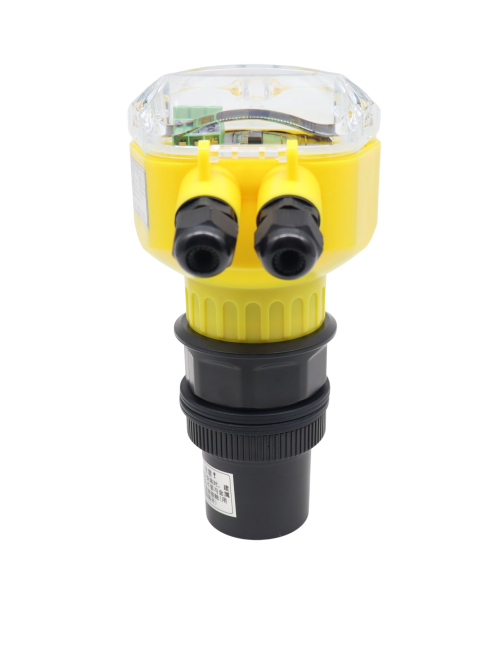
In winter, the large temperature difference between day and night causes moisture in the air to condense into dew droplets or even form thin ice on the probe surface. These droplets or ice layers adhere to the transmitting and receiving surfaces of the transducer. On one hand, they scatter or absorb part of the ultrasonic energy, significantly attenuating the echo strength and preventing the instrument from stably capturing valid signals. On the other hand, the droplets may create multipath reflections, producing false echoes that the processor misinterprets as real liquid surface reflections, thus outputting incorrect values.
Solution approaches
To address the above issues, the key is to pay attention to two points during selection or use:
First, prioritize ultrasonic level gauges with built-in temperature compensation, which can automatically adjust sound velocity parameters based on ambient temperature, eliminating temperature drift from the source.
Second, take anti-condensation measures on the probe, such as installing a sunshade, insulation cover, or heat tracing device, to prevent the probe surface from directly contacting cold and humid air. Dayu Electronic's related products have fully considered these actual working conditions during design, minimizing winter measurement deviations through optimized hardware and algorithms, ensuring the authenticity and reliability of the data.
In summary, when abnormal level readings are found in winter, do not rush to blame product quality. First, check for temperature and condensation factors, and the root cause can often be identified.