
Dayu Electronic Ultrasonic Open Channel Flowmeter Application Case: Flow Monitoring Retrofit of Outfall Pipeline in Xinjiang
I. Project Overview
1. Monitoring Requirements: The customer needed uninterrupted 24/7 flow data collection from the outfall pipeline, with remote wireless transmission of flow data for water resource accounting, discharge control, and environmental compliance record-keeping. The equipment had to be stable and reliable, suitable for the arid outdoor environment of Northwest China, and capable of long-term unattended operation.
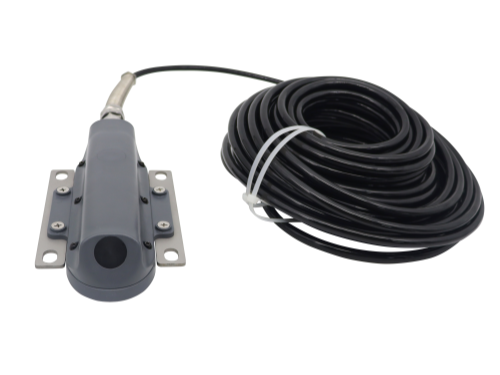
2. Initial Selection: Dayu Electronic Ultrasonic Doppler Pipe Flowmeter
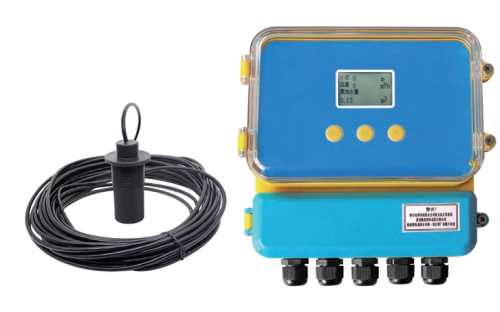
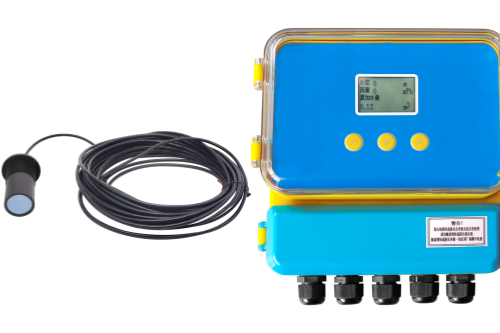
3. Final Implemented Solution: Dayu Electronic Wireless Non-Contact Ultrasonic Open Channel Flowmeter (with standardized flow-measuring weir/flume retrofit) as shown:
II. On-Site Conditions and Initial Equipment Fault Issues
The discharge water at the site was clear, with extremely low levels of suspended sediment and fine particulate matter, lacking sufficient ultrasonic reflection media. After the initial installation of the ultrasonic Doppler flowmeter, the equipment continuously experienced faults such as weak signals, zero flow readings, and flow rate resetting to zero, making it impossible to collect valid monitoring data. The root causes were as follows:
1. Principle Compatibility Shortcomings: The Doppler flowmeter relies on suspended particles and bubbles in the water to reflect ultrasonic waves and calculates flow velocity through frequency shift differences. Clear water lacks acoustic scattering carriers, so the ultrasonic waves have almost no effective echo, preventing the probe from recognizing water flow velocity, which directly caused monitoring failure.
2. Data Control Infeasible: Without stable real-time flow data, the customer could not complete daily total discharge statistics, and water resource metering, pollution discharge supervision, and water usage assessment were stalled. A flow measurement solution suitable for clear water conditions was urgently needed.
III. Optimized Solution: Wireless Non-Contact Open Channel Flowmeter
Considering the clear water characteristics and the need for outdoor wireless transmission, we redeveloped a non-contact flow measurement retrofit solution. The core product is the wireless ultrasonic open channel flowmeter, paired with a simple Parshall flume to convert the end of the outfall pipeline into an open channel, completely solving the signal failure problem of the Doppler device.
1. Working Principle of the Equipment
A standardized flow-measuring weir/flume is constructed at the end of the outfall pipeline. Water flowing through the flume creates a stable water level-to-flow relationship. The ultrasonic probe is installed above the water surface, non-contact, to measure the water level in real time. Built-in algorithms automatically convert it to instantaneous and cumulative flow rates. The device is equipped with a 4G wireless transmission module that automatically uploads data to a remote monitoring platform.
2. Core Advantages of the Solution (Tailored to Clear Water Conditions)
· Not Limited by Water Clarity: Only measures the water surface level, does not depend on suspended impurities in the water. Stable measurement is possible in clear water, purified water, and low-impurity water bodies, fundamentally avoiding the no-signal issue of Doppler flowmeters.
· Fully Non-Contact Measurement, Minimal Maintenance: The probe is installed suspended above the water, with no contact with the water body, unaffected by scale, sediment, or aquatic organism attachment. It operates reliably over the long term in Xinjiang's sandy, windy, and temperature-fluctuating environment, significantly reducing on-site inspection workload.
· Wireless Remote Data Upload: Built-in low-power wireless communication terminal, supports solar power supply adapted to Xinjiang's field conditions without grid electricity. Automatically reports instantaneous flow, cumulative discharge, and device online status 24 hours a day.
· Low Retrofit Cost and Easy Installation: The small weir/flume at the end of the pipeline requires minimal civil engineering, with no need to cut or modify the original main discharge pipeline. On-site replacement and commissioning can be completed in a short time to quickly restore flow monitoring.
Actual On-Site Installation
IV. Application Results After Retrofit
After the solution replacement, the equipment has been running continuously and stably, completely resolving the zero-flow-reading fault under clear water conditions. The project has achieved all monitoring expectations:
1. Continuous Valid Monitoring Data: Regardless of water clarity, it stably outputs instantaneous flow and daily cumulative discharge without data gaps, zero readings, or signal loss.
2. Convenient Remote Control: Management personnel can view discharge data in real time via computer, meeting water resource verification and environmental supervision requirements.
3. Reduced Overall Maintenance Costs: The non-contact probe has no underwater immersion loss, requiring only 1-2 simple visual inspections per year. Compared with the original Doppler device, later maintenance labor and material costs are reduced by more than 70%.
4. Verified Solution Versatility: This project confirms that for clear purified water and low-suspended-solid discharge scenarios, the open channel weir/flume combined with non-contact ultrasonic flow measurement is the preferred choice. Doppler pipe flowmeters are more suitable for sewage and high-sediment turbid water bodies.
V. Project Summary
This Xinjiang discharge flow monitoring project clearly demonstrates the application boundaries of different flow measurement devices: the ultrasonic Doppler flowmeter relies on suspended media in the water and is only suitable for high-impurity sewage and sediment-laden pipelines. For clear water and purified water discharge monitoring scenarios, the wireless non-contact open channel flowmeter has an irreplaceable adaptability advantage.