
Dayu Electronics Bridge Scour Monitoring Sensor Application Case at Yaohe, Gansu
I. Project Background
Located in Pingliang City, Yaohe in Gansu is a tributary of the Jinghe River. The basin experiences significant seasonal precipitation variations, with flood season (July–September) rainfall accounting for over 60% of the annual total. During flood periods, flow velocities can reach 3.5 m/s, and the water carries large amounts of sediment and gravel, posing a serious scour risk to bridge foundations along the river.
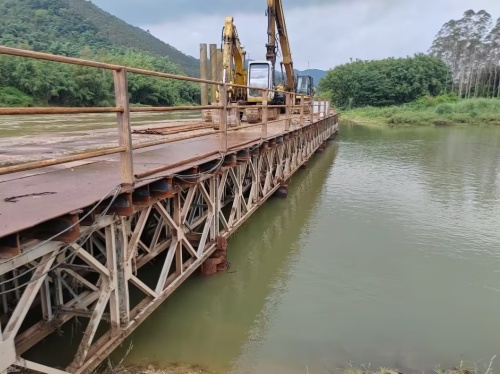
Previously, bridge maintenance units relied primarily on a traditional monitoring model of “quarterly manual underwater inspection + flood-season surface echo sounding,” which presented three core challenges: First, during flood season, the turbulent, high-sediment flow made underwater operations extremely hazardous, preventing real-time monitoring; second, manual measurements produced highly scattered data, making it difficult to capture the dynamic evolution of scour holes, and two traffic control incidents occurred due to delayed warning alerts; third, monitoring costs were high, with annual underwater inspection and patrol costs exceeding 180,000 RMB per bridge, and no continuous scour data records could be established.
II. Equipment Selection and Deployment Plan
(I) Equipment Selection
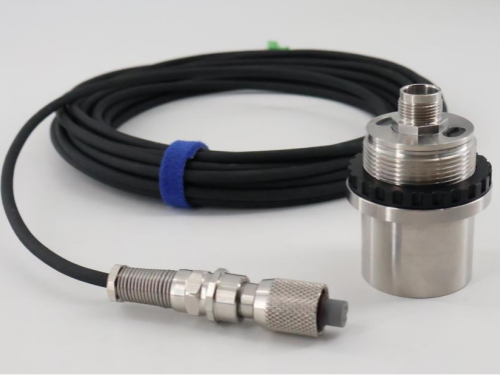
Based on the hydrological characteristics of Yaohe, the project team compared sonar, radar, and fiber Bragg grating technologies, and ultimately selected the Dayu Electronics SNW-CS series Integrated Ultrasonic Scour Sensor. The key advantages in adaptability are as follows:
Strong adaptability to complex operating conditions: Utilizing ultrasonic pulse ranging technology, the sensor operates reliably in high-turbidity water with sediment concentrations ≤30 kg/m³ and flow velocities ≤3 m/s, fully matching the high-sediment, high-velocity environment of Yaohe during flood season. It also supports simultaneous monitoring of four parameters—scour depth, riverbed elevation, water level, and flow velocity—enabling integrated analysis of hydrological changes and scour processes.
Measurement accuracy meets specification requirements: Scour depth measurement range is 0–15 m with a measurement error of ≤±5 cm. The sampling frequency is adjustable from 1 minute to 1 hour as needed, enabling precise identification of localized scour and general scour dynamic processes, resolving the industry challenge of unmonitorable conditions during flood season.
High long-term operational reliability: The device has an IP68 protection rating, no moving parts in the underwater section, and is mounted with a flow-resistant mounting bracket. Design service life is ≥10 years. It supports RS485/Modbus-RTU protocols and can be directly integrated into existing bridge health monitoring platforms, with features such as breakpoint data resumption and remote calibration, enabling maintenance-free underwater operation.
(II) Point Layout and Installation
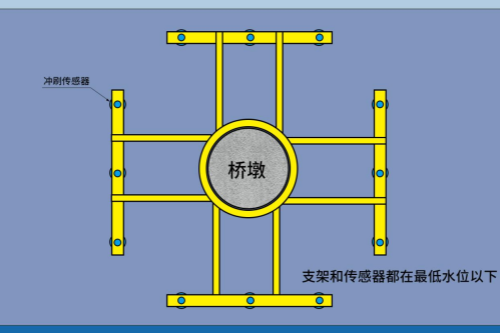
Based on Yaohe hydrological survey data, the project team selected 4 main channel piers with the highest scour risk as monitoring targets. The deployment plan is as follows:
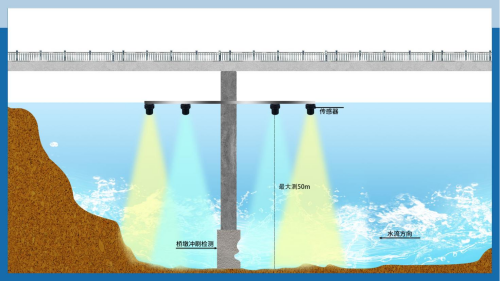
One sensor is installed on both the upstream face and the side face of each pier, for a total of 12 monitoring devices. The beams are oriented vertically toward the riverbed, avoiding vortex zones around the piers and pile cap obstructions, ensuring full coverage of the scour hole development process.
Underwater cables are protected with Kevlar abrasion-resistant sheaths, secured to the pier side walls with stainless steel clamps, and double waterproof sealing is applied at underwater connectors to withstand impact from floating debris and gravel during flood season.
Data acquisition terminals are installed at the top of each pier, powered by a solar + lithium battery system (with ≥30 days of battery backup), enabling uninterrupted operation without external power. Monitoring data is uploaded in real time to the Gansu Provincial Bridge Health Monitoring Platform via 4G network.
(III) System Architecture
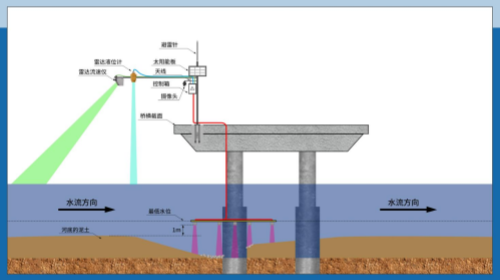
The system adopts a four-tier architecture: “Perception Layer – Transmission Layer – Platform Layer – Application Layer.”
Perception Layer: 12 ultrasonic scour sensors collect scour depth data in real time.
Transmission Layer: Data is uploaded via RS485 bus to the pier-top acquisition terminal, then transmitted to the cloud platform through the 4G network.
Platform Layer: A dedicated bridge scour monitoring module is deployed, providing data storage, trend analysis, and threshold-based alert functions.
Application Layer: Real-time monitoring, alert push notifications, scour/siltation analysis, and maintenance decision support services are provided to maintenance units.
III. Application Results
Since its commissioning in 2025, the system has operated stably for 7 months, successfully withstanding three flood peaks during the 2026 flood season. Key results are as follows:
Reliable and stable monitoring data: The overall equipment online rate reached 98.7%. No data drift or packet loss occurred under high-sediment flood conditions. Complete “scour–refill” curves were accurately captured for all three flood events, with deviations of ≤1.8% from manual re-measurement results, fully meeting bridge safety monitoring requirements.
Significantly improved alert response efficiency: The system implements three-level scour threshold alerts (Level 1: scour depth reaches 70% of design value; Level 2: reaches 90%; Level 3: exceeds design value), improving emergency response efficiency by 62% compared to traditional methods.
Substantial reduction in maintenance costs: Online monitoring replaces traditional high-risk operations such as manual underwater inspection and vessel-based echo sounding, reducing annual underwater inspection workload by more than 85% and greatly reducing personnel safety risks.
Support for scientific maintenance decisions: The system has established “one-pier-one-file” dynamic scour records for all 4 piers. Based on analysis of 6 months of scour/siltation data, the maintenance unit optimized the riprap protection scope for 3 piers, reducing protection works volume by 23% compared to conventional experience-based plans and saving approximately 400,000 RMB in reinforcement costs, providing data support for full life-cycle bridge management.
IV. Project Summary
This project represents a typical successful application of Dayu Electronics bridge scour monitoring sensors in seasonal river scenarios in Northwest China, validating the suitability of ultrasonic scour monitoring technology in high-sediment, high-velocity, seasonal flood regions. First, it resolves the industry challenge of being unable to conduct scour monitoring during flood season on northwest rivers, achieving transparent and continuous sensing of hidden underwater risks. Second, it establishes a replicable standardized solution covering “equipment selection – point layout – platform integration – maintenance management,” providing a reference for scour monitoring on similar bridges in the Yellow River basin and inland river areas of Northwest China.