
Dayu Electronics Open Channel Flowmeter Application Case at Jiaozuo Wastewater Treatment Plant Inlet and Outlet
I. Project Background
Jiaozuo Wastewater Treatment Plant has a designed treatment capacity of 120,000 m³/d, primarily serving urban domestic sewage and industrial wastewater from three industrial parks. The effluent complies with Grade A standard of the "Discharge Standard of Pollutants for Municipal Wastewater Treatment Plants." Before the plant's upgrade in 2025, two major pain points existed in flow monitoring at the inlet and outlet:
Inlet: The original in-line electromagnetic flowmeter had a maximum measurement error of 18% due to long-term non-full-pipe flow and large amounts of floating debris, failing to provide accurate data for process adjustment.
Outlet: The original open channel lacked standardized flow measurement facilities, making manual flow measurement inefficient and data delayed, unable to meet the real-time flow upload requirements of environmental authorities.
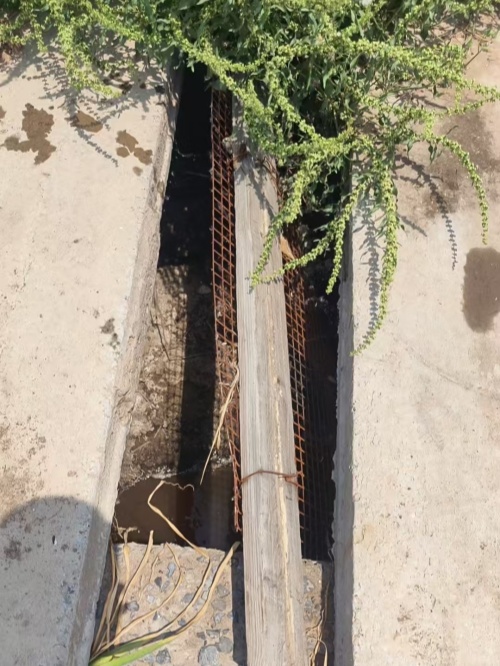
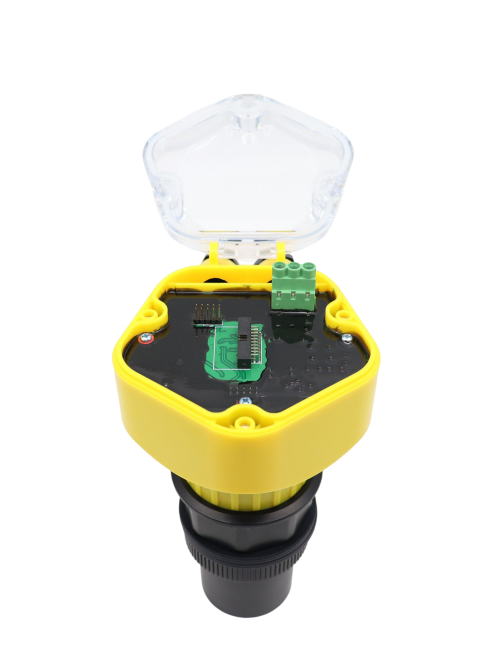
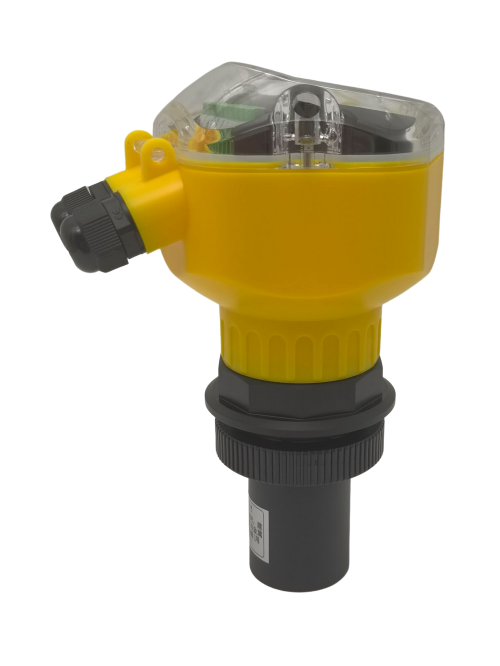
To address these issues, the plant completed the renovation of the open channel flowmeters at the inlet and outlet in 2025, selecting the Dayu series ultrasonic open channel flowmeter (with standardized Parshall flume), fully adapted to the gravity flow and complex water quality conditions of wastewater treatment plants.
II. Instrument Principle
The open channel flowmeter applied in this project adopts an architecture of "standardized weir/flume + non-contact water level measurement + intelligent totalization":
1. A Parshall flume is installed in the inlet and outlet open channels, creating a stable water level-flow relationship as water passes through the flume;
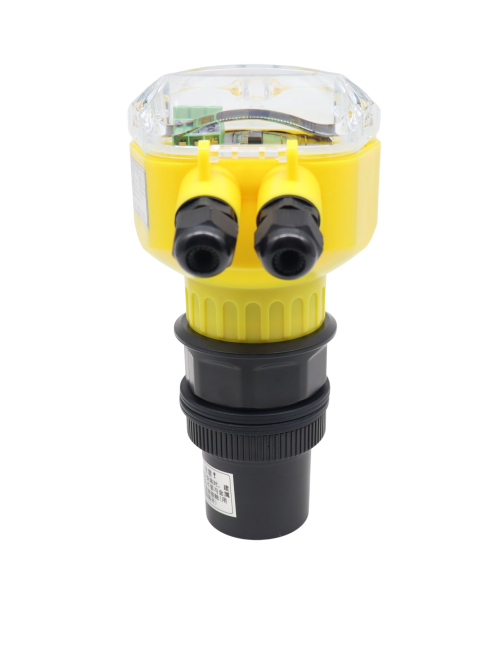
2. The ultrasonic flowmeter probe is mounted vertically at a position 1.5 times the throat width upstream of the Parshall flume, measuring the liquid level non-contact;
3. The flow totalizer calculates the flow rate once per second based on the built-in empirical formula for Parshall flumes, automatically accumulating to obtain the total flow.
III. Installation and Commissioning Process
3.1 Inlet Renovation (Using Existing Weir)
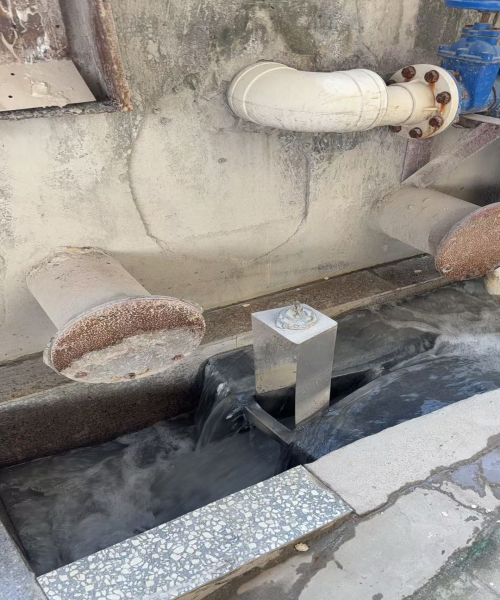
The existing distribution weir at the inlet of the high-efficiency sedimentation tank was a rectangular thin-plate weir of equal width (weir length 8m, weir height 1.1m, upstream straight channel length 1.3m), meeting the requirements of the "Verification Regulation of Open Channel Weir and Flume Flowmeters," so no additional weir or flume required construction. A bracket was installed directly 1m upstream of the weir to fix the ultrasonic probe. The flow coefficient was calibrated by the standard volumetric method during commissioning.
3.2 Outlet Renovation (New Parshall Flume)
The existing outlet channel had a rectangular cross-section (width 1.2m, depth 1.5m). A Parshall flume with a 400mm throat was embedded to standard dimensions, ensuring the centerline of the flume coincided with the channel centerline, with upstream and downstream straight channel lengths meeting the requirement of ≥5 times the channel width. During commissioning, protocol integration was completed, allowing data to be uploaded directly to the municipal environmental protection bureau's monitoring platform. The entire installation required no dewatering or production stoppage, with equipment deployment completed in just 3 days and passing acceptance after a 7-day trial run.
IV. Application Effect Analysis
1. Environmental Compliance Achieved: Outlet flow data is automatically uploaded every 15 minutes, fully meeting the online monitoring requirements of environmental authorities. During the Q4 2025 environmental inspection, the flow monitoring items showed zero anomalies, and the plant successfully passed the annual review of the national pollutant discharge permit.
2. Reduced Operation and Maintenance Costs: The device uses non-contact measurement, with no clogging or corrosion issues. Only quarterly cleaning of the ultrasonic probe surface to remove condensation is required. Annual maintenance costs are 65% lower than the original pipe flowmeter, eliminating the need for periodic sensor disassembly/cleaning or electrode replacement.
V. Case Summary
This project solved the common pain points of flow monitoring at the inlet and outlet of wastewater treatment plants through targeted selection and scenario-based installation of open channel flowmeters, combining data accuracy, ease of maintenance, and environmental compliance. For wastewater treatment scenarios where the inlet is not full-pipe and the outlet requires interfacing with environmental monitoring platforms, the ultrasonic open channel flowmeter offers the most cost-effective monitoring solution and can be widely promoted in similar wastewater treatment plants.