
Dayu Electronics: Principles and Essential Differences Between Acoustic Bandwidth and Impedance Bandwidth of Piezoelectric Transducers
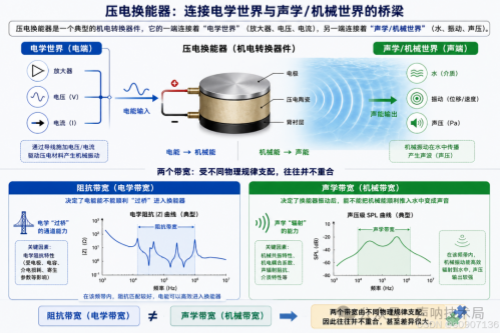
Piezoelectric transducers are the core components of ultrasonic equipment. They are somewhat like a "bridge": one end of the bridge connects to the electrical world—amplifiers, voltage, current; the other end connects to the acoustic/mechanical world—water, vibration, sound pressure. For the entire system to work well and stably, both ends of this bridge must be unobstructed.
How do we determine whether both ends are unobstructed? This involves two concepts: electrical bandwidth and acoustic bandwidth. To fully understand its performance, it is necessary to distinguish between impedance bandwidth (electrical bandwidth) and acoustic bandwidth (mechanical bandwidth), as both together determine the transducer's final working performance.
I. Impedance Bandwidth: The "Passport" for Electrical Energy
Impedance bandwidth, also known as electrical bandwidth, determines whether electrical energy can smoothly "cross the bridge" from the circuit into the transducer.
If the circuit's driving frequency is severely mismatched with the transducer's impedance (like a broken bridge), a large portion of the electrical energy will be reflected back, causing the transducer to heat up without vibrating. A wide and flat impedance bandwidth means that the transducer can maintain good conjugate matching with the circuit over a wide frequency range, ensuring that electrical energy is efficiently converted into mechanical energy—this is the prerequisite for the transducer to work properly.
II. Acoustic Bandwidth: The "Transmitting Antenna" for Mechanical Energy
Once the transducer is excited into vibration, whether the mechanical energy can be efficiently pushed into the medium (such as water) and converted into sound waves depends on the acoustic bandwidth.
Acoustic bandwidth refers to the frequency range over which the transducer can physically and effectively radiate sound waves. In the industry, it is typically defined as the frequency range corresponding to a 3 dB drop (i.e., half power) from the peak of the Transmitting Voltage Response (TVR) or Source Level (SL).
In simple terms, if your operating frequency exceeds the acoustic bandwidth, even if the transducer vibrates vigorously, most of the energy will be "trapped" inside and cannot be radiated out—like a person shouting in a vacuum, with sound but no audible output.

III. The Core Controller: Mechanical Quality Factor (Qm)
The width of the acoustic bandwidth is mainly determined by the transducer's mechanical quality factor (Qm).
? High Qm (narrow bandwidth): The transducer has a sharp resonance with concentrated energy. It is suitable for single-frequency pulse detection (such as traditional sonar), offering high energy density but poor frequency adaptability.
? Low Qm (wide bandwidth): The transducer has high damping and fast response. It is suitable for broadband communication or nonlinear signal processing, capable of accommodating complex coded signals and adapting to varying underwater acoustic channels.
Why are both bandwidths important?
Imagine this: The electrical bandwidth determines whether electrical energy can smoothly "cross the bridge" into the transducer; the acoustic bandwidth determines whether the transducer, after vibrating, can efficiently push mechanical energy into the water and convert it into sound. If the electrical bandwidth is wide but the acoustic bandwidth is narrow, then electrical energy enters, vibration occurs, but the sound wave simply cannot be emitted—wasted effort. The same applies in reverse.
Therefore, designing a good piezoelectric transducer essentially involves simultaneously optimizing these two bridges, ensuring that the electrical and acoustic aspects "shake hands successfully." In transducer design, Dayu Electronics always considers the matching at both ends, ensuring that the products you receive are both energy-efficient and loud.