
Dayu Electronics: Blind Zone and Range Configuration Strategy for Ultrasonic Water Level Meters in Deep Well Pipes
In industrial water level measurement, measuring in narrow pipe diameters has always been a pain point for engineers. Recently, the Dayu Electronics technical team received a customer request: to achieve accurate water level monitoring in a PVC pipe with a diameter of only 150mm and a height of 10 meters. The customer initially believed that an ultrasonic probe with an extremely small emission angle had to be selected to avoid signal blockage. However, after in-depth analysis and on-site verification, we concluded: as long as the inner wall of the pipe is smooth, there is no need to worry about the emission angle.

Ultrasonic level meter works by transmitting sound waves and receiving echoes to calculate distance. In open water, to avoid the beam hitting the pool wall, it is indeed necessary to control the emission angle (beam angle). But in a vertical pipe with a diameter of 150mm, the physical environment undergoes a remarkable change.
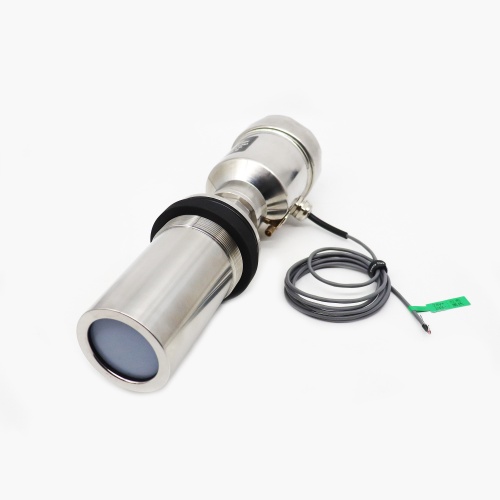
Because the inner wall of the pipe is smooth and continuous, the ultrasonic wave will encounter reflections from the pipe wall as it propagates downward. When the pipe diameter is relatively small compared to the range, the sound wave will form a "focusing effect" inside the pipe—even if the initial emission angle is slightly larger, the sound wave will be confined within the pipe and propagate axially, like in an acoustic waveguide, without easily "escaping" to the blind zone outside the pipe wall. Therefore, Dayu Electronics' standard ultrasonic probes are fully applicable, and there is no need to customize special narrow-angle probes.
But there is one absolute prerequisite: the inner wall of the pipe must be smooth
This solution is not applicable to all pipes. The key conditions that allow Dayu Electronics to be confident: the inner wall of the pipe must be smooth and even from top to bottom, with no large welds, flange protrusions, severe scaling, or irregular diameter changes. Once the inner wall is rough or has obstacles, the sound wave will undergo irregular scattering, the focusing effect will be destroyed, and the measurement will become unstable or even fail. Therefore, please be sure to confirm the condition of the inner wall of the pipe before installation.
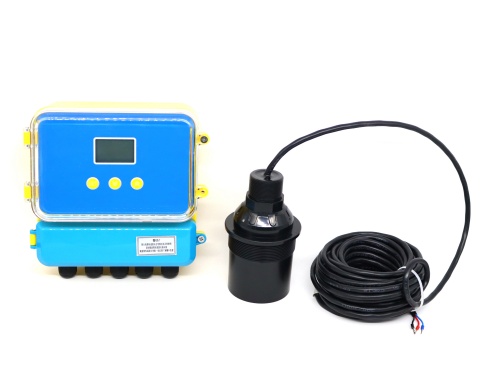
Why is it still necessary to "set the zero point to 10 meters"?
Since the sensor hardware with a 5-meter range is sufficient, the software settings of the instrument need to keep up. The total height of the pipe is 10 meters, and the sensor is usually installed at the top of the pipe. The measured "distance value" is the length from the sensor to the water surface, but what the user needs is the "water level value"—usually defined as the height of the water surface measured from the bottom of the pipe.
This requires the reference zero point (i.e., the empty height reference) of the instrument to be flexibly settable. The ultrasonic water level meter recommended by Dayu Electronics allows the user to set the highest reference zero point to 10 meters. The principle is simple: the instrument measures the distance L in real time, and the user sets the total pipe height H=10 meters, then the water level = H - L. In this way, even if the physical range of the sensor is only 5 meters, as long as the echo can measure distances in the range of 0-5 meters, the system can correctly convert to a complete water level range of 0-10 meters.
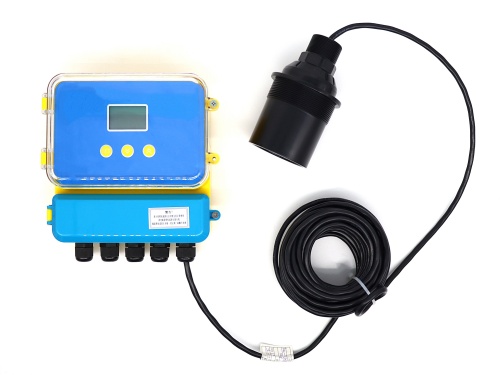
Based on the above principles, Dayu Electronics recommends a mature integrated measurement solution for you. Our split-type or integrated ultrasonic water level meters have flexible parameter configuration functions, support user-defined maximum reference zero point, and are perfectly suitable for 10-meter-deep pipe working conditions. At the same time, our products have a large number of successful application cases in various 150mm PVC and metal pipes.
Choosing Dayu Electronics means not only choosing an instrument, but also choosing a proven smart solution for pipe liquid level monitoring. We will use professional acoustic technology to solve your measurement challenges under complex working conditions.