
A Big Challenge in a Small Test Tube: Custom Corrosion-Resistant Ultrasonic Sensors for Laboratories [Dayu Electronics]
In the laboratory, PTFE test tubes are often used to hold various chemical agents. These agents range from common acids and bases to aqua regia, the "king of corrosives." Accurately measuring the liquid level inside these tubes without contacting the chemicals has always been a challenge.
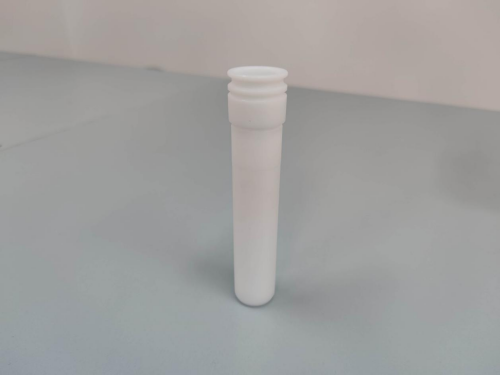
Recently, we received exactly such a request. The customer needed to measure the liquid level in PTFE test tubes with an inner diameter of approximately 20mm and a height of 150-200mm. The bottom of the test tube is curved, and the opening has a ring-shaped protrusion, making the structure somewhat irregular. More challenging, the chemical agents inside are highly corrosive, and conventional sensors simply cannot withstand them.
Solution: A "Corrosion-Resistant Upgrade" for the M18
Our initial approach was to start with the proven M18 ultrasonic sensor. However, the M18's housing material is not corrosion-resistant, so direct use was not an option. Therefore, we performed a thorough "corrosion-resistant upgrade."
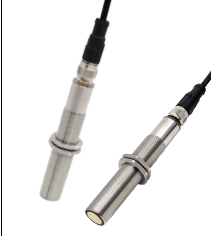
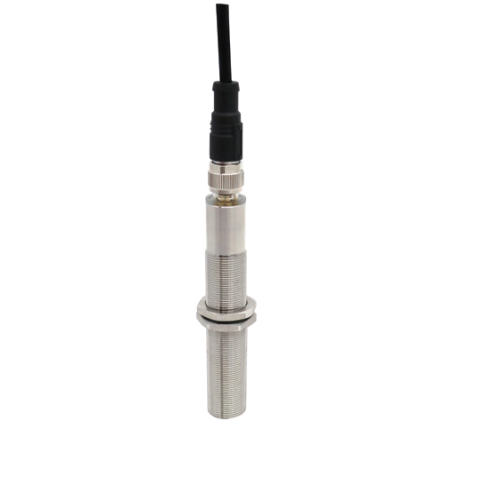
There were two key modifications: First, we replaced the original 200 kHz transducer with our self-developed 300 kHz PTFE-housed transducer. PTFE material resists almost all chemical corrosion, and using it as the probe allows direct contact with highly corrosive liquids like aqua regia. Second, we upgraded the sensor housing material from standard material to titanium alloy. Titanium alloy also offers excellent corrosion resistance, so the entire sensor is like wearing a "chemical protection suit," allowing it to operate reliably in harsh environments.
Details: How to Tackle the "Small Diameter" and "Curved Bottom"?
The inner diameter of the test tube is only 20mm, so space is very limited. The 300 kHz transducer we selected ensures accuracy while fitting well within this small diameter. Additionally, to address the curved bottom of the test tube, we optimized the sensor's acoustic parameters and signal processing algorithms to ensure the ultrasonic waves focus and reflect effectively, yielding stable and accurate echo signals.
As a result, whether the test tube contains concentrated sulfuric acid or aqua regia, our sensor achieves non-contact, high-precision liquid level measurement. The entire measurement process avoids contact with the chemicals, ensuring measurement reliability and preventing sensor corrosion damage, significantly extending its service life.
Beyond Customization: Full-Chain Service
This case is just one example of Dayu Electronics' customization capabilities. We have a complete in-house R&D system covering transducers, hardware, and software. When standard products cannot meet your specific operating conditions, we can start from the fundamental acoustic principles and provide one-stop service from requirement analysis and solution design to prototype development and performance verification.
If you have similar measurement challenges, feel free to contact us anytime. Let ultrasonic technology provide safer and more reliable solutions for your laboratory and production processes.