
Dayu Electronics: How to Scientifically Assess the Health of Ultrasonic Transducers
Ultrasonic transducers are core components in applications such as underwater communication, ranging, obstacle avoidance, and leak detection. During operation, determining whether a transducer is intact or its performance has degraded is a critical step in field maintenance and troubleshooting. Many users are accustomed to measuring static capacitance or resistance with a multimeter, but this method has clear limitations. So, what is the professional and reliable way to make such a judgment?
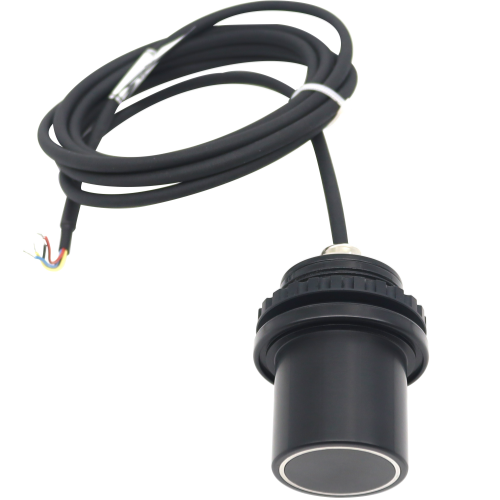
Recommended Equipment: Impedance Analyzer
Dayu Electronics recommends using an impedance analyzer to test transducers. An impedance analyzer provides a comprehensive evaluation of the transducer's electroacoustic characteristics, far beyond what a common multimeter can achieve.
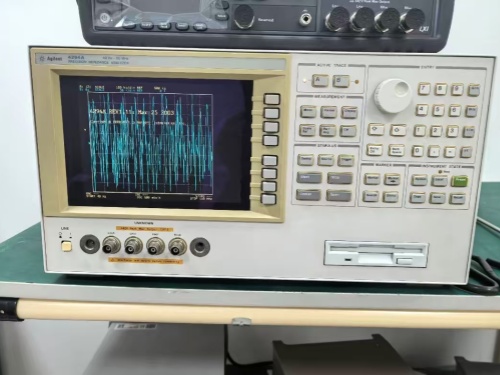
Core Criterion: Admittance Curve Plot and Signal Presence
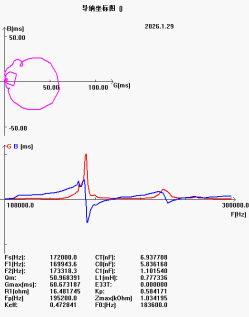
Once the transducer is connected to the impedance analyzer, the primary observation is the admittance curve plot (admittance vs. frequency characteristic curve). A properly functioning transducer will exhibit a clear, regular admittance peak near its resonant frequency, with a smooth curve and amplitude within the designed range. If the instrument shows no valid signal, or the admittance curve is abnormally flat, lacks characteristic peaks, or is severely distorted, the transducer is considered damaged.
Some users ask: Can we judge the condition by measuring static capacitance, resonant frequency, or harmonic frequency? It should be clarified that measuring capacitance alone can only detect a short circuit or open circuit in the transducer—in such cases, the capacitance value will deviate significantly from the normal range or become unmeasurable. However, for performance degradation caused by piezoelectric ceramic aging, depolarization, or mechanical damage, the capacitance may still appear normal, yet the transducer can no longer effectively transmit or receive acoustic waves. As for parameters like resonant frequency and harmonic frequency, although theoretically related to health status, precise field measurement is complex and requires comparison with factory nominal values, making them less intuitive and reliable than the admittance curve from an impedance analyzer.
Summary and Recommendations
In daily maintenance, if a transducer fault is suspected, use an impedance analyzer to observe the admittance curve and signal presence. If the curve is abnormal or there is no signal, the transducer can be judged as damaged. Do not rely solely on capacitance measurements to draw conclusions, as this may lead to misjudgment and affect normal equipment operation. Dayu Electronics can provide technical support for transducer testing as well as repair and replacement services.