How Does an Ultrasonic Doppler Current Meter Calculate Water Flow Velocity?
Recently, orders for ultrasonic Doppler current meters have become increasingly frequent, and many customers have asked how their flow velocity measurements can yield accurate data.
So how does an ultrasonic Doppler current meter calculate the flow velocity of water? Many people may only know part of the story.
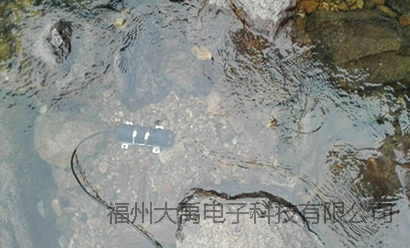
Figure: Field test of ultrasonic Doppler current meter
When ultrasonic waves are emitted into water, a Doppler shift occurs. Inhomogeneities in the water (such as suspended solids) cause irregular scattering of the sound waves, and the frequency of the reflected signal is slightly shifted. The transmitted ultrasonic frequency F0 is constant, and once the transducer is installed at a fixed angle, the constant K is also fixed. Therefore, by detecting the Doppler shift and the speed of sound in water (derived from temperature), the flow velocity can be calculated.
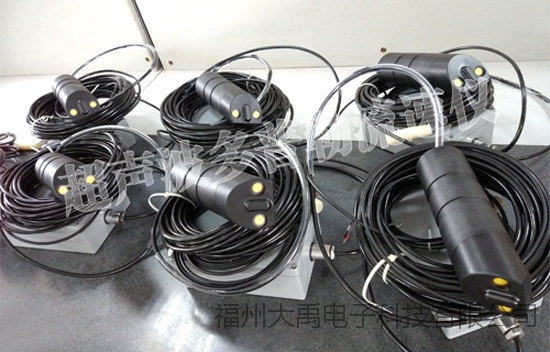
1. Product Features of the Ultrasonic Doppler Current Meter
Structure: Split type
Measurement types: Flow velocity, water depth, water temperature
Applications: Online measurement, online monitoring, automatic recording, remote data transmission (optional)
Flow velocity range: 0.02 m/s to 5.00 m/s (minimum water depth: 8 cm);
Measurement resolution: 1 mm/s;
Accuracy: ±2–3% of measured flow velocity;
Water depth measurement: 0.00 to 5 m;
Resolution: 2 mm;
Accuracy: ±0.5%;
Temperature range: 0 to 60°C;
Resolution: 0.1°C;
Flow range: No flow measurement function
Power supply: 10–14 VDC;
Output signal: RS485 MODBUS protocol;
Wireless transmission (optional): GPRS-type RTU wireless transmitter
Sensor cable length: 10 meters;
Measured waterway types: Pipes, channels, natural streams, and rivers;
Liquid pH requirement: pH between 5 and 7.
Liquid temperature requirement: 0 to 60°C
Liquid pressure requirement: 1 standard atmosphere under natural environmental conditions
Note: Flow velocity cannot be measured when water is frozen or near freezing.
Measurement status and wiring
Data is displayed 60 seconds after power-on, and then updated every 10–15 seconds thereafter.
For the ultrasonic Doppler current meter sensor, the power supply is 11–14 VDC, with a supply current of 160 mA.
The cable is a four-core shielded cable: two wires for power and two wires for the 485 signal.
2. Product Installation
Sensor installation
Most water pipes are standard circular, while a few are rectangular or trapezoidal.
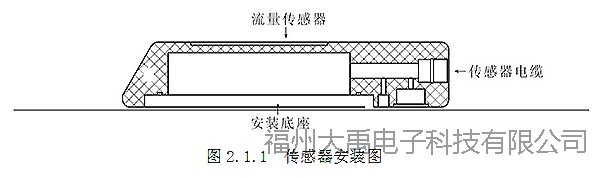
Inside the pipe, if there is no sediment, install the sensor at the center of the pipe bottom. If there is sediment, install the sensor next to the sediment. To prevent water flow from shifting the sensor's installation position, the sensor has a base at the bottom specifically for fixing it to the pipe. Additionally, the sensor should be installed near the inside of a manhole, which facilitates installation, maintenance, and replacement.