
Dayu Electronics: Synergistic Relationship Between Fishfinder Transmit Voltage and the Overall Acoustic Chain
When designing and selecting a fishfinder transducer, a common and critical question is: what is the most appropriate peak transmit voltage (Vpp) to drive the transducer? Many users expect a definitive numerical answer. However, professional design practice tells us that transmit voltage is not an isolated, fixed parameter, but a dynamic variable deeply coupled with the performance of the entire acoustic detection system. Determining its optimal value is essentially a comprehensive balancing process in systematic design.
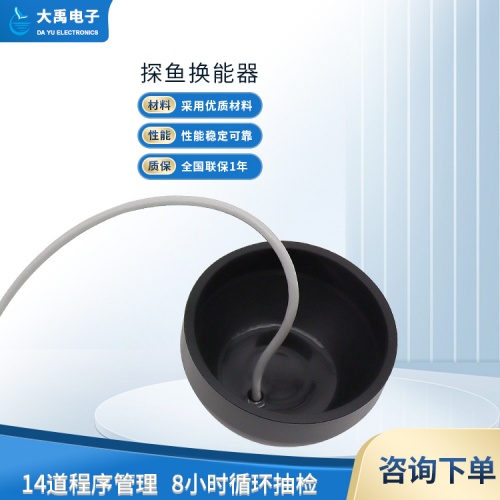
The working principle of an ultrasonic fishfinder transducer is to convert high-voltage electrical pulses into acoustic pulses transmitted into the water, and then receive echoes reflected from fish or the bottom, which are processed to form images or alarms. The magnitude of the transmit voltage directly determines the initial energy of the transmitted acoustic wave. However, the "appropriate" voltage is by no means the highest possible; rather, it must aim for clear, stable, and reliable detection results, depending on the synergistic effects of the following core factors:
First, the maximum measurement depth is a fundamental requirement. Detecting deeper water means longer sound propagation paths and greater attenuation, requiring stronger initial transmit energy (typically corresponding to higher voltage) to ensure that a sufficiently strong echo signal returns to the receiver.
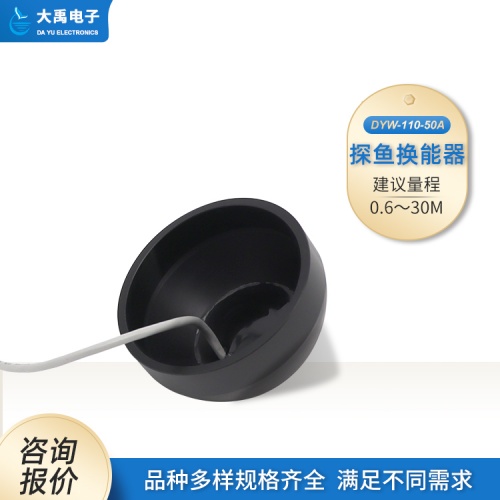
Second, and most critically, is the performance of the receiving circuit and signal processing chain. This mainly includes:
1. Gain and noise floor of the receiving circuit: The ability of the receiving circuit to amplify weak echo signals (gain) and its own noise level (noise floor) determine how weak a valid signal the system can identify. If the circuit has high gain and excellent noise floor control, it can effectively amplify and extract microvolt-level weak signals, thereby allowing the transmit voltage requirement to be appropriately reduced. Conversely, if the circuit processing capability is limited, the transmit voltage must be increased to compensate with a stronger transmit signal.
2. Sophistication of signal processing algorithms: Modern digital signal processing (DSP) algorithms, such as filtering, noise reduction, and signal enhancement, can more effectively extract target signals from echo signals mixed with noise. Advanced algorithms equip the system with keener "insight," enabling equivalent or even better detection performance at relatively lower transmit voltages, which helps reduce overall power consumption and design complexity.
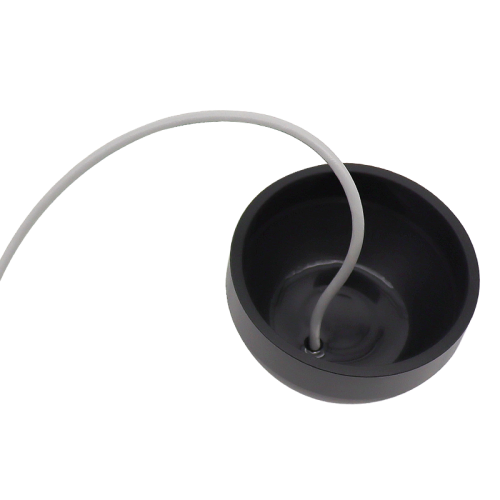
A simplified model can illustrate this dynamic relationship: Suppose at a fixed distance, a specific transmit voltage produces an echo of a certain intensity. If the receiving and processing chain can effectively handle a signal of this intensity, then that voltage is sufficient. If the chain requires a stronger input signal to operate reliably, the transmit voltage must be increased to strengthen the echo signal intensity to match the chain's requirements.
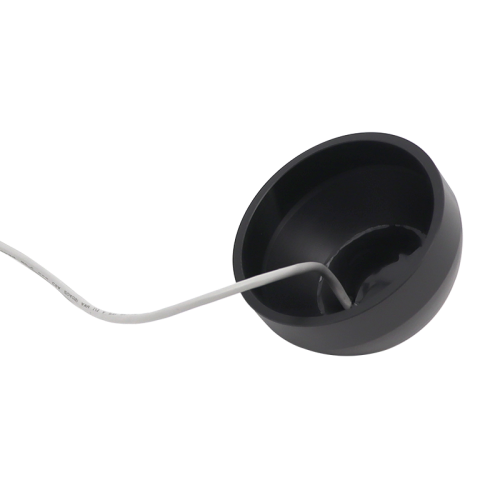
Therefore, the "appropriate transmit voltage" is the result of joint design and optimization with the receiving circuit's sensitivity, noise suppression capability, and the effectiveness of back-end processing algorithms, under clear target detection capabilities (depth, target size). Dayu Electronics consistently adheres to this systematic engineering mindset in the design of fishfinder transducers and system solutions. We not only provide high-quality transducers, but also focus on understanding our customers' overall application needs and circuit conditions. Through professional collaborative design, we help customers determine the optimal configuration of key parameters, including transmit voltage, to ensure that the final product's detection performance achieves the best balance.