
Dayu Electronics: Doppler Flowmeters Empowering Smart Hydrology and Water Resources Management
Flow monitoring in natural rivers is a critical foundation for hydrology and water resources management, flood warning, ecological assessment, and hydraulic engineering scheduling. However, the complex and variable hydrological conditions of river channels—particularly significant water level fluctuations and uneven velocity distribution—pose severe challenges to the adaptability, reliability, and accuracy of measurement equipment. Selecting a flowmeter capable of handling multiple operating conditions while providing continuous and stable data has become a core concern for engineers and decision-makers in related fields.
Dayu Electronics' ultrasonic Doppler flowmeter, based on the Doppler shift principle, transmits ultrasonic waves into the water and receives echoes reflected by suspended particles or bubbles, enabling non-contact measurement of flow velocity. The flow rate is then calculated using the cross-sectional area. This measurement method does not rely on full-pipe conditions and has no requirements for water conductivity, making it particularly suitable for flow monitoring in open waters such as natural rivers and open channels with irregular cross-sections and significant water level fluctuations.
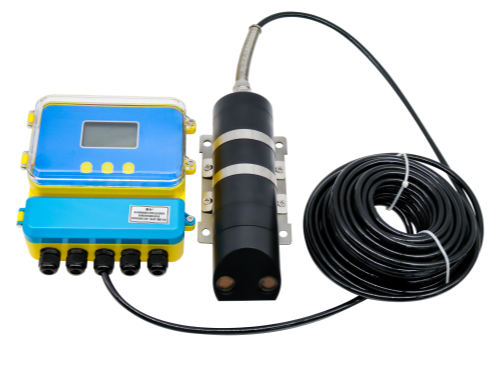
Given the significant water level variations in natural rivers, a single flowmeter model often struggles to maintain optimal measurement performance across all water level conditions. To address this, we provide professional product selection guidance, with the core principle being "match the most suitable sensor size based on the actual minimum water level." For example, for extremely shallow flows with a minimum water level of only about 5 cm, or during low-flow periods in river channels, we recommend using a compact Doppler flowmeter with a miniaturized design. Its smaller sensor size allows it to stay closer to the core flow at low water levels, effectively capturing velocity signals and avoiding measurement blind spots and data distortion caused by insufficient installation space or excessively shallow water.
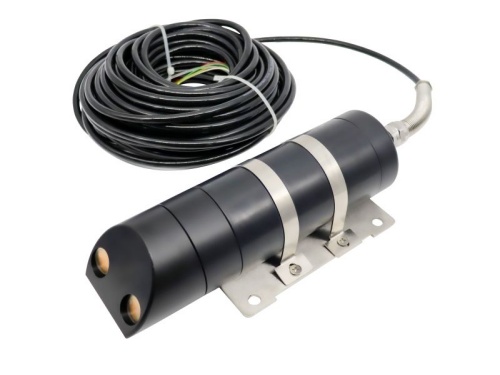
When the minimum water level reaches approximately 15 cm or higher, a large Doppler flowmeter is recommended. Its sensor features a wider beam angle and a longer measurement range, enabling it to capture more representative flow velocity profile information across a broader water depth range. This provides more stable and comprehensive flow data during normal or high water level periods. This water level-based product selection strategy ensures that the equipment performs optimally throughout the entire hydrological cycle, guaranteeing the continuity and accuracy of monitoring data.
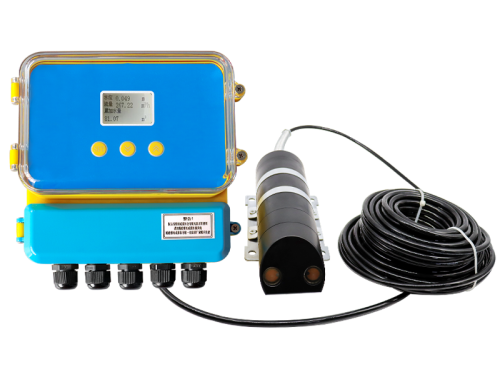
In practical deployment, this series of flowmeters can be flexibly installed on one side of the river cross-section, using the velocity-area method to calculate the overall flow rate. Its outputs include real-time velocity, water level (requires a separate level sensor), and calculated instantaneous and cumulative flow rates. Data can be transmitted to monitoring platforms via multiple communication methods. This provides an integrated and reliable tool—from data acquisition to analysis and application—for fields such as river ecological flow assurance, urban flood control and drainage, agricultural irrigation water metering, and soil and water conservation research.
In summary, Dayu Electronics' ultrasonic Doppler flowmeters, through differentiated product designs, precisely address the core challenge of variable water levels in natural rivers. They provide users with a full-scenario, high-reliability flow monitoring solution—from extremely shallow flows to normal water depths—and serve as a solid technical foundation for building smart hydrology monitoring networks and achieving refined water resource management.