As Above, So Below: Dayu Doppler Flowmeter Installation Site Is as Beautiful as a Painting in Hangzhou
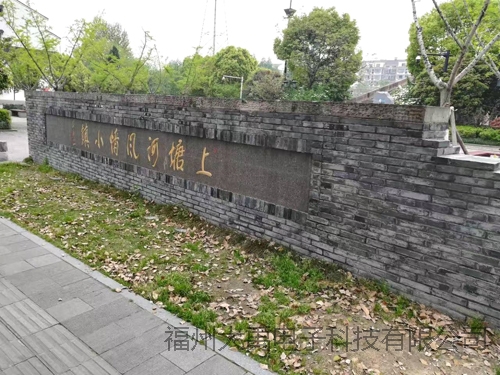
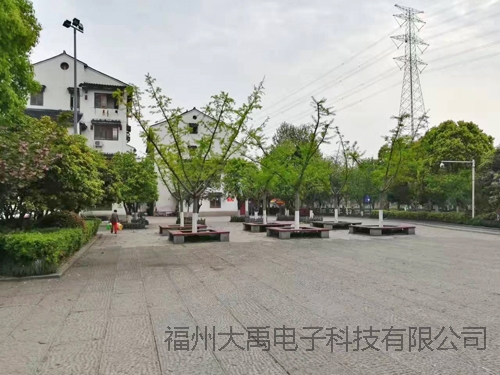
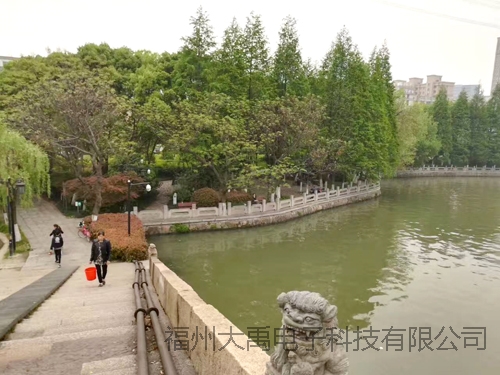
On April 15, Dayu's engineer Liu was invited to Hangzhou to survey the site for the customer's ordered Doppler flowmeter. Dayu Doppler flowmeters are widely applicable, serving as sensors to measure water flow velocity and flow rate in natural water bodies; the product is suitable for channels with sediment and debris such as silt and garbage in the water.
Ultrasonic Doppler flowmeter measurement principle is based on the Doppler effect in physics. According to the acoustic Doppler effect, when there is relative motion between a sound source and an observer, the frequency perceived by the observer differs from the frequency emitted by the source; this frequency change due to relative motion is proportional to the relative velocity between the two objects.
In ultrasonic Doppler flow measurement, the ultrasonic transmitter serves as a fixed sound source, and solid particles moving with the fluid act as an "observer" with relative motion to the source, of course merely reflecting the incident ultrasound back to the receiver. The frequency difference between the transmitted and received sound waves is the Doppler shift caused by the motion of solid particles in the fluid; since this frequency difference is proportional to the fluid velocity, measuring the frequency difference allows the velocity to be determined, and thus the fluid flow rate can be obtained.
Therefore, a necessary condition for ultrasonic Doppler flow measurement is that the measured fluid medium must be a two-phase medium containing a certain number of solid particles or bubbles that can reflect sound waves. This working condition is actually a significant advantage: the method is suitable for measuring two-phase flows, which is a problem difficult for other flowmeters to solve; hence, as a promising two-phase flow measurement method and flowmeter, ultrasonic Doppler flow measurement is increasingly being applied.