
Dayu Electronics: Application Case of Bridge Scour Sensors in Safety Monitoring of River-Crossing Bridges
Dayu Electronics Application Case of Bridge Scour Sensors in Safety Monitoring of River-Crossing Bridges
I. Project Background
As key nodes in the transportation network, river-crossing bridges are long-term affected by complex hydrological conditions such as high-velocity flood flows, riverbed erosion and siltation, reciprocating scour, and rapid water level changes. Scour at pier foundations is a major hidden risk leading to bridge instability. Traditional methods such as manual probing, diver inspections, and periodic depth sounding have pain points including delayed data, dangerous underwater operations, infeasibility during flood periods, and difficulty in continuous tracking, which cannot meet the requirements for all-weather, full-lifecycle bridge safety management.
For a certain major river-crossing bridge with long main spans, deep water, and swift currents, the water level varies significantly during flood seasons with high sediment content, and riverbed erosion and siltation alternate prominently. To ensure the operational safety of the bridge, a non-contact, long-term stable underwater, high-precision, and online early-warning scour monitoring solution is urgently needed to achieve integrated real-time sensing of pier scour depth, riverbed elevation, flow velocity, and water level, providing data support for bridge structural safety, emergency response, and maintenance decision-making.
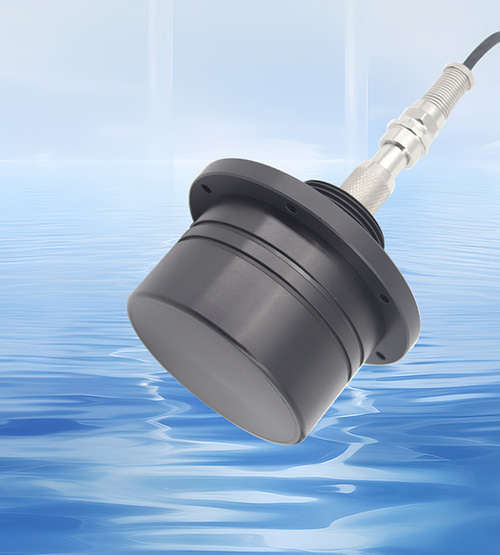
Core project requirements:
Adaptation to deep-water, reciprocating-flow river environments;
Continuous online monitoring of scour/deposition depth with accuracy meeting specification requirements;
Long-term reliable underwater operation;
Real-time data upload to platform with multi-level threshold alarms to support emergency dispatch.
II. Equipment Selection
(1) Selection Principles
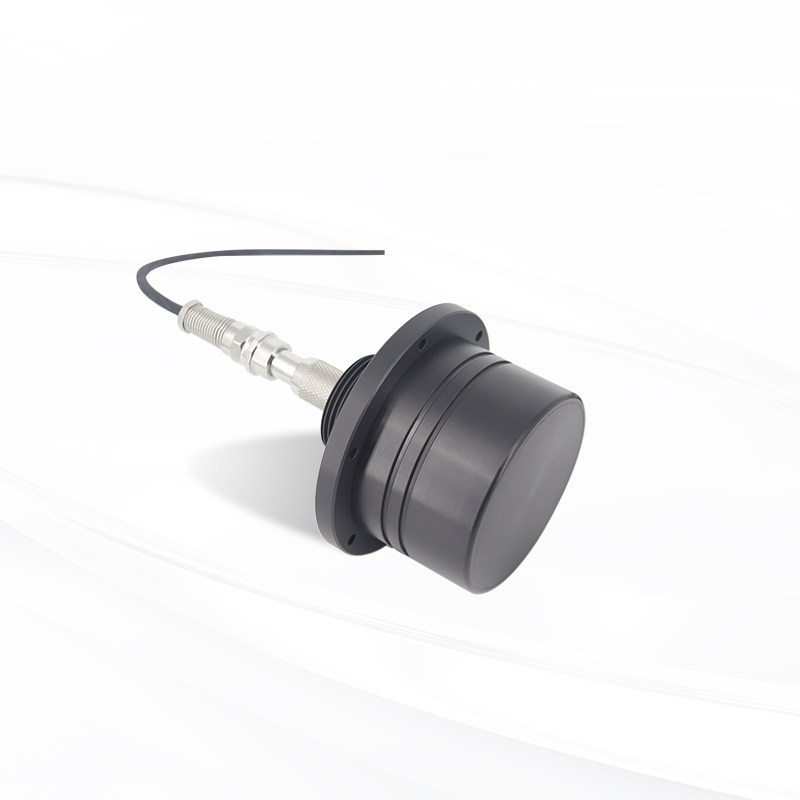
With core focus on underwater adaptability, measurement continuity, long-term reliability, and engineering safety, we compared technical approaches such as manual depth sounding, sonar profiling, pressure-type sensors, and ultrasonic scour monitoring. Ultimately, we selected Dayu Electronics Bridge Scour Monitoring Sensor (integrated ultrasonic scour/depth measurement solution).
(2) Selection Basis and Equipment Advantages
Mature principle, adaptable to complex river conditions
Utilizing ultrasonic ranging technology, it can operate stably under full water level and reciprocating flow conditions; it simultaneously monitors scour depth, riverbed elevation, water level, and flow velocity, enabling synchronized sensing of hydrology and scour.
Precise measurement, continuous with no blind zones
Scour depth measurement range: 0–20 m, with accuracy meeting highway bridge hydrological monitoring specifications; it can identify local scour, general scour, and the full scour pit development process, solving the industry pain point of inability to monitor during flood periods.
High underwater reliability, long-term maintenance-free
The sensor is IP68 waterproof and pressure-resistant, operating continuously and stably underwater; with no moving parts, it does not clog or tangle, making it suitable for various scenarios including freshwater, tidal, and sediment-laden flows, with low annual failure rates and an online rate ≥98%.
Non-contact / fixed installation, safe and convenient
Using fixed deployment on bridge piers, it eliminates the need for frequent underwater operations; one installation provides long-term monitoring; it supports RS485/Modbus-RTU for seamless integration with bridge health monitoring platforms, featuring breakpoint resume, tiered alarms, and remote calibration capabilities.
(3) Comparison Conclusion
Dayu Electronics Bridge Scour Sensor addresses the core shortcomings of traditional methods—'unseen, inaccurate, inaccessible, and high risk'—making it the optimal choice for online monitoring of underwater scour on river-crossing bridges.
III. Implementation Plan and Deployment
(1) Monitoring Point Layout
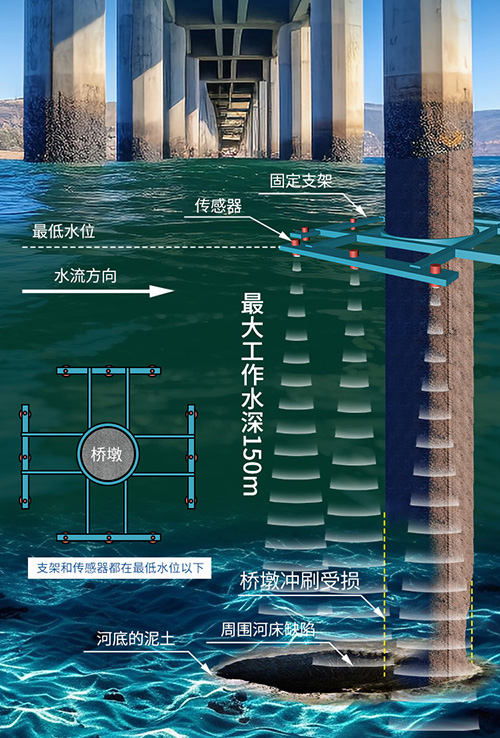
A total of 8 critical piers were selected, including deep-water main piers, scour-sensitive piers, and piers at flow confluences. Each pier was equipped with 2–4 scour monitoring probes, covering upstream faces, side faces, and areas around pile caps that are prone to scour, forming a bridge-wide underwater scour sensing network.
(2) Key Installation and Deployment Points
Sensors are fixed to the pier sidewalls / pile cap tops with beams vertically aimed at the riverbed, avoiding obstructions and vortex zones;
Underwater cables use anti-abrasion sheaths, firmly secured to withstand water flow impact;
Equipped with waterproof data acquisition terminals and solar power supply for stable operation without external power;
Integrated with the bridge health monitoring platform, featuring real-time monitoring, trend analysis, scour exceedance alarms, and historical data retrieval, with increased sampling frequency during flood seasons.
(3) System Architecture
Sensing layer (Dayu Scour Sensors) → Transmission layer (RS485) → Platform layer (Bridge Safety Monitoring Platform) → Application layer (real-time monitoring, alarm push, scour/deposition analysis, maintenance management).
IV. Application Results
(1) Continuous and Stable Monitoring with Reliable Data
Since continuous operation began, the equipment online rate has been 98.5%, with no data loss or drift under high-velocity, high-sediment flood conditions; the scour–siltation change curves during multiple flood events were accurately captured, and data consistency and reliability meet bridge safety monitoring requirements.
(2) Timely Safety Alerts with Controllable and Preventable Risk
During flood seasons, early warnings for scour, depth exceedance, and rapid water level changes provide critical evidence for traffic control, emergency patrols, and flood control dispatch. Since project implementation, no structural safety hazards caused by scour have occurred, and emergency response efficiency has improved by 60%.
(3) Supporting Scientific Maintenance and Extending Structural Life
Long-term data form a 'one pier, one file' scour record, used for riverbed evolution analysis, foundation safety assessment, and protective engineering optimization, guiding precise maintenance and reinforcement, avoiding over-maintenance and missed inspections, extending bridge service life, and reducing full-lifecycle maintenance costs.
(4) Replacing High-Risk Operations with Significant Cost Savings and Efficiency Gains
Online automatic monitoring replaces hazardous operations such as underwater probing, boat-based sounding, and nighttime inspections. The average annual underwater operations per bridge have been reduced by over 80%, personnel safety risks have significantly decreased, and monitoring costs have been reduced by approximately 50%.
V. Project Summary
Technical adaptability: Ultrasonic Doppler integrated monitoring perfectly fits complex scour scenarios in deep, high-turbidity, high-velocity river crossings, achieving transparent and continuous sensing of hidden underwater risks.
Safety and reliability: Fixed long-term online operation, maintenance-free, and resistant to harsh environments, shifting from 'periodic sampling' to '24-hour online protection'.
Management empowerment: Data-driven closed-loop process of alarm, assessment, maintenance, and emergency response improves intrinsic bridge safety and intelligent maintenance levels.
The successful application of Dayu Electronics Bridge Scour Sensors on river-crossing bridges validates the versatility and maturity of this technology for scenarios such as river-crossing and sea-crossing bridges, railway bridges, highway bridges, and municipal bridges. It can be scaled for underwater scour monitoring of bridges in rivers, bays, and reservoir areas, providing a standardized solution for the safe operation of transportation infrastructure.