
Precision Sensing: Radar Sensor Principles and Port Safety Application Practice [Dayu Electronics]
In the field of industrial level, liquid level, and distance measurement, non-contact, high-precision detection is key to ensuring production safety and efficiency. Radar sensors, with their strong environmental adaptability and stable ranging performance, are becoming a reliable choice in complex industrial scenarios. This article will delve into the core measurement principles of radar sensors and share their key applications in port rubber-tired gantry crane safety protection.
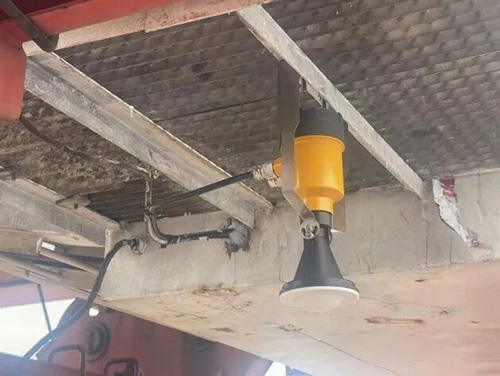
I. Core Measurement Principle: Gaining Insight into Nanosecond-Level Time Delays through "Special Demodulation"
The basic principle of a radar sensor is to transmit electromagnetic waves toward a target and receive their echoes, calculating the distance by analyzing the time of flight of the beam. The specific working process is as follows:
The antenna of the radar sensor first emits an extremely narrow microwave pulse. This pulse propagates through space at the speed of light. When it encounters the measured medium (such as a liquid surface, solid material, or container), part of the energy is reflected back and received by the same antenna.
The time interval between the transmitted pulse and the received pulse is strictly proportional to the distance from the antenna to the surface of the measured medium. This is the physical basis of all time-domain reflectometry techniques. However, the real technical challenge lies in the fact that since electromagnetic waves travel extremely fast (approximately 3×10^8 meters per second), this time interval is typically as short as nanoseconds. For example, measuring a distance of 1 meter corresponds to a two-way flight time of only about 6.7 nanoseconds. Directly and accurately measuring such a tiny time difference is a formidable challenge for conventional electronic technology.
To solve this worldwide measurement challenge, our radar sensors employ a special demodulation technique combined with advanced signal processing algorithms. This technology does not directly measure the elusive nanosecond-level pulse delay. Instead, through an ingenious signal transformation and comparison method, it can extremely stably and accurately identify and quantify the tiny phase or time difference between the transmitted and received pulses. This core algorithm acts like a "high-precision timer" installed in the sensor, enabling it to convert nanosecond-level time differences into high-resolution, high-linearity distance digital signals, thereby achieving millimeter-level measurement accuracy and excellent long-term stability.
II. From Principle to Practice: Safeguarding Port Arteries and Preventing "Bowling" Accidents
As key hubs of global trade, ports must prioritize operational efficiency and safety. Rubber-tired gantry cranes (RTGs) are core equipment in container yard operations. When lifting and moving containers, safety risks cannot be ignored. Among these, the "bowling" accident is a typical hazard: due to obstructed driver visibility or misjudgment, the spreader or container may not be lifted high enough and can collide with other containers or equipment in the yard while moving, just like a bowling ball knocking down pins. Such accidents can cause severe equipment damage, cargo loss, and even endanger personnel safety.
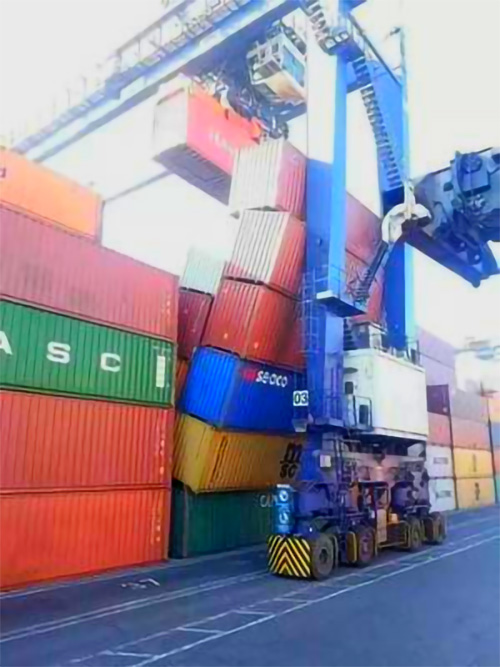
To thoroughly prevent such accidents, a height monitoring solution based on precise radar sensor ranging provides a reliable approach.
Solution Implementation and Value:
1.Precise Measurement: The radar sensor is installed on the spreader of the RTG, pointing vertically downward at the top of the container or the top layer of the stack below. The sensor continuously and accurately measures the real-time distance from the spreader to the target below.
2.Intelligent Calculation and Warning: The control system simultaneously obtains the absolute hoist height of the spreader. Through simple calculation (spreader height - radar measured distance - spreader body height), the actual height of the container or stack below can be determined. The system presets a safe passage height threshold (usually the minimum safe clearance between the bottom of the spreader/container and the top of the target).
3.Real-Time Intervention: During spreader movement, the system performs real-time comparisons. Once the calculated height difference falls below the safety threshold, the system immediately issues audible and visual alarms and can automatically interlock to limit gantry travel, thereby fundamentally preventing collision accidents and providing critical safety decision support to the driver.
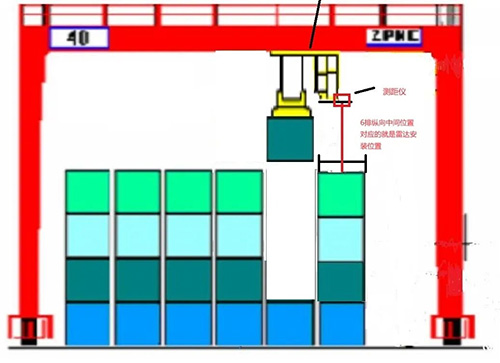
In field applications, this solution has withstood long-term trials in harsh port environments (such as wind, rain, salt spray, vibration, and temperature variations). We have optimized the sensor for complex operating conditions to ensure stable and reliable performance under all circumstances, safeguarding operational safety around the clock.
Summary
Radar sensors, with their precise "special demodulation" ranging principle, convert millimeter waves into reliable data. When this technology is deeply integrated with specific industrial scenarios, it unleashes tremendous practical value. In ports, it transforms into a "smart eye" for safety, effectively preventing "bowling" accidents and enhancing the intrinsic safety level and operational efficiency of terminals. This is not only a triumph of non-contact measurement technology but also a successful practice of the industrial safety concept from precision sensing to intelligent warning.