Liquid Level Measurement Inside PTFE Test Tube [Dayu Electronics]
Liquid Level Measurement Inside PTFE Test Tube (Case Study)
I. Working Conditions
1. Customer Requirement: Laboratory equipment needs an ultrasonic sensor to measure the liquid level height inside a PTFE test tube.
2. Terminology Explanation:
①PTFE Test Tube:
A PTFE test tube is made of polytetrafluoroethylene (PTFE). Its most outstanding advantage is excellent chemical stability, resisting almost all strong corrosive reagents, including aqua regia and hydrofluoric acid. It has excellent non-stick and hydrophobic properties, a smooth surface, is easy to clean, and leaves minimal sample residue. At the same time, it offers good thermal stability, typically operating within a range of -200°C to +260°C. In addition, it has good electrical insulation and biocompatibility. However, its disadvantages are also obvious: high cost, opacity, moderate mechanical strength, and slow heat transfer.
These characteristics determine its primary use in the following types of experiments: 1. Handling of strong acid/strong base samples, especially operations involving hydrofluoric acid (HF), where it is irreplaceable. 2. Trace and ultra-pure analysis, such as sample preparation and storage for cutting-edge detection methods like ICP-MS, due to its extremely low background levels. 3. Special synthesis, suitable for organic reactions involving strongly corrosive catalysts or solvents. 4. High-temperature and high-pressure reactions, commonly used as the liner for hydrothermal reaction vessels. 5. Long-term storage of standards and valuable samples.
②Laboratory Equipment:
Example of laboratory equipment using PTFE test tubes: Microwave Digestion System
A microwave digestion system is a sample preparation device that uses microwave energy to heat samples and acid solutions, rapidly and efficiently decomposing organic matter and difficult-to-dissolve inorganic substances under high temperature and pressure. It is primarily used to convert solid or complex matrix samples into a clear, homogeneous solution for subsequent elemental analysis using atomic spectroscopy (e.g., AAS, ICP-OES, ICP-MS). In simple terms, its core task is "sample dissolution," making it a key first step for efficient and accurate elemental analysis in modern laboratories.
Its core working principle is based on microwave heating and sealed high pressure. Unlike traditional conduction heating on a hot plate, microwaves directly act on polar molecules (such as water and nitric acid molecules) in the sample and acid, causing them to rotate and collide at high speed, creating an "internal heating" effect that makes heating more uniform and faster. The digestion reaction occurs in a sealed, high-pressure digestion vessel. As the temperature rises, the pressure inside the vessel also increases. The high-pressure environment significantly raises the boiling point of the acid (for example, nitric acid boils at 121°C at atmospheric pressure, but can exceed 200°C under high pressure). Higher temperature and pressure greatly enhance the oxidizing power and reactivity of the acid, enabling rapid decomposition of stubborn samples that are difficult to handle under normal pressure, such as fats, plastics, and ceramics. Modern microwave digestion systems are equipped with precision temperature and pressure sensors that monitor the status of each digestion vessel in real time and automatically adjust microwave power through a feedback system, ensuring the digestion process runs within set safety parameters, guaranteeing reproducibility and safety of results.
A microwave digestion system mainly consists of the following components: the microwave cavity, which generates and transmits microwaves; the magnetron, the core component for generating microwaves; the digestion rotor, a rotating rack that holds multiple digestion vessels, ensuring uniform microwave heating; digestion vessels, which are critical containers, typically including an outer vessel made of high-strength composite material, an inner vessel made of corrosion-resistant material (such as PTFE), and a sealing cap with a burst disc for safety. Additionally, it includes a control system for programming, a sensor system for real-time monitoring, and an exhaust system for handling acid vapors.
3. Measured Objects: Various experimental reagents, both non-corrosive and corrosive, including extremely corrosive reagents like aqua regia.
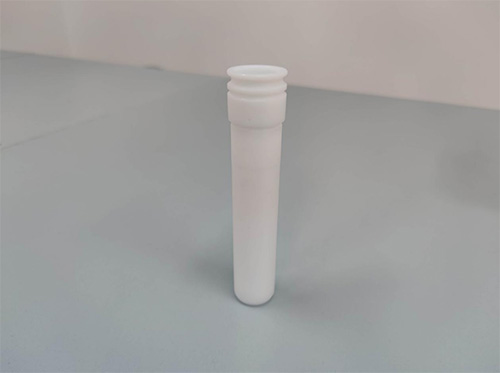
4. Container: PTFE test tube, with an inner diameter of approximately 20mm, internal height ranging from 150-200mm, and a curved semicircular bottom. There may be annular protrusions near the tube mouth. Refer to the image below for details:
II. Working Condition Analysis
1. The reagents are corrosive, so the sensor housing must have extremely high corrosion resistance.
2. The tube opening is small; the sensor's ultrasonic beam angle must be narrow enough to enter the tube without hitting the tube mouth.
3. The curved bottom of the tube may reflect false signals.
4. The annular protrusion at the tube mouth may cause the ultrasonic signal to hit it and generate false echoes.
5. Whether the blind zone and measurement range can meet the liquid level measurement requirements for such a small container.
III. Solution
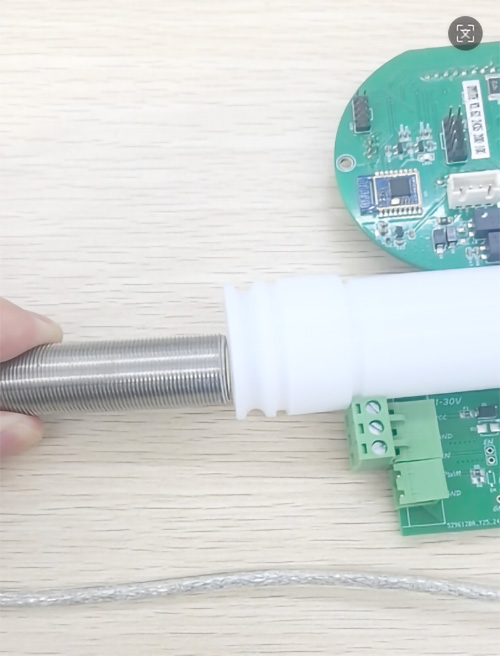
1. Preliminary Approach:Use our M18 as a base, modifying it because the M18 is not inherently corrosion-resistant. Replace the original 200 kHz transducer with a 300 kHz PTFE-housed transducer, and manufacture the sensor housing from titanium alloy.
2. Preliminary Test: Tested the sample with the M18, and it performed well. The ultrasonic signal could reach the bottom of the test tube even at a short distance from the tube mouth and correctly measure the distance. The signal did not hit the tube mouth or its annular protrusion. The blind zone also met the M18 sensor's specifications.